•
Accounting
•
Small Businesses
•
Automate Accounts Receivable
•
Collections
•
Reduce DSO
November 20, 2026
The problem with net 60 payment terms and why waiting to get paid costs you more than you think

Remember last month? You sent an invoice on the 1st of the month, with terms clearly stating: ‘DUE ON RECEIPT.’ Despite numerous follow-ups, the payment still showed up on day 58. Okay, maybe it was two months ago since it was day 58, but you get the picture.
If that sounds familiar, your business or accounting practice already operates with net 60 payment terms, even if you never agreed to it with any of your clients. Net 60 payment terms mean the client must pay the full invoice amount within 60 calendar days of the invoice date. This period effectively gives them two months to pay after you bill them, and if you're keeping track, that's a huge blow to your cash flow. And you’re not alone: Atradius reported in its 2026 survey of North American suppliers that about half offer payment terms of 1 to 2 months. That means your client keeps your money for 2 extra months, and you get nothing in return while you wait.
For service businesses, accounting firms, and managed service providers that invoice regularly, that delay affects cash flow, adds collection work, and makes it harder to cover expenses on time. This guide explains what net 60 means, the common variations you’ll see, how it compares with net 30, why companies use it, when it makes sense to offer it, what 60-day payment delays actually cost a small firm, and how to get paid sooner—including 5 ways to speed up payment without straining customer relationships or relying on early payment discounts.
Phew, that's a mouthful...so let's get into it.
What are net 60 payment terms?
Net 60 payment terms mean the client owes the full invoice amount 60 calendar days, or 2 months, after the invoice date. The clock starts on the invoice date, not the day the client receives it, unless the contract specifies a different start date, such as the delivery date.
Net 60 is basically a form of trade credit. You deliver the services now and give the client 2 months to pay. For example, if you send invoices dated November 30, 2026, payment is due January 29, 2027.
Net 60 sits alongside other net payment terms like net 15 and net 30, and that number indicates to the client how many days they have from the invoice date to pay. Larger companies often ask for longer net terms, and small practices or service providers (begrudgingly) tend to accept them just to win the work.
Common variations: 2/10 net 60, net 60 EOM, and more
There are many variations of net 60 terms. Some versions change when the clock starts, while others reward the client for paying early:
- 2/10 net 60: The client takes a small discount of 2% if they pay within 10 days. Otherwise, full payment is due on day 60. For example, on a $4,000 invoice, that's $3,920 paid by day 10 or the full balance by day 60.
- 1/10 net 60: The same structure as above, but with a 1% discount ($3,960 by day 10).
- Net 60 EOM (end of month): The 60 days start at the end of the month the invoice is dated. An invoice dated November 16, 2026, is due January 29, 2027, which actually gives the client 74 days to pay.
- Net 60 ROG (receipt of goods): The clock starts when the buyer receives physical goods. Note that this typically doesn’t apply to services.
Whichever version you use, the client can still take the full term to pay. A discount only speeds things up if the client decides your invoice is worth paying early.
Net 30 vs. net 60: what the extra 30 days cost you
A dollar in your account today is worth more than the same dollar 60 days from now. Today, you can use it to cover payroll, pay down your line of credit, or earn interest. But when a client pays you on day 60, they get that time value instead of you. In effect, net 60 terms work like an interest-free loan to the client.
Here's what that “loan” looks like on a retainer. Say a client pays you $4,000 a month for bookkeeping. On net 30, about 1 invoice is open at any time. On net 60, that means 2 are. That's an extra $4,000 sitting in the client's account for as long as you work together. Across 15 retainer clients, it's $60,000.
To price it out, multiply the cash tied up by your cost of money. Treasury's Prompt Payment rate for July 1-December 31, 2026, at 4.75%, which federal agencies pay when they're late, makes a useful reference point. At that rate, $60,000 costs about $2,850 a year. If your line of credit charges 8%, it's $4,800.
The wait also shows up in days sales outstanding (DSO). Moving a client from net 30 to net 60 adds about 30 days to your DSO, even when they pay on time. For more, read our guide to cutting DSO.
Why do companies pay net 60?
Paying later helps larger businesses keep cash on their books and manage cash flow, which also helps businesses manage cash flow on their side. The Hackett Group's 2026 Working Capital Survey of the 1,000 largest North American public companies found that days payable outstanding (DPO) increased by 2.9 days and is at its best level since 2021. For those companies, a better DPO means paying suppliers later.
Not to mention, the larger the company, the longer it takes to process payment. Invoices move through Accounts Payable (AP) approval chains and scheduled payment runs. Even buyers with AP automation often pay on a fixed cycle. The same 2026 Atradius survey also points to banking delays and internal approval processes as another reason payments arrive late.
Enterprise and government clients often write net 60 into contracts and purchase orders, so you agree to it before any work starts, and those longer terms can also help their suppliers’ customers generate revenue before payment comes due in longer sales or supply cycles.
How waiting to get paid became normal
No one made net 60 a rule. Here’s how it slowly became the status quo, one invoice at a time:
Credit became a sales tool
Selling on credit is standard in business-to-business (B2B) work. Atradius also reported that Canadian suppliers sell about half of their B2B sales on credit, with the United States (US) close behind at 45%. Smaller firms also offer flexible payment terms to win (and keep) new customers, with about half extending terms to 1 to 2 months. While these “extended terms” may help firms stay competitive, when every firm offers them, that differentiator disappears.
Terms drift longer, rarely shorter
When terms change, they rarely do so in your favor. Among suppliers whose terms changed in recent months, Atradius found the changes usually led to longer, not shorter, payment terms. Over time, those one-off longer payment cycles start to become the default.
When due on receipt turns into net 60
Plenty of accounting firms run on net 60 without ever agreeing to it. The engagement letter says due on receipt. You expect payment within the month, but the client pays on day 55.
Check your last 2 quarters. Compare the terms on your invoices with the number of days clients actually took to pay. If the gap is 30 days or more, you already offer net 60. You just don't know it.
Even the fixes start at 60 days
Lawmakers who want to fix late payments still treat 60 days as the ceiling. The UK's Commercial Payments Bill, introduced in May 2026, proposes "imposing maximum payment terms of 60 days, with strictly limited exemptions." It would also require interest on late payments at 8% above the Bank of England base rate.
In the US, federal agencies owe interest when they pay contractors late. However, private US businesses generally set payment terms by contract. That makes your engagement letter especially important for payment terms.
What net 60 does to a small firm's cash flow
Net 60 moves the cost of waiting from your client to you. Small business owners feel it in 3 places:
- Cash. Delayed payments are common, affecting 7 in 10 firms on average, and around one-third of suppliers report reduced cash availability, according to the Atradius 2026 survey. When cash flow needs run ahead of what’s come in, owners may dip into a line of credit or their own savings to cover expenses. A cash flow forecast can show you those gaps before they hit.
- Risk. The more you've invoiced and haven't collected, the more you lose if a client ghosts you or closes unexpectedly. Compared with net 30, net 60 doubles the balance at stake with each client.
- Time. Someone on your team has to track every open invoice, follow up, and match payments in QuickBooks or Xero. In a practice that bills by the hour, every hour spent chasing is an hour you don't bill.
When should business owners offer net 60?
Consider offering net 60 when it wins the type of work you want, and your price covers the wait. Skip it when the client is small, or the work repeats every month. Before you agree, weigh the potential drawbacks against the upside.
The upsides of net 60
Net 60 can work when:
- A large client requires it, and you want the work
- Your fee covers the cost of waiting
- You've checked the client's payment history
- Your engagement letter or contract spells out the terms
The downsides of net 60
Net 60 rarely makes sense for:
- Monthly recurring work, such as month-end bookkeeping, client accounting services (CAS), and payroll, where waiting 60 days can strain the supplier's cash flow
- Small businesses whose late payments hurt your cash flow
- Long-term project work with no deposit
How do you get clients to pay before day 60?
Most clients who pay invoices on day 60 aren't trying to stretch you. Here are 5 ways to fix how they pay before you touch the terms.
1. Reset terms at renewal with clear documentation
Many firms renew engagement letters in November and December, so year-end is the natural time to change terms. Clear documentation spells out the due date, when the clock starts, and how you'll collect. Explain the change in plain words and give clients notice before the new year.
2. Charge automatically on the due date
Collect a payment method at signing and charge it when payment is due. For example, Alternative Payments’ Auto-Pay lets you set the rules for each client, and clients can enroll themselves from the portal too. Timely payments become the default, and nobody has to send a follow-up email.
Learn how FlexKeeper moved subscription invoices onto Auto-Pay and cut their Accounts Receivable (AR) cycle in half.
3. Make invoice payment a one-click job
Every step you remove from the invoice payment process shortens the wait. Put a pay link in every invoice, accept automated clearing house (ACH) transfers and credit cards, and let clients see every open invoice together in one view. Demand for ACH keeps growing. Nacha reports that in a 2026 Datos Insights survey of 300 mid- and large-sized US organizations, 65% expected ACH usage to increase over the next 12 months.
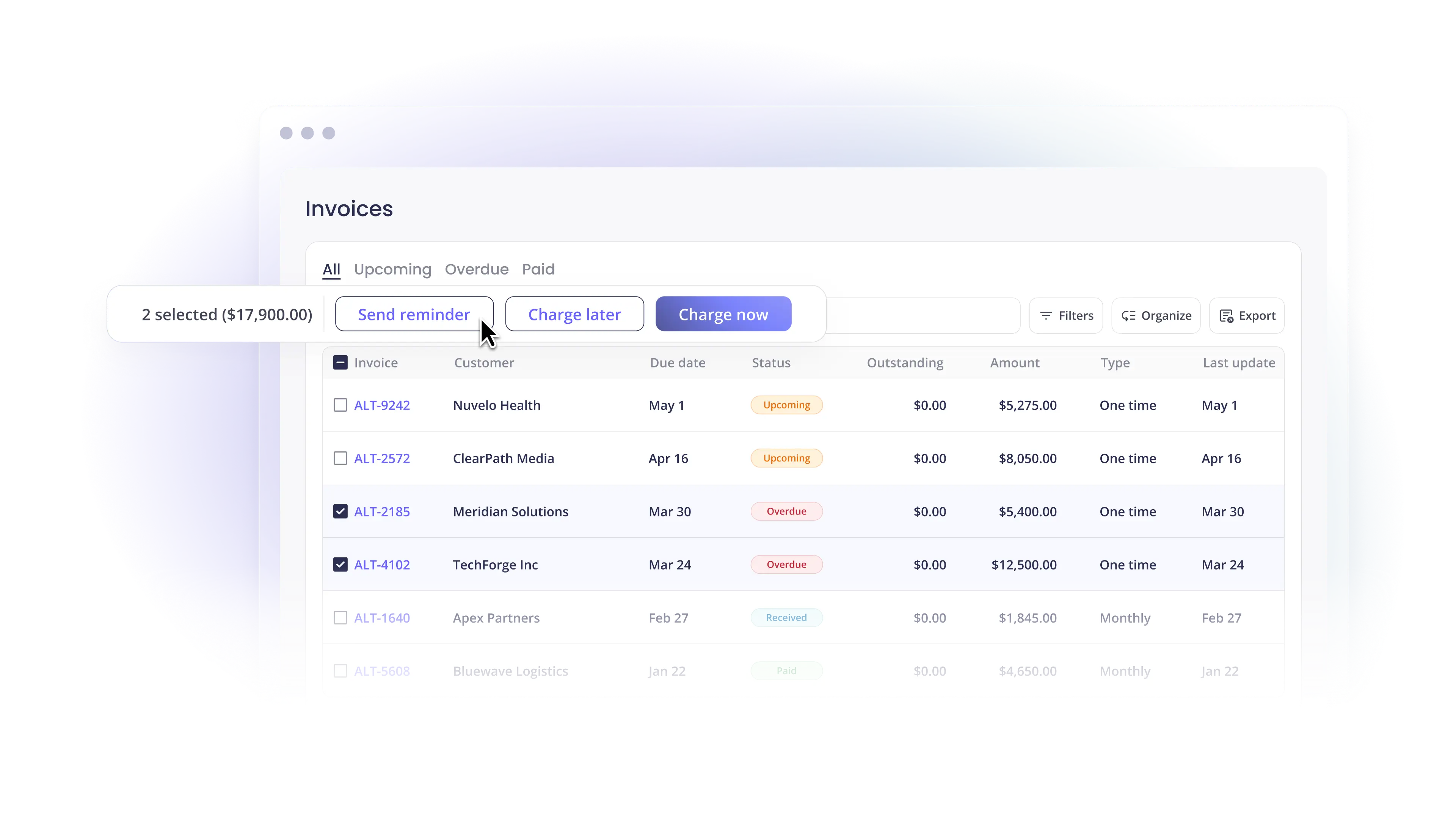
In the Alternative Payments portal, clients pay with your branding on the page and can clear several invoices at once, and payments sync to accounting tools like QuickBooks Online or Xero, so no one has to manually re-enter them.
4. Send reminders, especially before the deadline
A payment reminder sent after the due date is already late. Build a schedule into your invoicing process, such as 3 days before the due date, on the due date, and 7 days after. With automated reminders in Alternative Payments’ Accounts Receivable, you set the schedule once, and the software handles the nudging for payment from clients who haven't paid. And Alti, Alternative Payments’ Financial Assistant, can also draft and send reminders on your behalf, after you approve them.
5. Call after the second late invoice
If a client misses 2 due dates, pick up the phone. Usually, the reason for not paying is something small, like a new approver, a payment method issue, or an expired card. Alternative Payments’ Financial AI, Alti, can help by flagging clients who miss their usual payment pattern, so you know who to call before the balance grows.
If it goes beyond that, Alternative Payments can help with Collections Assist, where your outstanding invoices are followed up on for you, so you can get back to work and let someone else handle the chasing.
The issue with early payment discounts
While early payment discounts can encourage quicker settlement, they aren’t cheap, and they eat into your margins, so we didn’t include them in the recommendations above.
On 2/10 net 60 terms, you give up $80 on a $4,000 invoice to get paid on day 10 instead of day 60 (50 days sooner). As an annual interest rate, that’s about 14.9% ($2 for every $98 you collect early, about 7.3 times a year). That’s about double what banks charged on new small business lines of credit in early 2026: a median of 6.90% for fixed-rate versus 7.27% for variable-rate lines. Even 1/10 net 60 works out to about 7.4% a year.
Try these 2 early payment incentives instead
You can get faster cash without giving up 2%. Here are 2 alternatives to try:
- Ask for a deposit upfront. The same 2026 Atradius survey found that suppliers protect themselves by requesting advance payments. Alternative Payments makes Payment Requests easy with an auto-generated link to pay a deposit by card or via ACH transfer. Your client doesn’t even have to log in.
- Give a client more time without carrying the cost. Some clients need longer to pay, especially on larger projects. With Alternative Payments’ Pay in Installments, your client pays over 30 to 150 days. Partners receive the full invoice amount upfront, with no payment delay. The option is available to US businesses, and each request goes through a brief underwriting review.
Ready to stop waiting 60 days to get paid?
Net 60 is just as much a financing decision as it is an invoice term. Before you accept it on your next invoice, decide whether the client is worth the wait and whether your price covers it. If clients already take 60 days on invoices marked due on receipt, start with how they pay: a card on file, a pay link in every invoice, and reminders sent before the due date.
This article is general information only, so consult qualified professionals before making financial or business decisions.
Book a demo to see how Alternative Payments can get those hard-earned dollars in your pocket sooner.
Frequently asked questions
Does net 60 mean 60 business days?
No. Net 60 payment terms count 60 calendar days from the invoice date, weekends and holidays included. If day 60 falls on a weekend or bank holiday, the payment may arrive the next business day, because banks don't settle automated clearing house (ACH) transfers on those days. To avoid disputes, state in the contract whether a weekend due date moves to the next business day.
What happens if a client pays after day 60?
On net 60 payment terms, a payment after day 60 is late, and what happens next depends on your contract. Many firms charge late fees or interest on the overdue invoice balance. Those charges generally need to appear in the engagement letter or contract the client signed, and some states limit them. Without written terms, you're left with reminders and phone calls.
Can net 60 terms affect credit scores?
They can affect your client’s business credit score. Some suppliers report payment history to business credit bureaus such as Dun & Bradstreet, Experian, and Equifax. A client who pays net 60 invoices on time can build a stronger business credit file, and one who pays late can hurt their score. Offering net 60 doesn't affect your own score, but slow-paying clients can make it harder to pay your own bills on time.
Reviewed by Daniel Reiter, Creative Director at Alternative Payments, on November 20, 2026.
Simplify your customer payments, unlock instant cash flow
Keep reading

The problem with net 60 payment terms and why waiting to get paid costs you more than you think

5 Ways MSPs Can Streamline Their Accounts Receivable Process