•
Accounting
•
Reduce DSO
•
Automate Accounts Receivable
•
Collections
November 16, 2026
DSO accounting: How to reduce days sales outstanding at your accounting firm

It's that time of the month when you run your monthly client reviews. They start with running days sales outstanding (DSO) for each client, so you can explain to them what's slowing down their cash flow. For your clients, it's easier, but when you're always so deep and buried in client work, your own practice’s numbers are easy to put on the back burner, especially during tax season. In DSO accounting terms, you may know the formula like the back of your hand and still not consistently run it for your own firm. That's a problem.
This guide breaks down what DSO means for accounting firms and how to calculate it properly, without distortion from busy times like tax season. It also covers what a good number looks like for a firm and the variables that can bring it down.
DSO accounting basics: what days sales outstanding measures
In case you missed it in the intro, DSO stands for days sales outstanding. It's the average number of days between sending an invoice and getting paid, and across the financial industry, it's the standard financial metric for collection efficiency. It shows how fast your accounts receivable (AR) turns into cash.
DSO counts only a credit sale, not cash sales: work you invoice now and get paid for later. At an accounting firm, that’s basically every invoice. The longer those invoices go unpaid, the pressure on your company’s cash flow and your company’s ability to pay bills on time increases.
Days sales outstanding formula
Days sales outstanding (DSO) = (accounts receivable ÷ revenue billed in the period) × days in the period
The above formula compares what customers owe with what you billed over a set time period, then turns that ratio into days. For example, if clients owe exactly half of what you billed over the last 90 days, your DSO is 45. In other words, it took 45 days to collect payment.
Leave out any money a client pays before you do the work, such as a deposit or a prepaid retainer. That cash never sits in accounts receivable anyway, so it doesn’t belong in the billings you use in the DSO calculation.
While this guide uses your ending accounts receivable balance (the number your aging report shows), public-company financial statements often do not separate credit sales from cash sales, which makes DSO less precise outside internal accounting records. Other versions may use total credit sales accounts or an average accounts receivable balance, with net revenue and 365 days for an annual figure. The point is that any version works, as long as you use the same one every month.
Days sales outstanding calculation example
The examples in this guide follow one hypothetical firm: a six-person bookkeeping and tax practice on March 31, near the end of tax season.
| Input (example) | Value |
|---|---|
| Total accounts receivable today (what clients owe today) | $80,000 |
| Revenue billed in January (31 days) | $40,000 |
| Revenue billed in February (28 days) | $45,000 |
| Revenue billed in March (31 days) | $50,000 |
| Billed out the last 12 months | $480,000 |
| Days in the time period | 90 |
Using the formula above, DSO over a 90-day period running from January to March is ($80,000 ÷ 135,000) x 90 = about 53 days, and that selected period should match the firm’s sales volume for the month, quarter, or season being measured. So during that period, clients took approximately 53 days to pay.
In contrast, the full-year DSO formula ($80,000 ÷ $480,000) × 365 = about 61 days. As the next section shows, that makes this firm’s clients look much slower than they really are. For a more general take on this metric, read our article on Cutting DSO.
How to calculate days sales outstanding when tax season skews the math
The days sales outstanding formula assumes your billing stays fairly even. At most accounting firms, it doesn’t. When you bill heavily from January to April, new invoices are piled into outstanding receivables faster than the yearly average catches up to them, so DSO looks worse than it actually is. When billings drop off in late spring, DSO looks better than it is. Tracking DSO over several periods helps you tell whether that rise reflects normal seasonal billing or a real collections issue that could create cash flow problems.
Here are two methods that better handle seasonal sales swings:
1. Calculate DSO with a trailing three months
To calculate days sales outstanding on a trailing basis, divide your month-end receivables by the last three months of billings. Then multiply by the days in those months. This helps ensure a quiet summer doesn’t water down your busy-season billings.
| Input (trailing three months) | Value |
|---|---|
| Accounts receivable on March 31 | $80,000 |
| Billed January to March | $135,000 |
| Days from January to March | 90 |
| Trailing three-month DSO | ($80,000 ÷ $135,000) × 90 = about 53 days |
2. Switch to the countback method for your busy-season DSO calculation
Start with today's receivables and subtract each month's billings, newest month first, until receivables run out. Count the full months, plus the share of the last one. Because it matches receivables to your latest billings, it holds up best during tax season.
| Steps (countback method) | Receivables left | Days counted |
|---|---|---|
| Start with receivables on March 31 | $80,000 | 0 |
| Subtract March billings ($50,000, 31 days) | $30,000 | 31 |
| The remaining $30,000 is two-thirds of February's $45,000 (28 days) | $0 | 19 |
| Countback DSO | 50 days |
Now you can see that the calculation you use can make a sizable difference in your final DSO: 61 days annually, 53 on a trailing three months, and 50 with countback. Whichever DSO calculation you pick, use it consistently every month and compare the same month year over year.
What's a good days sales outstanding (DSO) for an accounting firm?
There's no published DSO benchmark for accounting firms, but you’ll often see 30 to 45 days quoted for professional services, and while many companies aim for under 45 days, treat that as a rule of thumb.
The better test is the gap between your DSO and your own terms. If your engagement letter says due on receipt and your DSO is 48, each of those 48 days creates friction in how clients pay or how your practice follows up. A good DSO sits close to your terms, while a high DSO is a warning sign. Each extra day is cash you’ve earned but can’t use, and our article, Hidden Leaks: Why Uncollected Fees Kill Growth, shows how that trapped cash holds back hiring and investment.
Industry benchmarks make a poor comparable in this case because DSO benchmarks vary significantly by industry and business models, so cross-industry comparisons can mislead, especially where some sectors use relatively long payment terms. The 2026 Atradius Payment Practices Barometer found that for North American suppliers, the cash conversion cycle can "typically extend to around two months from invoicing." A firm that charges monthly clients on the due date should land much closer to its terms.
Even the largest North American public companies saw DSO worsen by 2.1 days in The Hackett Group's 2026 Working Capital Survey, which tracks working capital performance at the 1,000 largest North American public companies. Compare any average DSO only with peers of similar revenue and operating structure. A DSO of 85 days may be acceptable in some industrial sectors even though it would be high for an accounting firm. The difference is that they have large cash reserves and credit lines to cover the wait. A small accounting practice rarely has that cushion.
DSO's blind spot: unbilled work and lockup
DSO starts the clock when you send the invoice, but your wait for cash starts when the work is done. In professional firms, work in progress (WIP) means billable time logged on a client’s file that you haven’t invoiced yet. A finished return waiting for its invoice is WIP, and so are bookkeeping hours you’ll bill at month-end. None of it shows up in DSO.
This is where lockup comes in. It measures both stages: WIP days plus DSO, the full path from finished work to cash collection. You calculate WIP days the same way as DSO:
WIP days = (unbilled work ÷ billings in the period) × days in the period
If the example firm carries 20 WIP days on top of its 50-day countback DSO (the most accurate read at the end of tax season), cash arrives about 70 days after the work is done. Pull the total value of unbilled work from wherever you track time, such as Karbon or Canopy.
Fixed monthly fees billed at the start of the month and charged on the due date keep both numbers low. Hourly work billed at month-end raises both.
Why DSO creeps up in your accounts receivable
At a big company, rising DSO usually prompts a review of the company’s collections process. At an accounting firm, the causes tend to start early. If a company sells most of its services on credit and takes too long to collect, DSO rises and can point to weak customer creditworthiness or friction in the invoicing process.
- Invoices go out late.
- The terms exist, but nobody enforces them.
- Paying takes effort, like mailing a check or calling in a card number.
- Invoice and payment follow-up stops or slows down a lot in busy season, when your team is buried in work, chasing overdue invoices is often the first task to slip. In the AICPA’s 2026 CPA Firm Top Issues Survey, firms with 11 to 30 professionals ranked staff workload and capacity No. 3.
- Clients are short on cash, and another reminder won’t change that, and consistently slow payment can also help identify customers who may not be creditworthy.
- An invoice comes in higher than the client expected, so the client questions it before paying.
8 ways to reduce DSO at your accounting firm
Most of these changes happen before invoices are sent. Follow-up still matters, of course, but is typically one of the last steps in the whole process.
1. Write payment terms and a payment method into the contract or engagement letter
Every client signs the engagement letter or contract, before work starts, so it’s a good place to set expectations as to how you’ll get paid. State your terms, such as due on receipt or net 15, and spell out what the engagement costs so none of your invoices surprise your clients. Then ask clients to authorize automatic payments when they sign on the dotted line. A client who agrees to be charged on the due date will make timely payments by default, without anyone having to ask. Clear expectations at the contract stage also support better customer relationships later because clients know exactly when and how they will pay.
2. Bill the day the work is done
An invoice that sits in drafts for two weeks delays your cash by two weeks (diminishing your cash flow), so bill as close to the day the work ends as you can. For fixed monthly fees, send invoices at the start of the month. For longer projects, such as book cleanup, bill at intermittent milestones. A three-month cleanup billed in three parts gets paid as you go, instead of landing as one large invoice the client needs time to absorb. Financial cleanups are often a new client’s first project with you, so collect a deposit before you start. It confirms the client's commitment and covers your time if the engagement stalls.
Payment Requests are fixed-amount payment links that make it easy for new one-off clients to pay by card or Automated Clearing House (ACH), without logging in (Free in Alternative Payments).
3. Set up automatic payments for recurring clients
Even though retainer clients get the same invoice every month, you still might need to send a reminder or two before they remember to pay. Automatic payments can put an end to that cycle. The client’s saved payment method gets charged on the due date, which brings DSO as close to your terms as it can get. Reminders still get sent, but they're worded to make it clear the invoice is already scheduled, and sales teams or other client-facing staff should reinforce the same payment expectations during renewals or scope changes. It’s a win-win for both parties: The client doesn’t have to remember to pay on time, and you don’t have to chase them for payment.
That’s exactly what FlexKeeper did. The full-service financial firm bills almost exclusively via subscription and roughly halved its AR collection cycle from about 30 days to the first 15 days of the month after moving to Alternative Payments.
Auto-Pay in Alternative Payments lets you set rules for each client, and clients can enroll from the payment portal on their own.
4. Make paying as easy as possible
Every step between the invoice and the payment adds time. Start by accepting payment on every invoice and reminder, and offer easy payment methods, such as credit card and ACH. In particular, ACH suits large invoices because money moves straight from the client’s bank account and costs less to process than a credit card payment. This is already a popular payment method, with Nacha reporting that B2B ACH payments grew 9.7% in the third quarter of 2026 to nearly 2.3 billion payments.
Alternative Payments allows your clients to pay several open invoices at once in one branded portal, and you can pass credit card fees on to them. The 3% that used to disappear from your invoices to processors stays in your business.
5. Automate reminders before and after the due date
Reminders work best when they start before an invoice is late. A typical automated reminder schedule is 3 days before the due date, on the due date, and 7 days after, with optional follow-up reminders at 15, 30, and 45 days past due. You can also create client categories based on payment history and adjust reminder timing or escalation by group. Integrating accounts receivable workflows into the firm’s practice management system can make reminder and follow-up steps more consistent. An invoice reminder from your billing system feels routine and helps surface unpaid invoices without adding manual admin during busy periods.
6. Review your accounts receivable aging report every week
An aging report sorts every unpaid invoice by how long it’s been outstanding, usually in 30-day buckets. Check it at the beginning of each week. Invoices that just moved past 30 days need a personal follow-up before they slide further, and clients who pay late every month belong on automatic payments.
Alti, the Financial AI inside Alternative Payments, can group overdue accounts by age, create an automated routine aging report you get every Monday, and draft outreach, which you approve before it goes out to clients.
7. Offer a payment plan on large invoices
Some late payments have nothing to do with process. This Atradius survey found that suppliers mostly blame delayed payments on cash liquidity rather than disputes or admin errors. If a client can’t meet this month’s financial obligations, no amount of reminders will make that payment come faster, but a payment schedule might.
With Pay in Installments (only available in the US, subject to approval), the client picks terms from 30 to 150 days, and Alternative Payments advances you the full invoice amount upfront. The client pays over time, while the invoice leaves your receivables right away.
8. Track DSO every month to keep a steady cash flow
Calculate your company's DSO at the end of every month with the same method, against a target tied to your terms, and track average DSO over time to see whether changes are improving collection efficiency or masking new pressure on the company's cash flow. For example, if your terms are net 15, a DSO of 25 is on track, whereas a DSO of 40 means something has slipped, and low DSO generally means cash comes in sooner and the firm can cover expenses with less borrowing. Tracking DSO this way turns cash flow management into a monthly habit that helps keep cash flow steady.
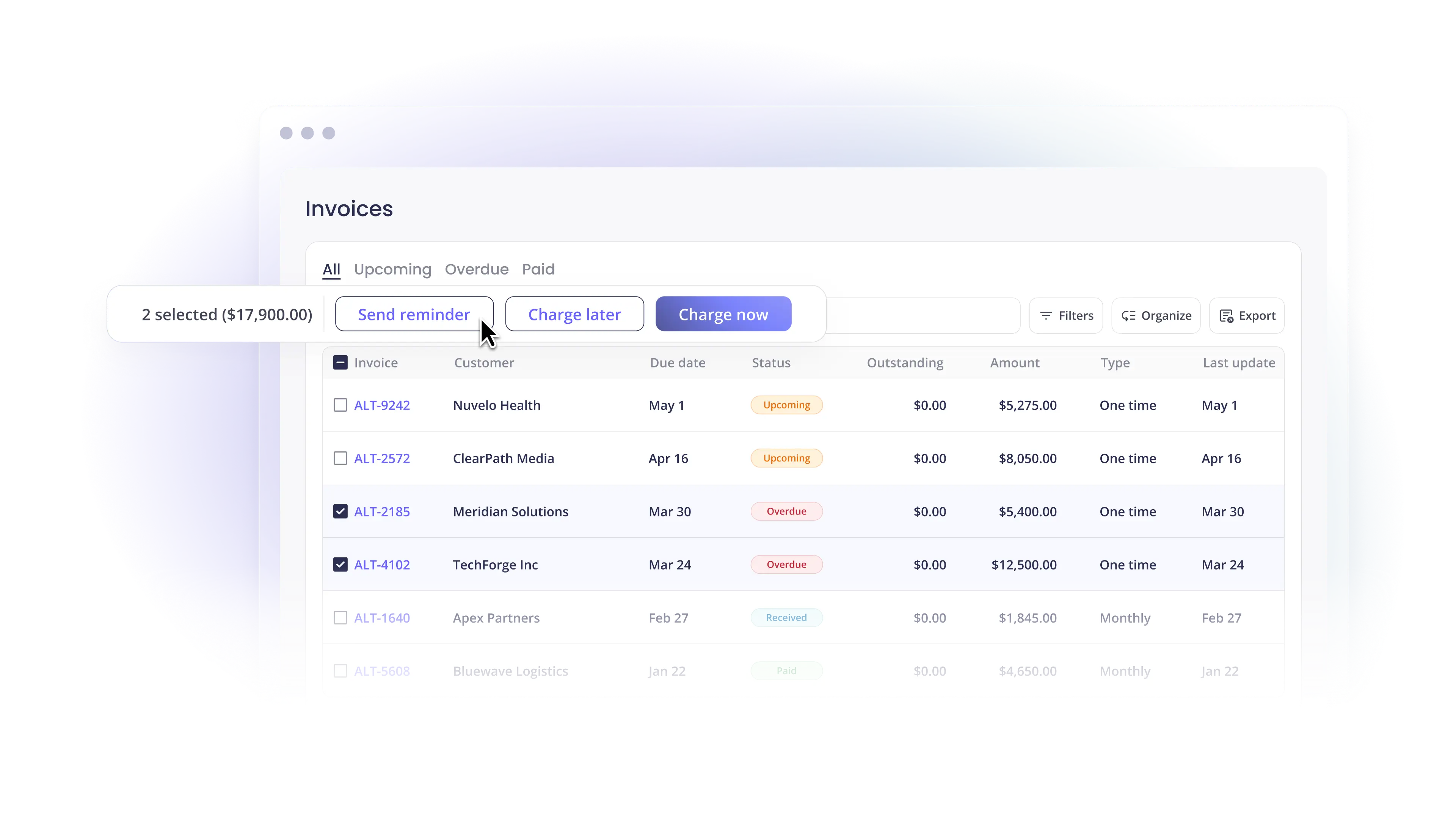
Insights shows DSO, time to pay, and AR aging by client, while Collections Assist takes over follow-up on invoices more than 30 days overdue. For the handful of invoices that never come in, read our article: When to Write Off an Unpaid Invoice.
A DSO reset before busy season
November: Update engagement letters with terms and automatic payment authorization.
December: Move monthly clients to automatic payments and turn on reminders.
January to April: Review your aging report weekly and use Pay Before Release, so clients pay before you file their return.
May: Run DSO and lockup for the season and compare them with last year.
Ready to lower your DSO before tax season starts?
Your DSO is set mostly by your engagement letter, your billing schedule, and how clients pay. Accounts Receivable from Alternative Payments syncs invoices from QuickBooks Online, QuickBooks Desktop, Xero, FreshBooks, or Zoho Books. Clients pay in a portal with your firm's branding or through Auto-Pay, and payments get marked paid in your accounting software.
For more, read The Accounting Firm Guide to Accounts Receivable Automation, or book a demo to see how accounting firms put monthly clients on Auto-Pay and track DSO and aging all in one place.
Frequently asked questions (FAQs)
Is DSO the same as AR turnover?
No, but they're related. Days sales outstanding (DSO) is the average number of days it takes to get paid after you send an invoice. Accounts receivable (AR) turnover is annual billings ÷ average accounts receivable. DSO turns that into days: 365 ÷ AR turnover. A firm billing $360,000 a year with an average AR balance of $40,000 has a turnover of 9 and a DSO of about 41 days.
Should accounting firms offer early payment incentives or discounts to lower DSO?
Usually not. Some firms do succeed by offering early payment incentives, but it works best only when the cash-flow benefit outweighs the revenue given up. Early payment incentives or discounts take a small percentage off an invoice for paying early, often 2% within 10 days. For a firm billing fixed fees, that discount cuts into the fee of every client who would have paid on time anyway. Automatic payments and reminders before the due date usually lower days sales outstanding (DSO) without giving up revenue.
How does Alternative Payments help accounting firms lower DSO?
Alternative Payments syncs invoices from supported integrations like QuickBooks Online, QuickBooks Desktop, Xero, FreshBooks, or Zoho Books. Clients pay through a branded portal by ACH, card, or Pay in Installments, or Auto-Pay charges them on the due date. Automated reminders go out before and after the due date, and Insights tracks days sales outstanding (DSO) and aging by client. Alti, the built-in Financial AI, helps the firm group overdue accounts and draft outreach for approval before sending.
Reviewed by Daniel Reiter, Creative Director at Alternative Payments, on November 16, 2026.
Simplify your customer payments, unlock instant cash flow
Keep reading


DSO accounting: How to reduce days sales outstanding at your accounting firm
What Should Sync and How to Test a PSA Integration for MSP Payments