•
Accounting
•
Automate Accounts Receivable
•
Collections
•
Reduce DSO
•
Professional Services
•
Set Up Subscription Billing
June 25, 2026
Payment Processing Software for Accounting Firms and CAS Practices: What to Look For
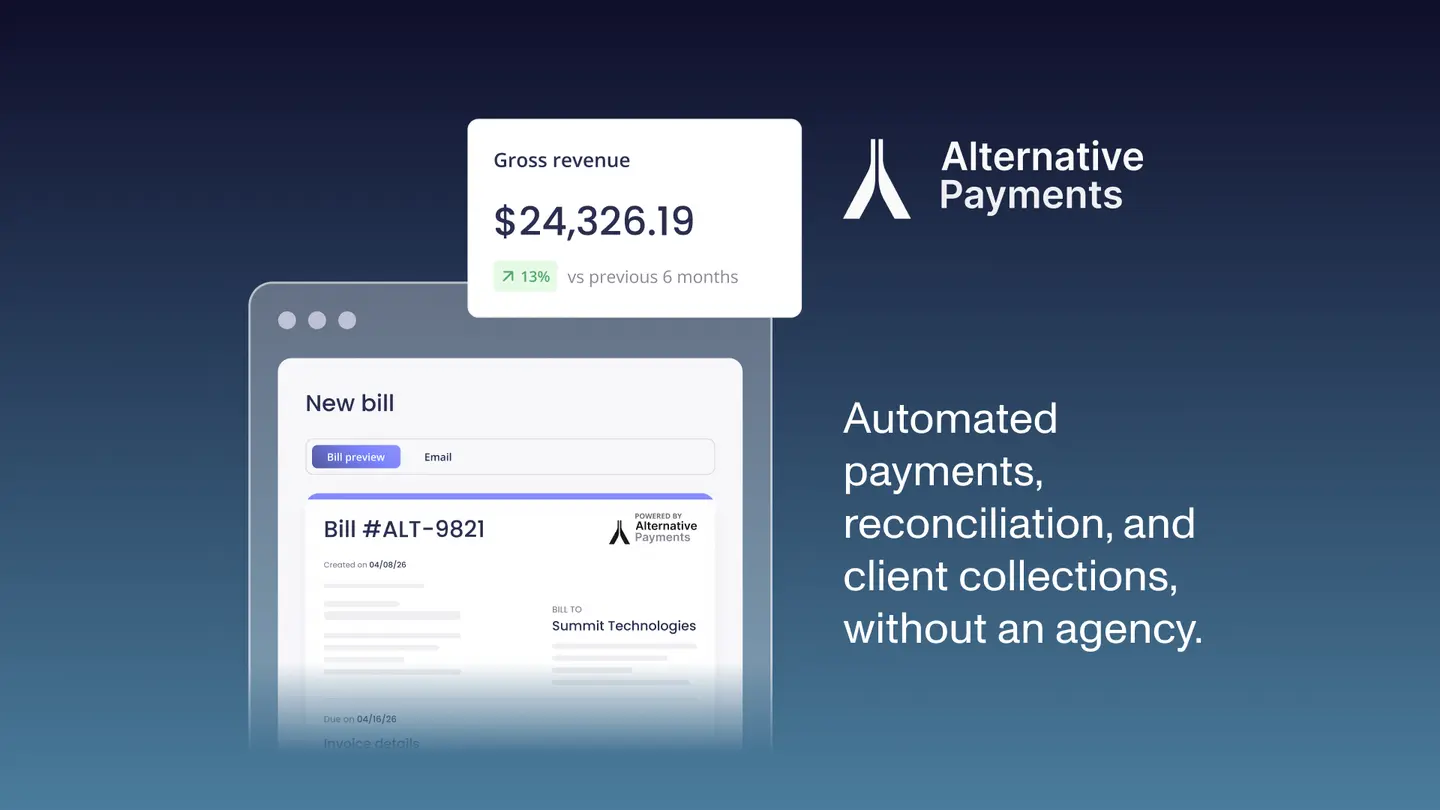
If you run an accounting firm or a CAS practice, the right payment processing software for accounting firms has to do double duty: handle your own client billing and work cleanly for the clients' businesses you serve. Client advisory services are the fastest-growing line in public accounting. CAS practices reported a 17% median growth rate in 2023 and project 99% growth over the next three years, according to the 2024 CPA.com & AICPA PCPS Benchmark Survey. That growth runs on recurring revenue. And recurring revenue runs on getting paid on time, every month, without your team chasing it.
In our experience working with service firms, the payment software worth choosing does three things well: it lets clients pay automatically, it reconciles every payment back to the right invoice in your accounting system, and it follows up on overdue balances without a collection agency. Most tools do one of those well. The gap between them is where your billing time goes.
This guide walks through how CAS firms charge for monthly work, where generic processors fall short, and what to look for in a platform that handles your firm's billing and your clients' payments in one place.
How CAS Firms Charge Clients for Monthly Bookkeeping
The billing model has shifted, and it shifted toward recurring revenue. In CPA.com's research on accounting advisory services, 63% of buyers reported paying through fixed monthly fees or per-project arrangements, and 54% now buy services in bundles or packages rather than by the hour. The 2024 CAS Benchmark Survey puts the typical monthly CAS fee at $3,000, with a median of $90,000 in monthly recurring revenue from outsourced accounting.
Most firms land on one of these structures for monthly bookkeeping and CAS work:
- Fixed monthly fee. A flat rate for a defined scope: monthly bookkeeping, reconciliations, and financial statements. Predictable for the client and for your cash flow.
- Tiered packages. Three or four bundles that step up from compliance work to advisory. Each tier carries a higher recurring price.
- Value-based retainers. Fees tied to the outcome or the client's size, often layered on top of a base subscription.
Every one of these models depends on the same thing: a charge that repeats on a schedule. That is where the operational problem starts. A fixed fee is only predictable if the payment arrives without a reminder, posts to the correct invoice, and reconciles cleanly. When any of those steps needs a human, your recurring revenue stops being recurring and starts being a monthly collection project.
Why Generic Payment Processors Fall Short for Accounting Firms
Generic processors treat every charge like a one-off ecommerce transaction. That model works for a retail checkout. It breaks for contract-driven, recurring billing, because an accounting firm is not selling a product once. You are billing the same client every month against an engagement, and each payment has to find its way back to a specific invoice in QuickBooks or Xero.
Here is where the gaps show up:
- Disconnected reconciliation. A processor collects the payment, then hands you a lump-sum deposit. Matching that deposit to individual invoices is a manual step that runs every week across every client account.
- No client self-service. Clients get an email payment link instead of a portal where they can view invoices, store a payment method, and enroll in auto-pay.
- Limited payment options. Card-only or basic ACH, with no surcharging, installments, or B2B BNPL for larger advisory retainers.
- No collections follow-up. Overdue invoices need a structured cadence, not a manual email chain from a team that is already stretched.
The cost of this manual middle ground is measurable. Firms running AR by hand spend only 20% of their time engaging customers on payment, compared with 62% once AR is automated, and write off roughly 4% of receivables as bad debt, according to Sage. For a practice with $1.6 million in CAS revenue, a 4% write-off is real money walking out the door.
The fix is not another spreadsheet or a second processor bolted onto the first. It is a platform built for the way accounting firms actually bill.
Generic Processor vs. Purpose-Built Platform
The difference is workflow alignment, not just a longer feature list.
| Capability | Generic processor | Purpose-built platform |
|---|---|---|
| Invoice sync | Manual upload or basic API | Bi-directional sync with QuickBooks and Xero |
| Reminders | Limited or manual | Automated cadence before, on, and after the due date |
| Reconciliation | Lump-sum deposits, manual matching | Per-invoice auto-reconciliation to the GL |
| Client experience | Third-party checkout | White-label portal branded to your firm |
| Payment options | Card or limited ACH | ACH, cards, surcharging, installments, B2B BNPL |
| Collections | Not available | Built-in, success-based follow-up |
A purpose-built platform handles the full payment lifecycle: issuance, communication, collection, reconciliation, and reporting. Each stage hands off to the next automatically, so nothing falls through the cracks between your invoicing and your GL.
What to Look for in Payment Software for Accounting Firms
When you evaluate a platform for your practice and your clients' businesses, check it against the workflow you run every month, not the demo.
Native accounting integration
The platform should connect directly to QuickBooks Online, QuickBooks Desktop, and Xero through native integrations, not third-party connectors. When a client pays, the payment should post back to the invoice and reconciled to your GL without anyone keying it in. We built auto-reconciliation so every payment maps to the specific invoice it covers and posts to the right account automatically.
Auto-pay with stored payment methods
For recurring CAS billing, auto-pay is the difference between predictable cash flow and a monthly follow-up cycle. Clients enroll once, store a payment method, and the platform charges on schedule. ACH should be the default for retainer billing. It costs less than card and settles predictably, which suits the recurring nature of advisory work.
A branded client portal
Your payment page should look like your firm, not a third-party processor. A white-label portal lets clients log in, see current and past invoices, manage payment methods, and pay on their own schedule. For CAS clients who interact with your billing every month, that consistency reduces inbound billing questions and builds trust.
Flexible payment options in one checkout
Not every client pays the same way. The platform should offer ACH, credit cards, surcharging, installments, and B2B buy now pay later in a single flow, so a larger advisory retainer can be financed without a separate setup.
Collections that work without a collection agency
Overdue invoices need a structured escalation, not a manual chase. Our Collections Assist tool activates automatically on overdue balances and handles reminders and follow-up. According to our Collections Assist launch announcement, the historical recovery rate for delinquent receivables is roughly 40%, or about $0.40 on every delinquent dollar. Embedding follow-up into the payment workflow is designed to lift that recovery without adding billing staff or handing accounts to an agency.
Reporting that surfaces the metrics that matter
You should be able to track days sales outstanding (DSO), exception rates, and on-time payment ratios in one view. These are the numbers that tell you whether your billing is healthy or quietly leaking cash.
How the Workflow Comes Together
The cleanest setup is not one tool that does everything. It is a connected workflow where each system handles the step it was built for, and the handoffs happen automatically.
- Engagement and scope live in your practice management platform, whether that is Karbon, Canopy, or another tool your firm already uses.
- Invoices generate in QuickBooks Online or Xero, which stays the accounting source of truth.
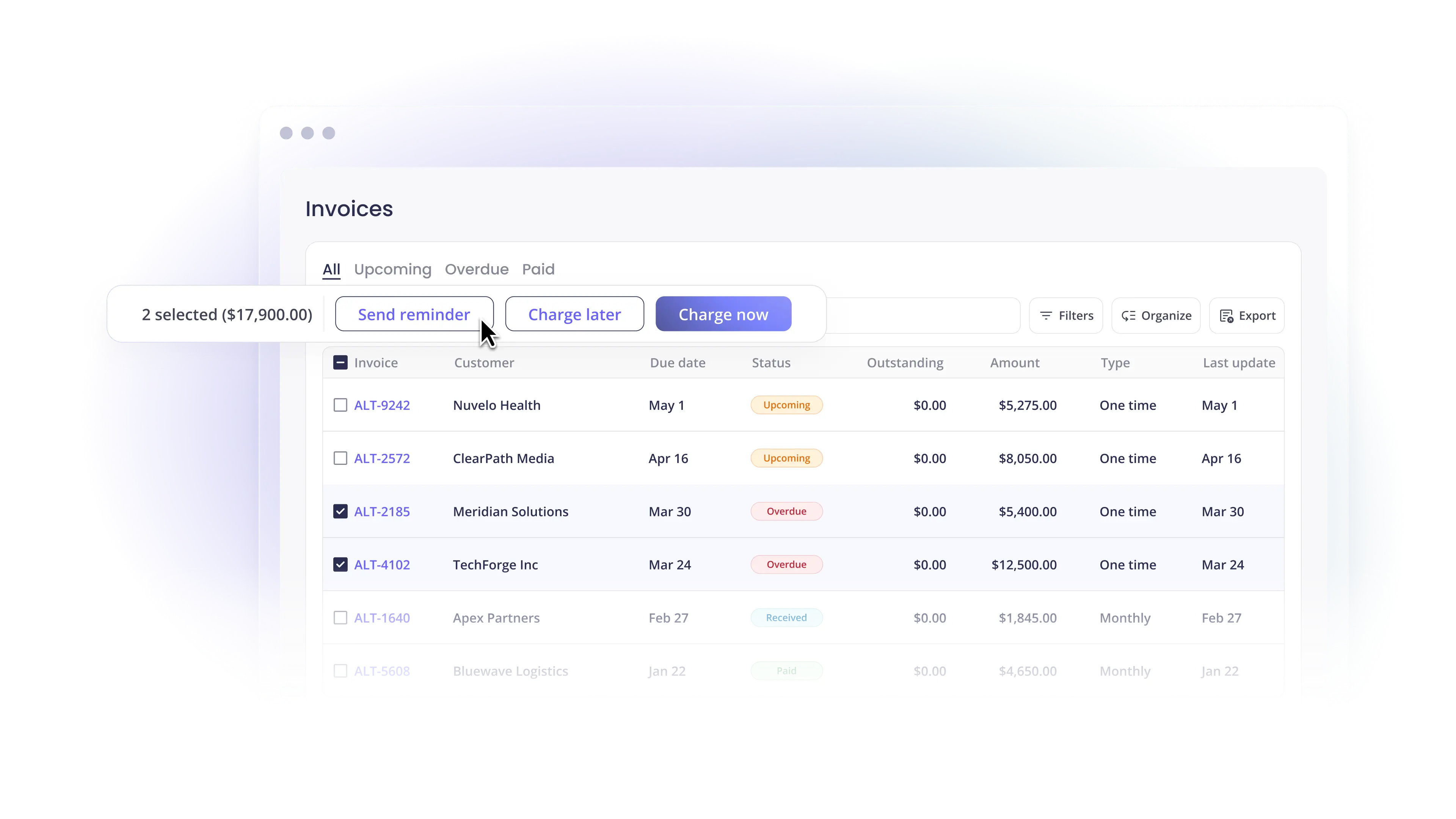
- Alternative Payments presents the invoice through a branded portal, collects via ACH or card, and enrolls clients in auto-pay.
- Payment posts back to your accounting system and reconciles to the invoice automatically.
- Collections Assist follows up on anything overdue, without a manual email from your team.
The result is the outcome CAS owners care about: faster collections, a lower DSO, cleaner books at month-end, and a billing operation that scales with your client book instead of against it. Your team stops chasing invoices and gets back to advisory work.
FAQs
Can clients enroll themselves in auto-pay?
Yes. Clients log into a branded portal, store a payment method, and enroll in auto-pay for their recurring invoices. The platform then charges on schedule and reconciles each payment back to the invoice automatically, so your team is not initiating each charge.
Does the platform work for both my accounting firm and my clients' businesses?
Yes. Alternative Payments is built for service businesses with recurring revenue in the U.S. and Canada. You can use it to bill your own clients and recommend it to clients who run their own recurring billing, since the same auto-pay, reconciliation, and collections workflows apply.
How is this different from QuickBooks Payments or Stripe?
QuickBooks Payments and Stripe are solid for simple payment acceptance. They were not designed for contract-driven, recurring billing where reconciliation, client communication, and collections need to work as a connected system. A purpose-built platform syncs natively with your accounting software, offers a persistent client portal, and includes AR automation that those tools leave to you.
Can I automate collections without using a collection agency?
Yes. Collections Assist embeds follow-up directly into the payment workflow, activating automatically on overdue invoices and handling reminders. It is designed to recover more than a manual process while keeping the client relationship intact, so you avoid handing accounts to an outside agency.
Does ACH cost less than credit cards for monthly bookkeeping fees?
Generally, yes. ACH carries lower processing costs than card and settles predictably, which makes it the right default for recurring CAS retainer billing. The platform supports ACH with no per-transaction ACH fee, and surcharging is available when clients pay by card.
See It Work for Your Firm
Recurring revenue only feels predictable when payment, reconciliation, and collections run on their own. If your firm is still matching deposits by hand or chasing overdue invoices over email, the gap is in the workflow, not your team.
Book a 20-minute demo to see how Alternative Payments automates client collections, reconciliation, and reporting for your firm's engagement types and accounting stack.
Simplify your customer payments, unlock instant cash flow
Keep reading