•
Accounting
July 8, 2026
FlexKeeper
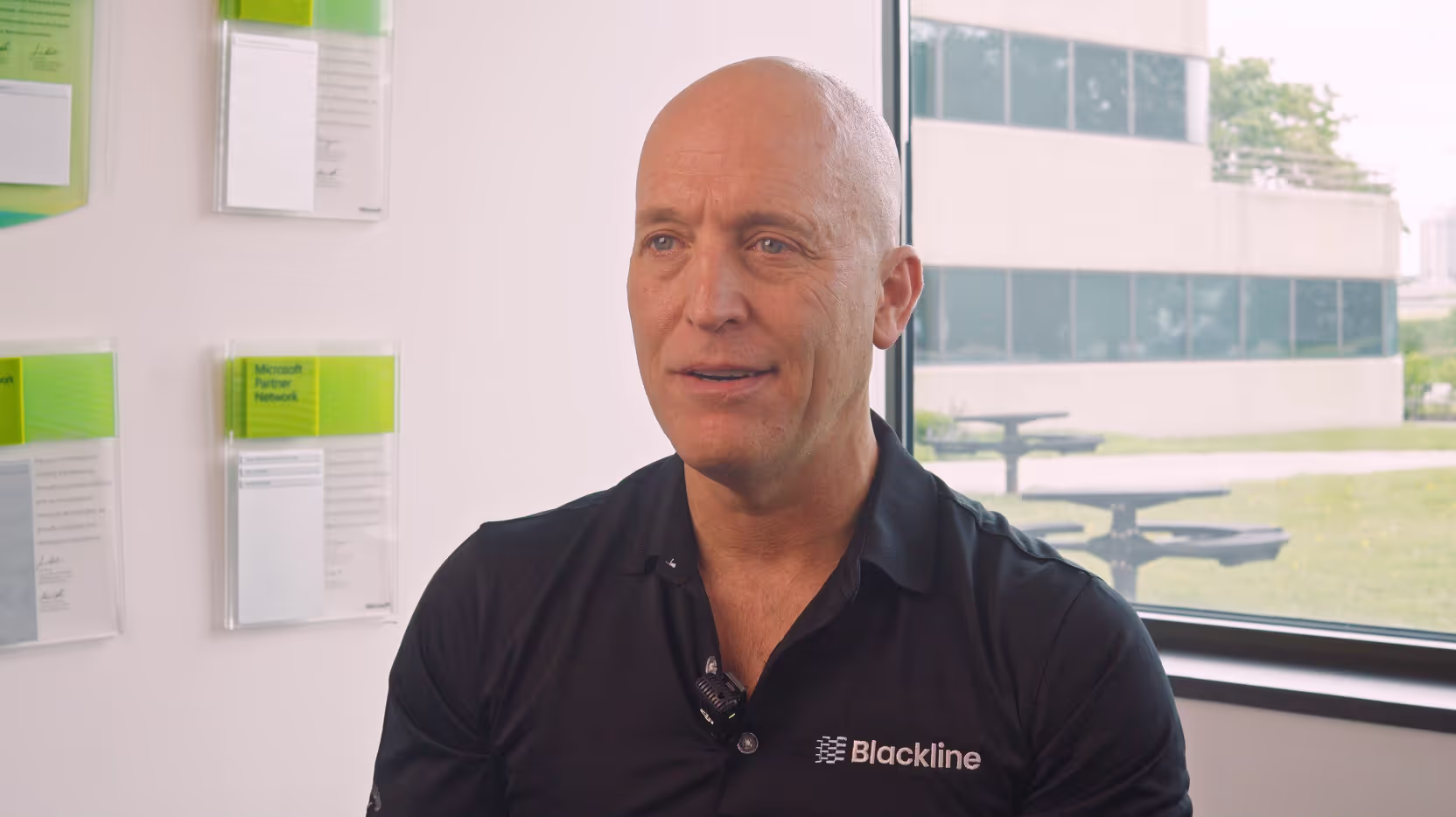
Talking with Jason Plett, CFO at FlexKeeper

00:00
/
00:00
FlexKeeper is a full-service financial firm offering everything from basic bookkeeping to tax planning, tax prep, payroll, and high-level financial advisory services. Founded in 2011 by Jodi Plett, the company has grown to serve roughly 800 clients across its tax and bookkeeping portfolios, ranging from home service businesses to high-profile retail clients.
Challenge
Running Billing and Collections Out of QuickBooks Alone
FlexKeeper ran its entire invoicing and collections process through QuickBooks. It worked as accounting software, but it wasn't built to manage the relationship side of getting paid. Every overdue invoice meant an awkward conversation, a staff member chasing a client, or an absorbed credit card fee. As the firm grew, those small frictions added up to real cost and real time.
Chasing overdue invoices ate into staff time during off-season
During tax season, collections weren't top of mind. But once the pressure eased, the backlog surfaced fast. Staff would find themselves with roughly 20 hours of catch-up work: texting clients, asking why they hadn't paid, and digging through QuickBooks to confirm whether an invoice had even been opened. QuickBooks had some reminder functionality, but it wasn't built for visibility or for personal communication. The firm needed a system that gave clear answers without staff having to dig for them.
Absorbing credit card fees was costing the firm $15,000 a year
FlexKeeper was paying about $15,000 annually in credit card processing fees, money that should have stayed in the business instead of subsidizing client convenience. QuickBooks didn't offer a simple way to pass those fees through to clients without manually adjusting every invoice. For a firm that had analyzed the numbers and concluded it couldn't keep absorbing that cost, this became the deciding factor in looking elsewhere.
Solution
Passing through credit card fees, without an all-or-nothing tradeoff
The ability to pass credit card fees directly to clients was the single biggest factor in FlexKeeper's decision. Alternative Payments turned the feature on during the very first demo. Just as important, the firm could apply it selectively. Some clients could be exempted from fees on a case-by-case basis, rather than forcing an all-or-nothing policy across the entire client base, a flexibility FlexKeeper hadn't found anywhere else during its evaluation.
A seamless QuickBooks integration that runs in the background
FlexKeeper bills almost entirely on subscription, including its tax services. Invoices are entered into QuickBooks on a recurring basis and pushed automatically to Alternative Payments the moment they're created. Clients on autopay are charged within 24 hours, and the predictability of the billing cycle drives a high payment rate right around the first of the month. Reconciliation between QuickBooks and Alternative Payments requires no manual work in roughly 95 percent of cases. The transition itself was nearly invisible to clients — most didn't even read the emails announcing the switch. The only thing they noticed was a new logo on their invoice, prompting the occasional "is this really you guys?" rather than any payment friction.
A passwordless client portal that removed a common excuse to delay payment
Clients can view their full invoice and payment history in one place, even without logging in. That visibility eliminated a recurring point of friction: clients disputing which invoice a payment had been applied to. Instead of FlexKeeper resending invoices and untangling email threads, clients could check their own payment history and self-reconcile. Combined with a passwordless login, there's little reason left for a client to delay paying.
A support team that treats a small firm like it matters
As a two-to-ten-person firm, FlexKeeper isn't Alternative Payments' biggest account — and Jason says it's never felt that way. The team has direct relationships with support and leadership, gets fast turnaround on questions, and knows there's always someone else to reach out to if an issue isn't resolved right away. For a small business used to being an afterthought with larger vendors, that responsiveness has stood out.
"We probably cut our AR cycle down by half. If I said it was 30 days with QuickBooks, we would probably collect most of our invoices within the first 15 days of the month. We have definitely increased our cash flow and seen a very positive difference in our collection process."
.png)
Jason Plett
CFO

Results
Faster Collections, Lower Fees, and Far Less Manual Work
Alternative Payments gave FlexKeeper control over its billing process instead of working around the limits of QuickBooks. Collections sped up, processing costs dropped, and client communication around payments became almost entirely self-service — all with a transition so smooth that most clients never noticed it happened.
- Cut the AR collection cycle roughly in half, from about 30 days to within the first 15 days of the month
- Reduced credit card processing costs by an estimated $1,000 per month
- Cut check payments from a routine method down to about 12 per year
- Eliminated nearly all manual reconciliation between QuickBooks and client payments
- Migrated billing systems with virtually no client disruption or complaints
"Alternative Payments has streamlined our payment processing, our AR collection time, and also assisted in helping our clients with their payments, making it easier for us to get our fees and avoiding the difficult conversations that we might have had with our clients otherwise."
Jason Plett
CFO
Built for people who run
real businesses
See how business owners like you simplify payments and improve cash flow with us.
.avif)
00:00
/
00:00


00:00
/
00:00


00:00
/
00:00

00:00
/
00:00