•
IT Services
•
Automate Accounts Receivable
•
Collections
•
Reduce DSO
•
Accounting
July 8, 2026
How MSPs Automate Invoice Collection and Reconciliation with Their PSA
The Manual Billing Trap
If you run an MSP, you already know where the month goes. Invoices generate in ConnectWise or Autotask. Then someone exports them, emails clients, chases the late ones, logs into a separate processor to confirm payments, and matches each deposit back to an invoice in QuickBooks by hand. The PSA creates the invoice, but it does not collect the payment, reconcile the transaction, or talk to the client about an overdue balance. That gap between invoice creation and cash in your account is where the manual work lives.
The cost is not abstract. The median B2B DSO across industries is 56 days, according to Upflow's State of B2B Payments in 2024 report. For a recurring revenue business, every day past due is working capital you have already earned but cannot deploy. And the work itself is brittle: manual data entry is the leading source of reconciliation discrepancies, so the same process that drains hours also introduces errors.
The good news is that this is a solved problem. The automation path is well defined, and the payoff (faster collections, cleaner books, and hours returned to your team every billing cycle) is measurable from the first run. This guide walks through how MSPs automate invoice collection and reconciliation, what to look for in a billing platform that integrates with Autotask or ConnectWise, and how purpose-built platforms differ from generic tools like BILL (formerly Bill.com).
How MSPs Automate Invoice Collection and Reconciliation
The cleanest way to think about MSP billing is as a lifecycle with five stages: issuance, communication, collection, reconciliation, and reporting. Automation does not replace one step. It connects all five so data flows from your PSA to your general ledger (GL) without manual handoffs. Here is what each stage looks like when it runs on a unified platform.
1. Issuance
Your PSA generates invoices from service agreements, time entries, and project milestones. Automation starts here: the payment platform pulls invoice data from the PSA in real time, with full line-item detail, so there is no CSV export or manual upload. When a client adds 10 devices mid-cycle and the PSA generates a prorated charge, the platform picks it up automatically and bills the correct amount.
2. Communication
Automated reminders replace manual email follow-up. The platform sends branded notifications on a configurable schedule (before the due date, on the due date, and at escalating intervals after) so no one on your team chases a payment by hand. Timing matters more than most owners expect. Automated reminder cadences outperform manual follow-up by 12–18 days on average, and first contact within 48 hours of a missed payment achieves a 65% collection success rate, dropping to 15% if you wait 14 days, according to Credit Pulse's 2025 DSO benchmarks.
3. Collection
This is where the gap between PSA and payment platform matters most. A purpose-built payment layer offers:
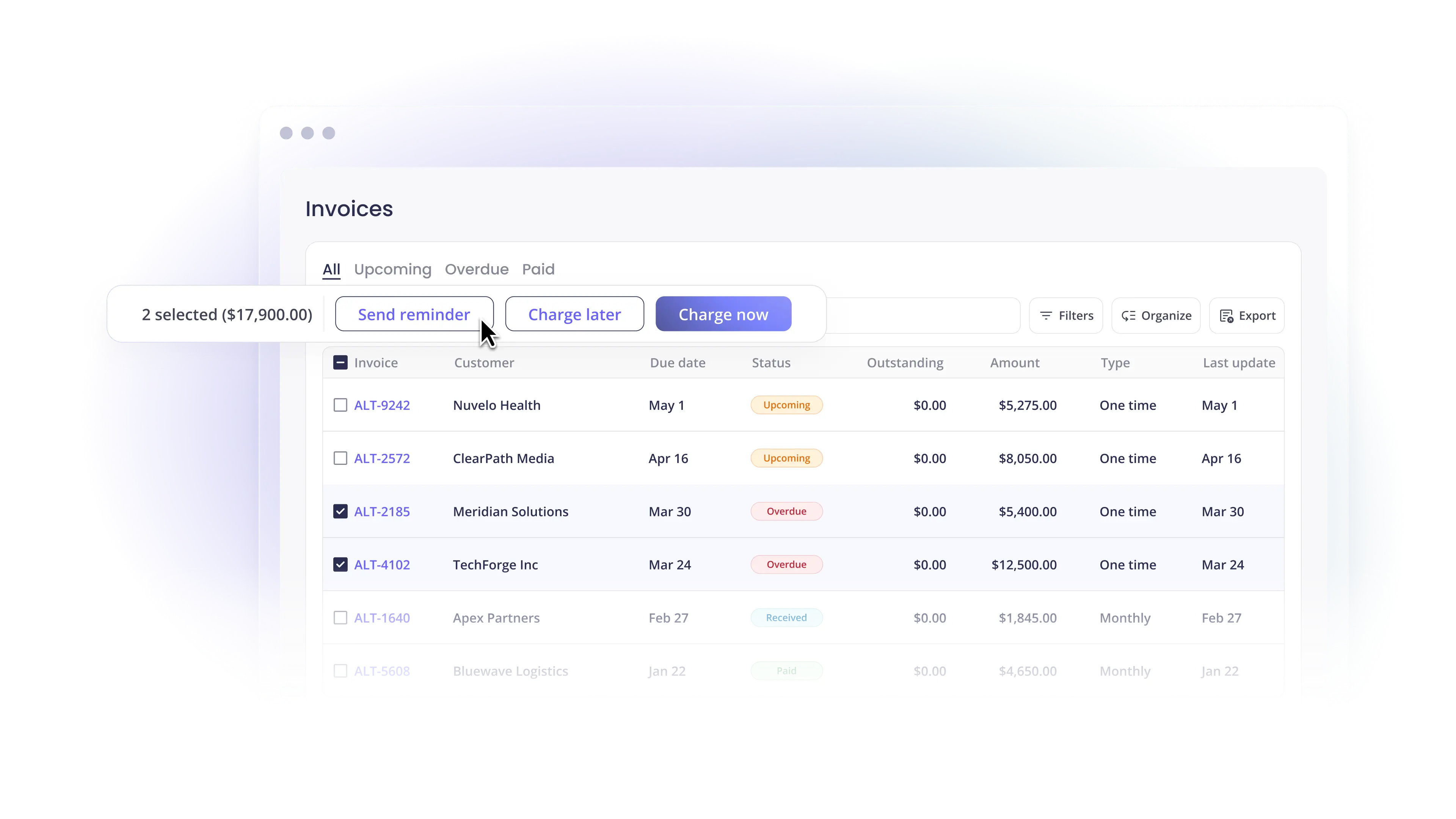
- Auto-pay on stored methods: ACH and card charges trigger automatically on the billing schedule, so invoices get paid without anyone sending an email. Auto-pay is the single highest-impact feature for reducing DSO.
- Retry logic: failed charges from an expired card or insufficient funds are retried on a configurable schedule before escalating, so your team is not manually re-running transactions.
- Multiple payment methods in one checkout: ACH, credit card, and client-facing financing, including installments and B2B buy now pay later, in a single branded checkout. Offering ACH alongside cards lowers your processing costs; offering installments reduces friction for clients facing large project invoices.
4. Reconciliation
Every payment should map to the specific invoice it covers and post to your accounting system automatically, with no spreadsheets and no line-by-line matching. This is the step that quietly consumes the most time at month-end. When payments batch into a single daily deposit, matching each one back to an invoice in QuickBooks by hand can take hours. Native PSA integration eliminates that by posting reconciliation automatically: invoice created in the PSA → pushed to the payment platform → client pays → payment posted back to the PSA → reconciliation auto-posted to accounting.
5. Reporting
With the lifecycle connected, AR health becomes visible in one place. You track DSO, exception rates, and on-time payment ratios instead of stitching the picture together across three systems. A platform with strong AR automation surfaces unmatched transactions and overdue balances as they happen, so your team resolves exceptions proactively rather than discovering them at month-end.
What to Look for in MSP Billing Software for Autotask or ConnectWise
Not every "integration" closes the loop. The difference between a native PSA integration and a bolt-on connector determines how much manual work actually remains. When you evaluate a platform that works with Autotask or ConnectWise, prioritize these capabilities.
Native two-way PSA sync
Native means bidirectional, real-time, and without middleware. Invoices created in your PSA push to the payment platform with full line-item detail. Payment status and settlement data push back automatically. Contract changes in the PSA reflect immediately in billing.
Bolt-on integrations wired through Zapier or generic APIs work differently. They tend to import invoice totals without line-item detail, require manual mapping between PSA entities and accounting categories, and create reconciliation gaps that compound over months. The right question is not "Does it integrate with my PSA?" It is "Does it sync bidirectionally, in real time, with no middleware required?"
Auto-pay with retry logic
When clients store a payment method and authorize recurring charges, invoices get paid on schedule without an email or a phone call. Retry logic handles failed charges automatically. This is the feature most directly tied to a lower DSO.
Automatic GL reconciliation
Reconciliation to QuickBooks or Xero should happen without manual matching. This is what eliminates the month-end matching exercise that generic processors leave on your plate.
Multiple payment methods and a branded portal
Clients should be able to pay by ACH, card, or installment financing through a single checkout that carries your brand, not your processor's. A white-label experience is not cosmetic. B2B companies that implemented customer payment portals reduced DSO by an average of 8 days in the first quarter after rollout, according to Resolve.
For a deeper, PSA-by-PSA breakdown of where ConnectWise, Autotask, and Syncro billing ends and where a payment layer fills the gap, see our guide to MSP billing automation across PSA environments.
Alternative Payments vs. BILL (Bill.com) for MSP Billing
A common question from MSPs evaluating options is how a purpose-built platform compares to a general AP/AR tool like BILL. The short answer: BILL is built for businesses that receive invoices from hundreds of vendors, not businesses that send invoices to hundreds of clients under recurring agreements. That difference shows up in three places.
- Invoice source. MSPs do not generate invoices from an ERP or by manual entry. Invoices originate in ConnectWise, Autotask, or HaloPSA, pulling data from service agreements and time entries. A tool that integrates only with accounting software misses the upstream data that makes billing accurate.
- Billing model. Generic AP/AR tools assume standard net terms. MSP billing is recurring, per-device, tiered, and hybrid, often all four for a single client. A platform that treats each invoice as a standalone transaction cannot manage that complexity.
- Reconciliation scope. Generic tools reconcile to the accounting system only. A PSA-integrated platform reconciles across the full lifecycle: PSA → payment → accounting.
Here is the practical contrast. A generic platform can tell you that Invoice #4872 is 45 days overdue. A PSA-integrated platform tells you that Invoice #4872 belongs to a managed services agreement on a per-device tier, that the client's average payment time has drifted from 18 to 34 days over the past quarter, and that a reminder sequence is already running.
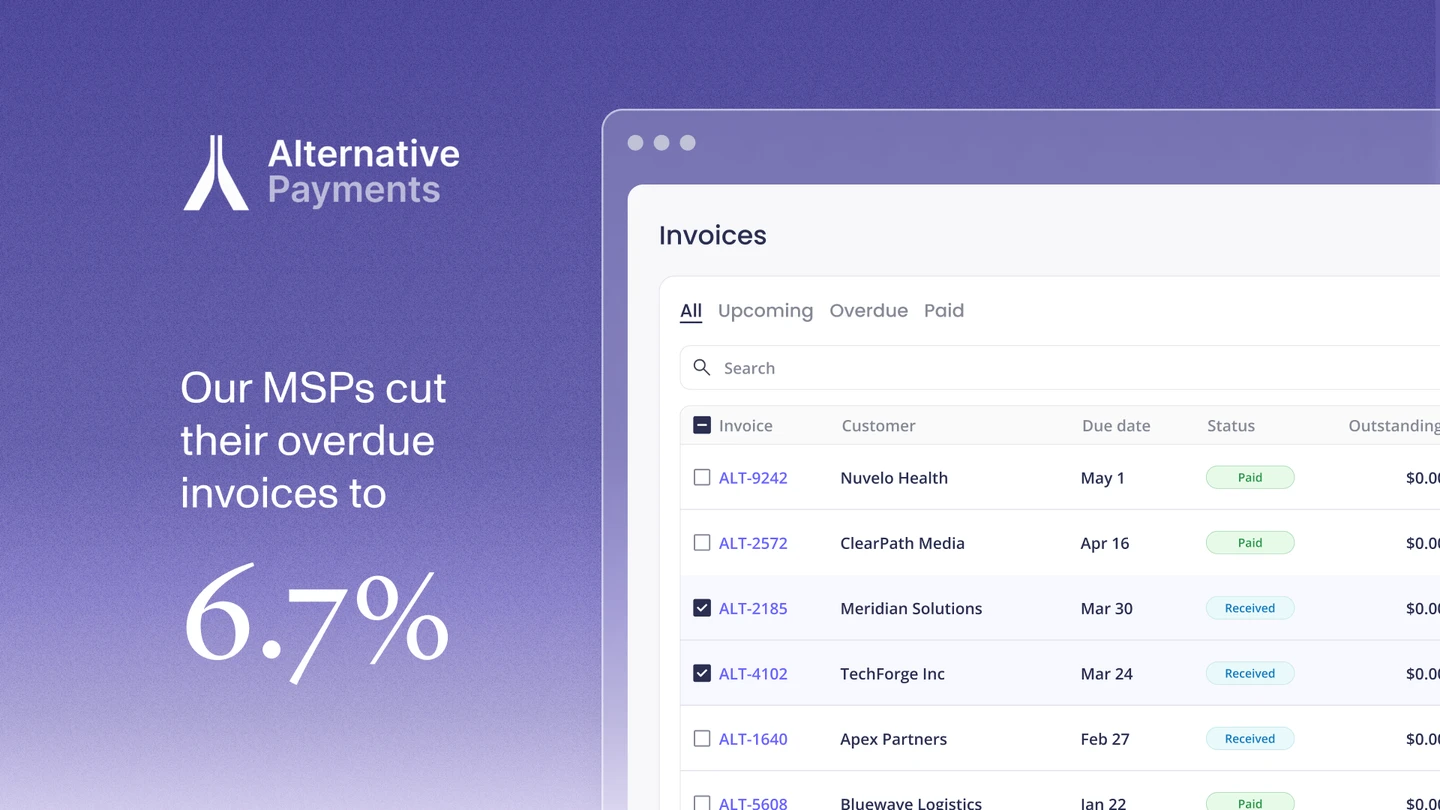
Alternative Payments is purpose-built for service businesses running on recurring revenue. It integrates natively with ConnectWise, Autotask, HaloPSA, and SuperOps on the PSA side, and with QuickBooks and Xero on the accounting side, so both sides of the sync are handled in one platform. Internal data from Alternative Payments shows MSPs on the platform have only 6.7% of invoices overdue, compared to 20.5% for MSPs using traditional methods, a reduction of more than two-thirds.
Generic Processors vs. Purpose-Built Platforms
If your current processor treats invoices like one-off ecommerce transactions, you are leaving efficiency on the table. The distinction comes down to four things:
- Contract awareness. A purpose-built platform reads contract logic from the PSA (recurring, per-device, tiered, hybrid) rather than treating each invoice as a standalone event.
- Lifecycle management. It manages issuance through reporting, not just the moment of payment.
- Accounting integration. It posts reconciliation to the GL automatically, with no manual export.
- AR visibility. It surfaces DSO, exception rates, on-time payment ratios, and aging, the metrics that actually drive decisions.
The MSP market is large and still growing, from USD 312 billion in 2023 to a projected USD 658 billion by 2030, a CAGR of 11.4%, according to Aventis Advisors. As an MSP scales from 20 clients to 200, manual billing stops working. The platforms that win are the ones built for how MSPs actually bill.
How Alternative Payments Connects the Stack
We built Alternative Payments to close the loop between the PSA and the GL, so finance stops being a monthly fire drill. Here is what the platform delivers, paired with the outcome each capability produces:
- Native PSA integrations: two-way sync with ConnectWise, Autotask, HaloPSA, and SuperOps eliminates manual imports and mismatched records.
- Automated reconciliation: every payment maps to the right invoice and posts to QuickBooks or Xero automatically.
- Client-facing financing: offer ACH, credit cards, and installments or B2B buy now pay later in one branded checkout.
- White-label checkouts: deliver a payment experience that carries your brand and reduces friction.
- Collections Assist:** automate follow-up on overdue invoices, even on receivables clients are refusing to pay.
- Reporting and visibility: track DSO, exception rates, and on-time payment ratios in one view.
The platform serves recurring revenue businesses (MSPs, telecom providers, and accounting firms) across the U.S. and Canada. If you want to see how the PSA-to-GL workflow maps to your stack, book a demo with our team and we will walk through it with your systems in mind.
Frequently Asked Questions
How do MSPs automate invoice collection from clients?
The PSA generates the invoice, and a connected payment platform handles the rest: it pulls the invoice, sends automated reminders, collects payment by ACH, card, or financing through a branded checkout, and reconciles the payment back to accounting. Auto-pay on stored payment methods collects most invoices on schedule without anyone sending an email. For a full breakdown, read our complete guide to PSA-integrated billing.
Can something automate reconciling payments with my PSA?
Yes. A platform with native two-way PSA sync posts each payment back to the invoice it covers and reconciles it to QuickBooks or Xero automatically, with no spreadsheets or line-by-line matching. The key is native integration rather than a bolt-on connector that imports totals without line-item detail. See how PSA integration removes manual reconciliation.
How is Alternative Payments different from BILL (Bill.com) for MSP billing?
BILL is a general AP/AR tool built around accounting software and standard net terms. Alternative Payments is purpose-built for MSP billing: it integrates natively with ConnectWise, Autotask, HaloPSA, and SuperOps, supports recurring, per-device, tiered, and hybrid models, and reconciles across the full PSA-to-GL lifecycle rather than to accounting alone.
What is the best MSP billing software that integrates with Autotask or ConnectWise?
Prioritize native two-way PSA sync, auto-pay with retry logic, automatic GL reconciliation, multiple payment methods in one checkout, and a branded client portal. Alternative Payments delivers all five with native ConnectWise and Autotask integrations and connections to QuickBooks and Xero.
How do managed service providers handle payment processing and invoicing?
Most run on a five-stage lifecycle: issuance in the PSA, automated communication, collection across ACH, card, and financing, automatic reconciliation to accounting, and reporting on AR health. The platforms that work best for MSPs unify all five stages so data flows from PSA to GL without manual handoffs. For the fundamentals, read MSP Payments 101.
Simplify your customer payments, unlock instant cash flow
Keep reading


ConnectWise QuickBooks integration: what a complete payment workflow should cover

NetSuite payment gateways: an enterprise MSP buyer's framework