•
Automate Accounts Receivable
•
Accounting
•
IT Services
•
Collections
•
Reduce DSO
•
Set Up Subscription Billing
May 28, 2026
Unified B2B Payment Automation: How One Platform Replaces Fragmented Billing Workflows
Most service businesses run their billing across three or more disconnected systems, and the gaps between them turn into hours of manual work every month. The full picture of B2B payment automation, from invoice to reconciled deposit, covers more ground than most platform comparisons acknowledge.
This guide maps the categories clearly, names the tools that dominate each, and explains where the lines between them blur in practice. If you are evaluating payment infrastructure for an MSP, accounting firm, or other recurring-revenue service business, the goal is to help you build a stack that closes the gaps rather than creates new ones.
What "B2B Payment Automation" Actually Covers
B2B payment automation is not one thing. It is a chain of steps that each requires its own tooling, and confusion about which category does what leads to stacks that still have manual gaps in the middle.
The full chain looks like this:
- Invoice generation — creating and sending bills based on contract terms, time tracked, or milestone completion
- Invoice delivery and communication — delivering invoices to the right contact and following up on overdue balances
- Payment collection — accepting ACH, card, or check; managing stored payment methods; running auto pay
- Reconciliation — matching payments to invoices and posting entries to accounting
- Reporting — surfacing DSO, collection rates, and aging AR
Most tools do one or two of these steps well. The platform that does all five and connects natively to your PSA and accounting software is the one that actually eliminates the manual work.
Core Categories and the Tools That Lead Each
Here is a clear category breakdown with the dominant platforms in each space as of 2025.
PSA Platforms: Where Invoicing Starts for MSPs
ConnectWise and Autotask (Kaseya) are the two dominant PSA platforms for small to medium MSPs. Both handle contract management, ticketing, time tracking, and invoice generation. Neither handles payment collection, automated reminders, or reconciliation natively.
HaloPSA has grown as a third option, particularly for UK-based MSPs and firms looking for a more flexible data model. It integrates with accounting tools and payment platforms but, like ConnectWise and Autotask, stops at invoice creation.
Syncro and Atera combine PSA and RMM functionality for smaller MSPs. They include basic invoicing but limited payment automation, making them better fits for operations that do not yet need full billing lifecycle management.
Accounting Software: The GL and Reconciliation Layer
QuickBooks Online and Xero are the two most widely used accounting platforms among MSPs and service firms. Both accept payments through their native payment tools and offer some reconciliation capability, but both stop short of the automated AR follow-up and PSA-native integration that growing service businesses need.
Sage Intacct and NetSuite serve the mid-market and enterprise segments. They offer stronger GL and financial reporting but are priced for organizations with dedicated finance teams and typically require integrators to connect them to PSA and payment tools.
Payment Processing: Collection, ACH, and Card Acceptance
Stripe, Square, and PayPal are the most widely known processors. All three handle card acceptance well and offer developer-friendly APIs. None of them natively integrates with ConnectWise or Autotask, which means payment status updates back to the PSA require middleware or manual entry. Reconciliation back to QuickBooks is partial at best.
Stripe, in particular, is a strong fit for product companies and marketplaces. Its contract-awareness is limited, which creates friction for MSPs billing complex recurring agreements with per-seat adjustments.
Accounts Receivable Automation: The Collections and Reminder Layer
Gaviti, YayPay (now part of Quadient), and Upflow are purpose-built AR automation tools. They handle dunning, payment reminders, aging dashboards, and collector workflows. They are designed for finance teams managing high invoice volumes, often in manufacturing, wholesale, or SaaS contexts.
For MSPs and service firms, these tools typically require integration with the PSA and accounting software to pull invoice data, which reintroduces the gap they are trying to close.
Purpose-Built MSP and Service Business Payment Platforms
This is the category that closes the full chain. Platforms in this space integrate natively with PSA tools, handle payment collection via ACH and card, automate reminders and follow-up, and reconcile every payment back to QuickBooks or Xero without manual matching.
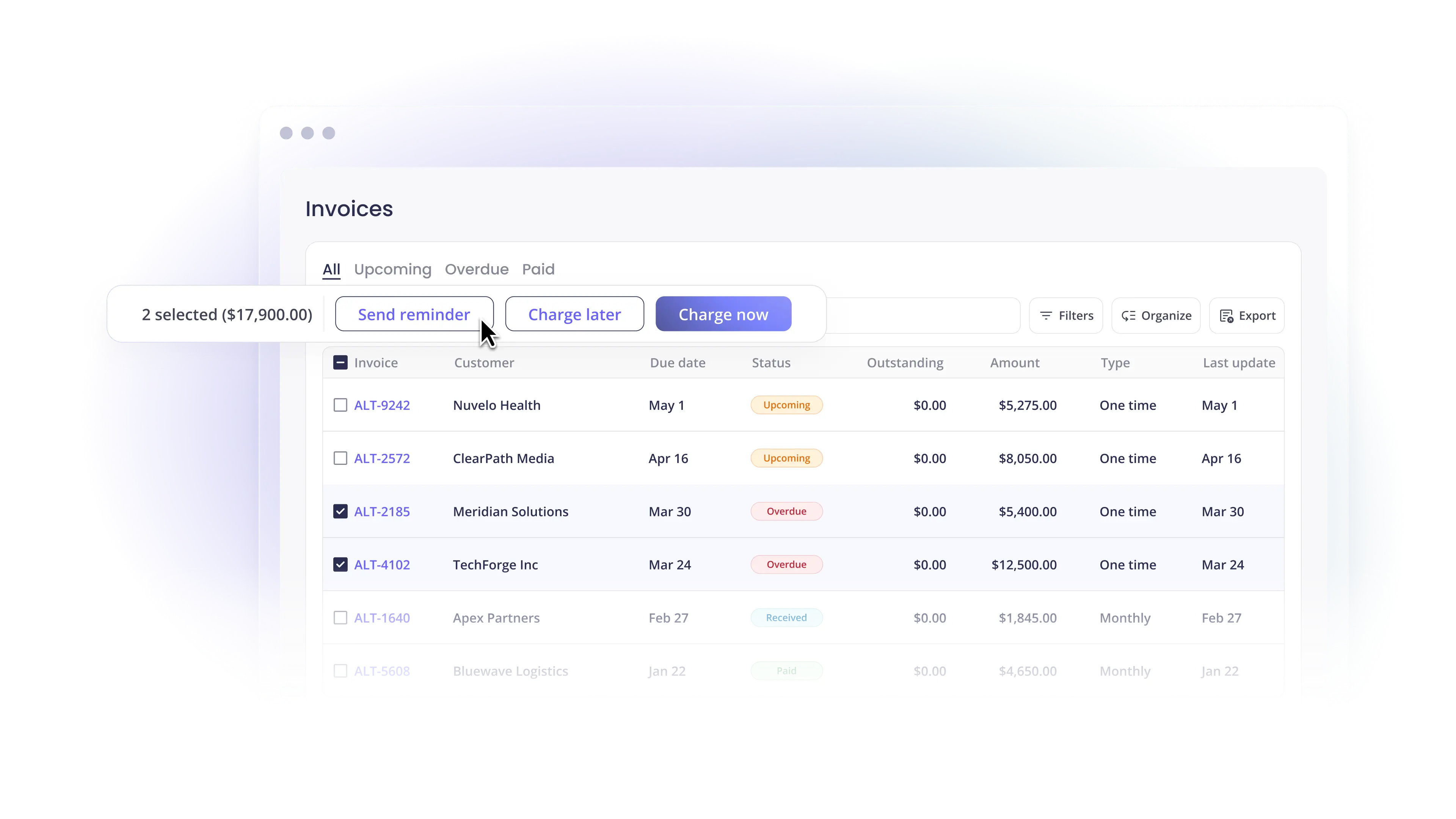
Alternative Payments sits in this category. It connects natively with ConnectWise, Autotask, HaloPSA, QuickBooks Online, QuickBooks Desktop, and Xero. It handles ACH with no per-transaction fee, card with built-in surcharging, client-facing financing including installments and B2B BNPL, and Collections Assist for automated AR follow-up. Every payment maps to the originating invoice and reconciles automatically. Pricing is a flat monthly fee, which makes cost predictable regardless of invoice volume.
ConnectBooster (now owned by Kaseya) serves a similar function for MSPs inside the Kaseya ecosystem. It integrates with ConnectWise and Autotask and offers a client portal and automated reminders. It does not currently integrate with HaloPSA or Xero, and its per-transaction ACH fee structure means costs scale with volume.
Where the Lines Blur in Practice
The categories above are clean in theory. In practice, several overlaps create confusion during evaluation.
PSA + payment bolt-ons. Some PSA vendors have added payment acceptance directly. ConnectWise Pay and Autotask's payment options are examples. These work for basic card acceptance but stop short of automated reminders, ACH without fees, and full reconciliation. They reduce the number of vendors but do not replace a purpose-built payment platform.
Accounting software + payments. QuickBooks Payments and Xero's native payment tools accept payments and handle some reconciliation. They do not connect natively to PSA tools, do not automate dunning across large client books, and do not support client-facing financing. They are a starting point for small firms but create gaps as billing volume grows.
AR automation + payment processing. Tools like Gaviti and Upflow are adding payment acceptance to their AR automation capabilities. This is a legitimate convergence, but most implementations still require a separate integration to pull invoice data from PSA tools, which leaves the first half of the chain (invoice creation to payment platform) as a manual or middleware-dependent step.
How to Evaluate Without Getting Lost in the Category Map
The cleanest way to evaluate payment infrastructure for a service business is to start from the full billing lifecycle and ask where each proposed tool covers which step.
Five questions cut through most evaluations:
- Does the platform connect natively to my PSA, or does it require middleware?
- Does it reconcile back to QuickBooks or Xero at the invoice level, not just the deposit level?
- Does it support ACH without a per-transaction fee?
- Does it include automated AR follow-up across all client accounts, or do reminders require manual initiation?
- Does the client-facing checkout carry my brand, or the processor's?
If a platform cannot answer yes to all five, it is covering part of the lifecycle and leaving the rest to manual work or additional tooling. For a clear comparison of purpose-built MSP platforms versus generic processors, see our breakdown of generic versus MSP-specific payment processors.
Putting the Stack Together
For most MSPs and service firms, the stack that covers the full billing lifecycle without manual gaps looks like this:
- PSA (ConnectWise, Autotask, HaloPSA) for contract management and invoice generation
- Purpose-built payment platform (Alternative Payments) for collection, reminders, and reconciliation
- Accounting software (QuickBooks Online, Xero) as the GL source of truth
The payment platform sits in the middle and connects the other two natively. Invoices flow in from the PSA. Payments flow out to clients through a branded portal. Settlement data flows back to accounting automatically. The result is a billing stack where the manual steps disappear and the finance team spends their time on exceptions, not routine reconciliation.
Book a demo to see how Alternative Payments connects to your specific PSA and accounting stack.
Simplify your customer payments, unlock instant cash flow
Keep reading


Can AI financial analysis explain why your margins changed?

Autotask QuickBooks integration: choosing a billing and payment operating model