•
Automate Accounts Receivable
•
Reduce DSO
•
IT Services
•
Mid-market
•
Security
August 7, 2026
Online Payment Adoption
By Baxter Lanius, Founder & CEO, Alternative Payments
The work is done. This month’s invoices went out three weeks ago. This morning, someone on your team is drafting another just-checking-in email to a client you’ll be invoicing again next month anyway. That isn’t a client problem. It’s cash you’ve already earned, sitting in someone else’s account, because paying you takes more steps than it should. The businesses that get paid fastest didn’t find better clients. They just took out the steps between the invoice and the payment.
The Delay Is the Distance Between Your Invoice and Their Payment
When a payment runs late, the reflex is to look at the client. Most of the time the client isn’t the variable. The number of steps between your invoice and their payment is.
Counting the steps makes the delay obvious. A mailed check takes five: open the mail, find the checkbook, write it, address the envelope, and get it to a mailbox. “Call us for the card details” takes four, and a saved method with a one-click portal takes one. Every step you leave in place is a day, sometimes a week, that you’ve quietly agreed to wait, and the client didn’t decide to pay late so much as the process decided for them.
Three Things Get Clients Paying Online
For a mid-market MSP, getting clients onto online payment comes down to three things, and not one of them is talking a client into behaving differently.
The first lever is method: let clients pay the way they pay everyone else, by card, bank transfer, or by splitting the invoice into installments when a client needs room. When the option they already use is sitting right there, the payment happens.
The second lever is timing: reminders that go out before the due date, on it, and after, on a schedule you set once, because the nudge that gets a client to pay is the one that lands while the invoice is still in front of them, not the one your team gets to on a slow Friday.
The third lever is familiarity: a portal in your branding, so paying you looks like paying you and not a detour to a site nobody recognizes, and once a method is on file each invoice can be charged automatically so the next one collects itself.
If you run an MSP, this is easy to miss. Recurring contracts keep your MRR looking healthy on the books, so the cash feels handled right until you notice how much of it is unpaid past 30 days. A method on file means each month’s invoice collects on its own instead of waiting on a person to chase it.
What Changes When They Actually Use It
When clients pay online and the reminders run on their own, three things change at once.
Cash arrives in days instead of weeks. The average business waits 35 days to collect, and our partners collect in 5. That gap is the whole story: about 30 days of cash that used to sit in someone else’s account, now in yours.
The follow-up work disappears. The average Accounts Receivable (AR) operator gets back 3+ hours a week once reminders and payment collection stop being manual, and partners report a 94% reduction in outstanding AR in the first year.
Your team stops being the bad cop. Nobody has to decide whether today is the day to chase a specific client, because the system already sent the note and the client already had a one-click way to act on it.
If you want the mechanics of how this pulls your whole collection timeline down, that’s the sister piece: Your DSO isn’t a number problem. It’s a process problem.
But My Clients Won’t Switch
The most common objection is that clients won’t change how they pay, but they already have. Your clients pay their software, their suppliers, and their utilities online, saved on file, on autopay. Pointing that same habit at you is close to the smallest ask there is. The switch cost is a familiar portal and a default method on file. And if the hesitation is about security, Alternative Payments is SOC 2 Type 2 certified and PCI-DSS Level 1 compliant, so payment details never sit anywhere they shouldn’t.
The Wait Is a Setting, Not a Fact
The wait on money you’ve earned feels like a fixed cost of doing business, but it’s really just a setting. It comes from the steps you’ve left between your invoice and a payment, and the reminders you’re still sending by hand. Take out the steps, let the reminders run, and the cash shows up when the work is done, which is when you earned it.
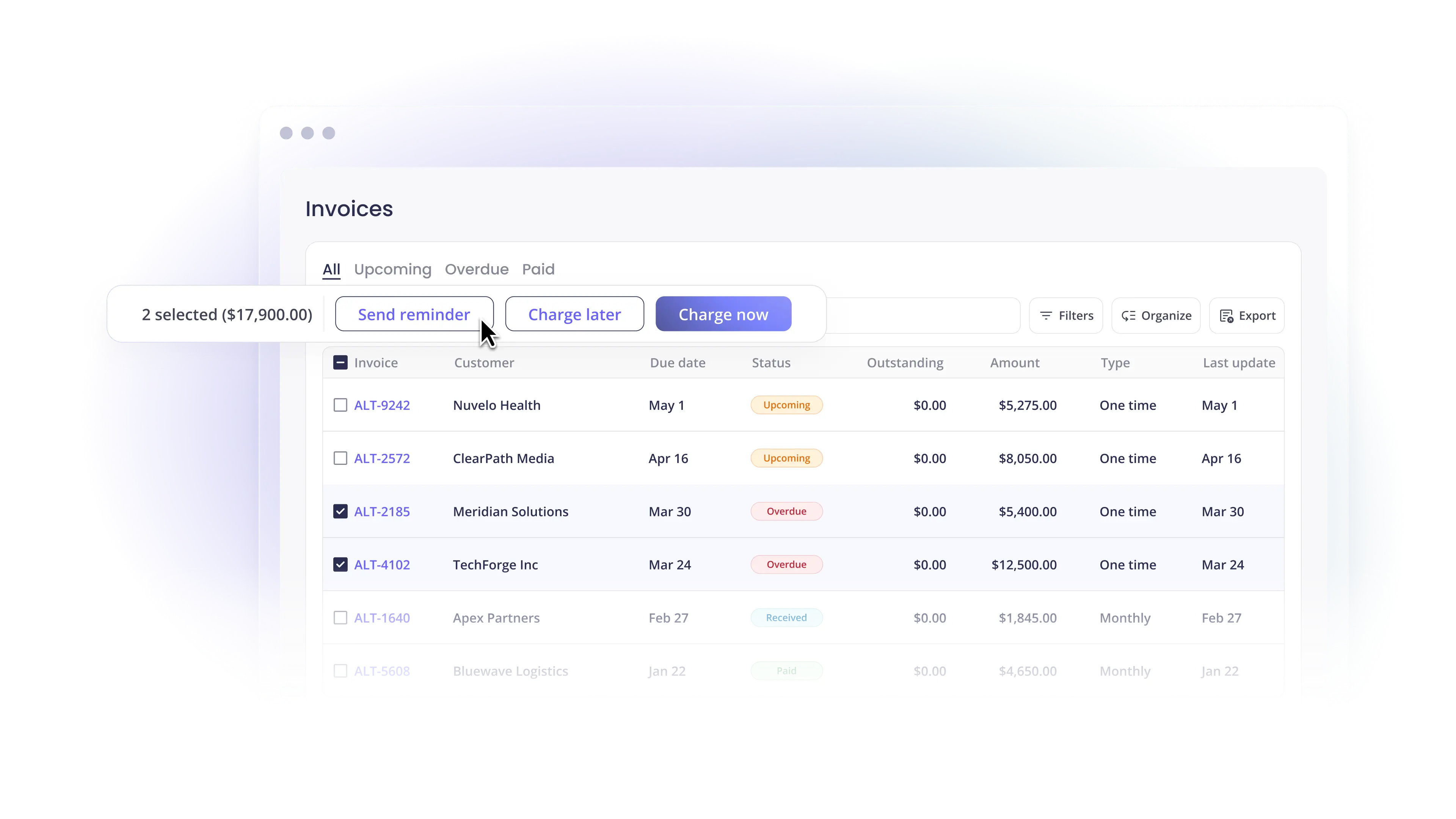
That is the work Alternative Payments does for you. It keeps a payment method on file for every client and charges it automatically on your schedule, sends every reminder before, on, and after the due date, and gives clients a portal in your branding where they can pay by card, bank transfer, or an installment plan that runs 30 to 150 days while you still receive the full amount upfront. For MSPs it runs on top of ConnectWise, Autotask, and HaloPSA, so invoices flow in and payment status flows back without anyone re-keying a thing.
See how AR automation gets clients paying on time.
Frequently Asked Questions
Will clients actually pay online if we offer it?
They already do it everywhere else. The businesses that see fast adoption make the online option the default and save a method on file, so paying takes one step instead of five. When the familiar option is right there, most clients take it.
Is it safe to store client payment methods?
Yes. Alternative Payments is SOC 2 Type 2 certified and PCI-DSS Level 1 compliant, and card details are stored to that standard rather than living in an inbox or on a sticky note.
How soon do payments actually speed up?
Setup to go-live runs two to four weeks. Once clients have a method on file and reminders are automated, the average partner moves from 35 days to collect down toward 5.
Baxter Lanius is the Founder & CEO of Alternative Payments, the payments and billing platform built for service businesses. Alternative Payments works with MSPs to solve the problem that never really goes away: getting paid for work they’ve already delivered.
Simplify your customer payments, unlock instant cash flow
Keep reading