•
Collections
•
Automate Accounts Receivable
•
Reduce DSO
•
Small Businesses
July 20, 2026
What to Do When a Client Pays Late

By Baxter Lanius, CEO and Founder of Alternative Payments
Most late payments are a process failure, not a client failure. Before you fire a late-paying client, run a simple diagnostic: if your invoices are hard to pay, reminders are inconsistent, and late payment carries no consequence, the process is the problem. If a client keeps paying late after the process is fixed, the client is the problem, and it is time to make a decision. This guide covers both paths.
Why Do Clients Actually Pay Late?
Late payment feels personal. It usually isn't. When you look at why invoices go unpaid past the due date, the same four reasons show up again and again.
The invoice is hard to pay. The email went to one person's inbox instead of the billing contact. There is no payment link, or the link leads to a page that asks for a login nobody remembers. Every extra step is a place for the payment to stall.
Nobody reminded them. Your client's inbox looks like yours. An invoice with no follow-up is not being ignored on purpose. It is buried under everything that arrived after it.
Late payment has no consequence. If paying you on day 45 feels exactly like paying you on day 5, some clients will drift to day 45. Not out of malice. Because nothing in the experience tells them the due date is real.
The client is in genuine trouble. Sometimes the money isn't there. This is the smallest group, but it is real, and it needs a different response than a reminder email.
Notice that three of the four reasons are on your side of the table. That is good news. You can fix your side this week.
Is It Your Process or Is It the Client?
Here is the diagnostic. Be honest with the left column before you act on the right one.
Signs it's your process:
- Multiple clients pay late, not just one
- Invoices go out on different days each month, or later than promised
- Reminders happen when someone remembers, not on a schedule
- There is no stated late fee, or there is one you have never applied
- Clients have to ask how to pay, or mail you a check because it is the easiest option you offer
Signs it's the client:
- Other clients pay on time through the same process
- They have broken two or more specific payment promises ("I'll send it Friday")
- They dispute invoices only after the work is delivered, never before
- They avoid the conversation entirely: no replies, no calls back
- The relationship costs more in chasing time than the contract is worth
If most of your checks landed in the first list, do not fire anyone yet. Fix the process first, then re-run this diagnostic in 60 days. Most "problem clients" disappear when the process stops giving everyone room to be one.
Fix the Process: The Escalation Ladder
The Escalation Ladder is a five-rung sequence for overdue invoices that moves from friendly reminder to final decision on a fixed schedule, so every unpaid invoice always has a defined next step.
The fixed schedule is the point. You are not deciding what to do about each unpaid invoice as it happens. You decided once, and now every invoice climbs the same rungs.
Rung 1: The Nudge (day 1 to 3 past due). A friendly email that assumes oversight, not avoidance. Re-attach the invoice and the payment link.
"Just a quick note that invoice #1234 came due on [date]. Here's the payment link in case it slipped through. Let me know if anything's off on our end."
Rung 2: The Check-In (day 7). A second email, still warm, but now it asks a direct question. A reply is a commitment, and a commitment is progress.
"Following up on invoice #1234, now a week past due. Is there anything holding this up that I can help resolve?"
Rung 3: The Direct Ask (day 14). Change the channel. A phone call, or a personal note from a real name instead of the billing address. Name the amount and the date. Offer a payment plan if there is a real problem, and state plainly what happens next if there isn't: the late fee applies, or work pauses, per your agreement.
Rung 4: The Consequence (day 21). Whatever you stated at rung 3 happens. The fee is applied, the work pauses, or the invoice goes to the client's decision-maker. This rung is where the ladder earns its credibility. Skip it once and you have taught the client that your deadlines are decorative.
Rung 5: The Decision (day 30+). The invoice gets one of four resolutions: a payment plan, a final demand, collections, or a write-off. Write-off is a decision you make at the top of the ladder, with full information. It is never a default you drift into.
Two rules make the ladder work. Every invoice enters rung 1 automatically the moment it is past due, no exceptions and no "they're probably good for it." And the timing never stretches because a client is friendly. Friendly clients get the same rung 1 email everyone gets. That is what keeps it from feeling personal, because it isn't.
What Does One Unpaid Invoice Actually Cost You?
Follow a single invoice to see what waiting really costs. Say you send a $2,500 invoice on the first of the month, due in 15 days.
The average small business waits 28.8 days to get paid, according to Xero Small Business Insights data drawn from more than 32,000 US businesses. Until it's paid, that invoice is not money. It is a promise sitting in a spreadsheet for a month while the payroll it was supposed to cover comes out of your pocket, the software renewal goes on a credit card, and the hire you planned waits another cycle.
Now multiply by every open invoice, because they are all aging at once. The cost of late payment is not the invoice amount. It is everything you could not do while you waited for it. We break down the full math in Hidden Leaks: Why Uncollected Fees Kill Growth.
On the Escalation Ladder, that same invoice gets a nudge on day 18, a check-in on day 22, and in most cases it is paid before rung 3 ever happens. The invoice resolves ahead of the 29-day average, before the typical business has been paid once.
When Is Firing a Late-Paying Client the Right Call?
A payment platform can fix your process. It cannot fix a client who has already decided they are not going to pay you.
If you've fixed your process, it may be time to fire a client if:
- They have hit rung 4 of the ladder on three or more invoices in a year
- They make payment promises and break them, specifically and repeatedly
- They dispute finished work as a negotiating tactic
- The math fails: chasing them costs more hours than the account earns
And exit cleanly. Finish the work you owe, collect what you can while you still have leverage, and put the ending in writing with a specific final date. Do not ghost them, and do not keep taking new work "one last time." A clean exit protects your reputation in a market where your clients talk to each other.
If they never hit those criteria, you do not have a client problem. You had a process problem, and you already fixed it.
Can the Escalation Ladder Run Itself?
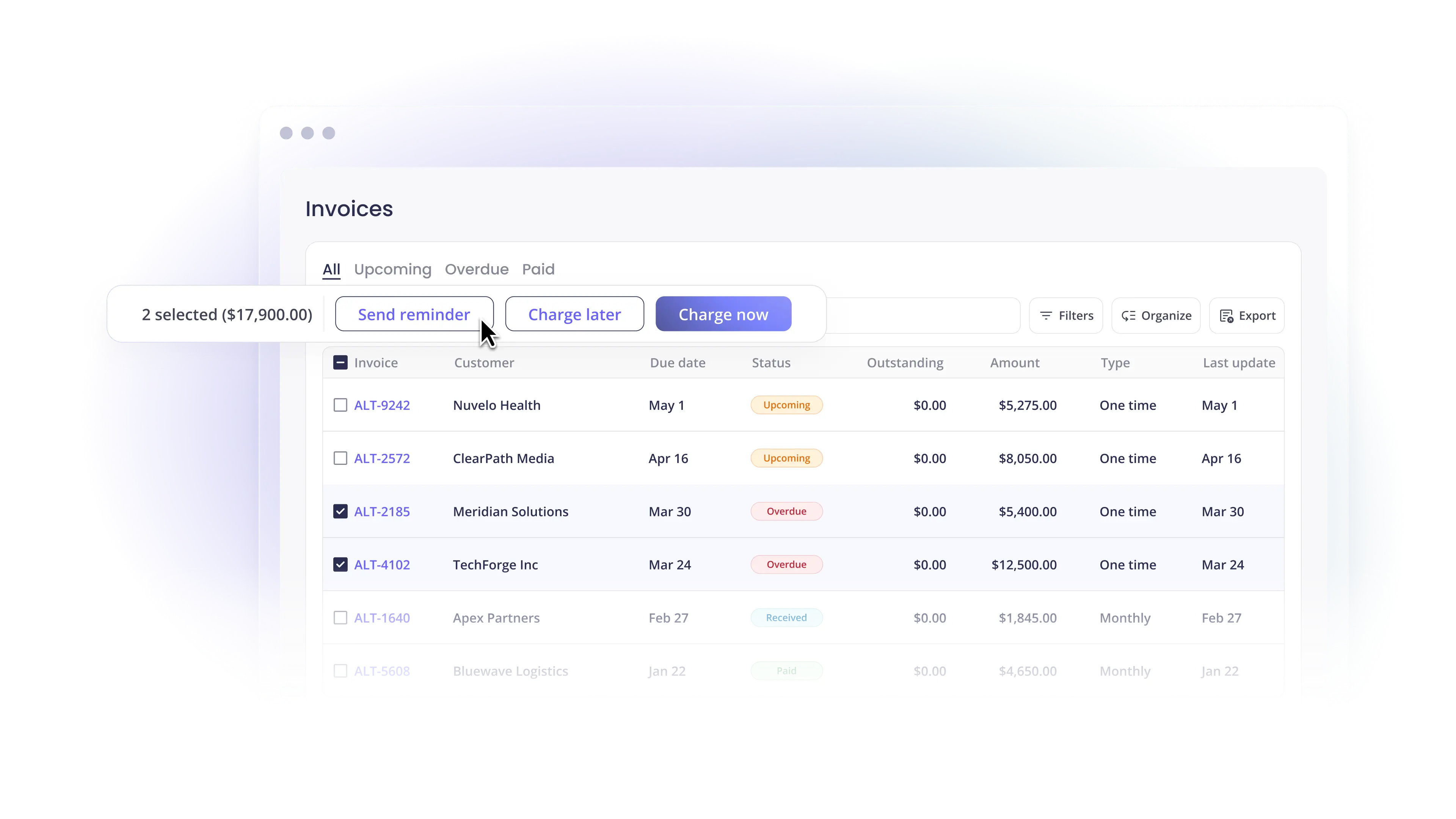
Rungs 1 through 3 should not involve a human at all. This is exactly what Alternative Payments' Collections Assist automates: reminders go out on your schedule with the invoice and payment link attached, every client gets the same cadence, and when an account does need rung 4 judgment, a real person on our team is there to work it with you rather than leaving you a dashboard and a wish of good luck. You set the ladder once. It climbs on its own.
Frequently Asked Questions
How long should I wait before following up on an unpaid invoice?
Three days. A short, friendly reminder on day 1 to 3 past due is expected and professional. Waiting two weeks to "not be pushy" just teaches clients the due date is soft.
Can I charge late fees on overdue invoices?
In most cases yes, if the fee is stated in your contract or engagement letter before the work starts. State it up front, apply it consistently, and check the rules where you operate. A fee you never apply is worse than no fee, because it proves your terms are negotiable.
Should I keep working while an invoice is unpaid?
Keep working through rungs 1 and 2, since most late payments are administrative. If an invoice reaches rung 3 or 4, pausing new work is reasonable and should already be stated in your terms. Announce it as policy, not punishment.
What do I say to a client who won't pay an invoice?
Be direct and specific: name the invoice, the amount, and the date, then ask one question. "Invoice #1234 for $2,500 is now 14 days past due. Is there a problem with the work, or with the payment?" That question splits disputes from delays, and each has a different next step.
When should I send an unpaid invoice to collections?
At rung 5, generally 60 to 90 days past due, after a final demand with a firm date has passed and the client has stopped engaging. Collections trades a percentage of the invoice for a chance at recovery, so exhaust the ladder first.
When should I just write off an unpaid invoice?
Later than you think. Write-off is the last rung of the ladder, not the next step after frustration. Stop Writing Off 30+ Day Invoices.
Baxter Lanius is the Founder & CEO of Alternative Payments, the payments and billing platform built for service businesses. He works with MSPs and accounting firms every day on one problem: getting paid for work they already did.
Simplify your customer payments, unlock instant cash flow
Keep reading


AI cash-flow forecasting: how business owners can test assumptions

Can AI financial analysis explain why your margins changed?