•
Accounting
•
Automate Accounts Receivable
•
Set Up Subscription Billing
•
Reduce DSO
•
Collections
July 22, 2026
Payment Platform for Accounting Firms That Also Works for Your Clients
If you run an accounting or CAS practice, you face a payment problem most software ignores: you need a tool that collects your own firm's recurring fees on time, and you want something you can confidently put in front of your clients' businesses. Most payment processors solve one of those needs and break the other. A payment platform for accounting firms should do both, because the workflow that keeps your retainers paid is the same workflow your clients struggle with every month.
This is the case for picking one purpose-built platform instead of stitching together a processor for your firm and a separate tool for each client. We build for contract-driven, recurring revenue, so the same system that maps a payment to the right invoice in your books does it in your clients' books too.
Why Accounting Firms Need a Payment Platform Built for Recurring Billing
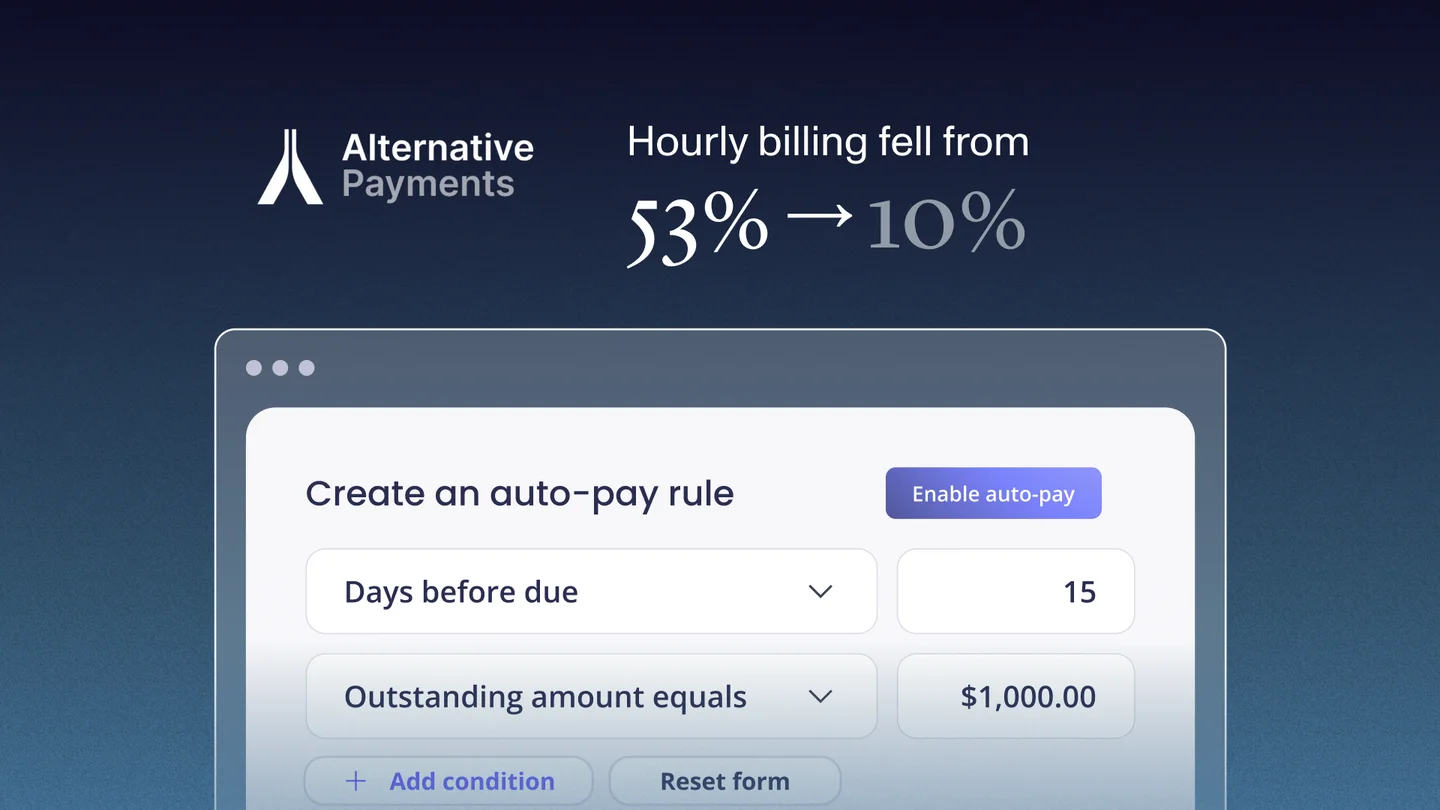
Accounting firms have shifted to recurring fees, and generic processors never caught up. In 2018, 53% of CAS practices used hourly billing as their primary pricing method. By 2024, that figure had dropped to 10%, with 84% of respondents shifting to fixed-fee billing payable on a monthly, quarterly, or annual basis, according to the 2024 CPA.com and AICPA PCPS CAS Benchmark Survey.
Recurring fees should mean predictable cash flow. For many firms they do not, because the tools collecting those fees were built for one-off transactions. A typical firm runs QuickBooks Online for accounting, a separate processor like Stripe for cards, bank feeds for matching, and email for follow-ups. Each tool works alone. Together they create fragmented data, manual reconciliation, and no single view of what is owed, paid, or overdue.
The friction is not unique to accounting. Across U.S. business, 55% of B2B invoiced sales are overdue, according to data compiled by The Kaplan Group. When you advise clients on their finances while chasing your own invoices by hand, the credibility gap is hard to ignore.
What "Works for My Clients' Businesses" Actually Requires
A platform that serves both your firm and your clients has to respect contract logic, not just accept a card. Generic processors treat every charge as a standalone sale. Purpose-built platforms maintain the contract context that recurring billing depends on.
Here is the difference in practice:
When you extend the platform to a client's business, every one of these rows matters again. Your client also has recurring invoices, also needs payments matched to the General Ledger (GL), and also wants a checkout that carries their brand. A tool that solves these problems for your firm solves them for theirs.
The Five Stages of a Payment Lifecycle Your Tool Should Automate
The cleanest way to evaluate any payment platform is to follow a single invoice through its full lifecycle: issuance, communication, collection, reconciliation, and reporting. A tool built for accounting firms automates every stage. A duct-taped stack breaks at the handoffs.
Issuance
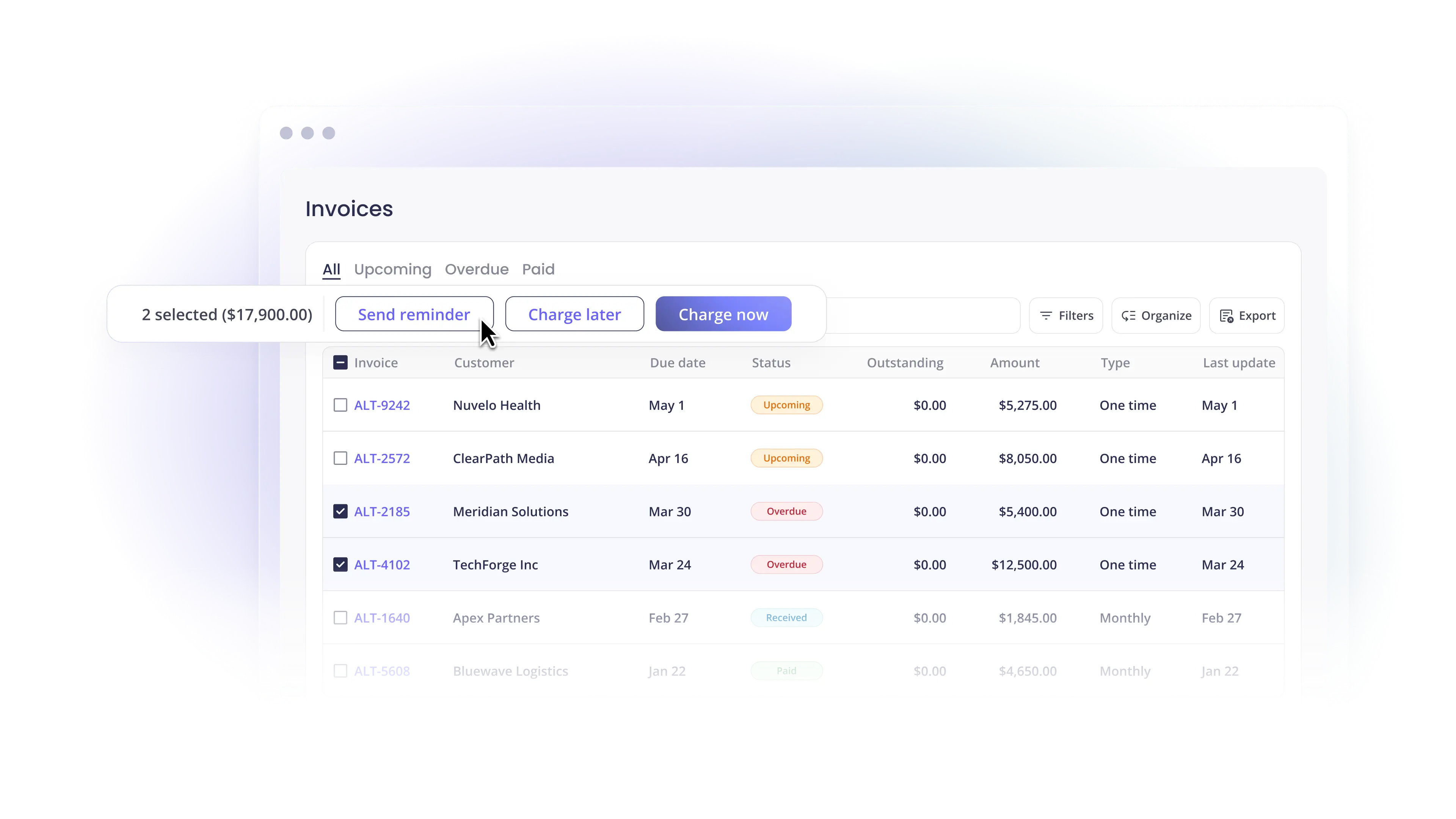
Your clients pay on a schedule, so your platform should bill on that schedule without anyone creating each invoice by hand. Look for auto-pay enrollment, configurable billing rules, and support for prorated charges, credits, and adjustments inside one system.
Communication
Automated reminders go out before the due date, on the due date, and at intervals you set afterward. Each message carries the invoice details, the amount owed, and a direct link to pay. Consistent, traceable reminders end the "I never got the invoice" excuse.
Collection
Clients enroll through a white-label checkout that looks like your firm, then choose Automated Clearing House (ACH) transfer or credit card. The platform charges the stored method on the due date automatically. For firms that bill on retainers, ACH should be the default: it costs less to process and settles predictably.
Reconciliation
This is where most billing workflows quietly break. A client pays, the payment lands in a clearing account, and someone matches it to the right invoice, applies the correct GL code, and confirms the posting. A purpose-built platform maps each payment to the exact invoice, posts the GL entry, and updates the balance in real time. No CSV exports, no manual matching at month end.
Reporting
You see Days Sales Outstanding (DSO), on-time payment ratios, overdue balances, and exception rates in one dashboard instead of pulling reports from three tools. For a firm managing dozens of client books, that single view is the difference between reacting to aging receivables and getting ahead of them.
Extending the Platform to Your Clients' Businesses
The dual-use case is where a purpose-built platform earns its place in your firm. Once you run Alternative Payments for your own AR, the same workflow becomes a service you can offer clients who struggle with collections.
Your clients get the white-label checkout, auto-pay, automated reminders, and clean reconciliation that you already trust. You get visibility into their AR health alongside your own, which strengthens the advisory work you already do. Instead of telling a client their cash flow is slow, you can show them the DSO trend and fix the collection workflow that caused it.
Client-facing financing extends the value further. You can offer your clients' customers installments, ACH, credit cards, and B2B buy now pay later (BNPL) in one flow, so a large invoice does not stall because the payer needs time. That flexibility speeds time-to-pay without putting your client's cash flow at risk.
Why Generic Processors Fall Short for Accounting Firms
Generic processors like Stripe and QuickBooks Payments handle simple payment acceptance well. They were not designed for contract-driven, recurring revenue, where billing logic, client communication, and reconciliation need to work as one connected system.
The gaps show up at scale. QuickBooks Online limits automated reminders to three per invoice, with no ability to exclude specific customers or escalate messaging based on aging. For a firm managing 50 or more clients on recurring retainers, three fixed reminders do not replace a real collections workflow. Surcharging has no built-in automation in QuickBooks, so the firm either absorbs 2 to 3% on every card transaction or manually adds a line item to each invoice. Reconciliation between bank feeds and individual invoices still needs manual review on every batch.
The results of closing those gaps are traceable. Service firms on Alternative Payments reduce overdue invoices from 20.5% to 6.7%, according to Alternative Payments platform data. S1 Technology, an MSP that switched from a generic processor, cut collection times by 70% and reached 90% customer adoption within three months. Heiden Technology reported collection times 29 days faster than the industry average after automating billing through the platform.
Choosing a Payment Platform for Your Accounting Firm
The right payment platform for accounting firms meets four standards that general-purpose tools usually miss:
- Deep accounting integration: payments post back to QuickBooks or Xero automatically, invoice status updates in real time, and no one matches transactions by hand at month end.
- Recurring billing without manual invoicing: auto-pay enrollment, configurable rules, and support for proration, credits, and adjustments in one system.
- A branded client experience: a white-label checkout and self-service portal that looks like your firm, not a third-party processor.
- One platform that extends to clients: the same collection, reconciliation, and financing workflow you can confidently put in front of your clients' businesses.
Pick the platform that runs the full lifecycle, and you stop being the glue between four disconnected tools. Your firm's receivables get cleaner, your month-end close gets faster, and you gain a payment workflow worth recommending to the clients who trust your advice.
Ready to see how one platform handles your firm's AR and your clients' billing? Book a demo and we will map it to your stack.
FAQs
What is the best payment platform for an accounting firm that also serves clients?
The best fit is a platform built for contract-driven, recurring billing rather than one-off transactions, because that workflow applies to both your firm and your clients. Look for native QuickBooks or Xero reconciliation, auto-pay, white-label checkout, and the ability to extend the same system to your clients' businesses. Alternative Payments is built for U.S. and Canadian service firms running recurring revenue, including accounting and CAS practices.
Can a payment platform handle recurring billing without manual invoicing?
Yes. A purpose-built platform runs recurring billing on the schedule your clients are on, charging stored payment methods automatically through auto-pay enrollment. You set the billing rules once, including proration and adjustments, and the system issues, collects, and reconciles each cycle without anyone creating invoices by hand.
How does auto-pay help if my clients never pay on time?
Auto-pay charges the client's stored ACH or card on the due date, so collection no longer depends on the client remembering to act. Combined with automated reminders before and after the due date, it removes the manual follow-up that lets accounts slip. Firms on Alternative Payments see more than 50% fewer overdue invoices as a result.
Why not just use QuickBooks Payments or Stripe?
QuickBooks Payments and Stripe handle simple payment acceptance well, but they treat each invoice as a standalone sale and leave reconciliation, reminder limits, and surcharging as manual problems. For a firm managing dozens of recurring client books, those gaps compound at scale. A purpose-built platform automates the full lifecycle from issuance to reporting and keeps your PSA, payments, and accounting in sync.
Is Alternative Payments available for firms outside the U.S.?
Alternative Payments serves service-based businesses with recurring revenue models in the United States and Canada. That includes accounting firms, CAS practices, managed service providers, and telecom businesses. If your firm operates in those regions and bills on recurring terms, the platform is designed for your workflow.
Simplify your customer payments, unlock instant cash flow
Keep reading

AP Automation Software for Mid-Market Service Companies: What to Automate First