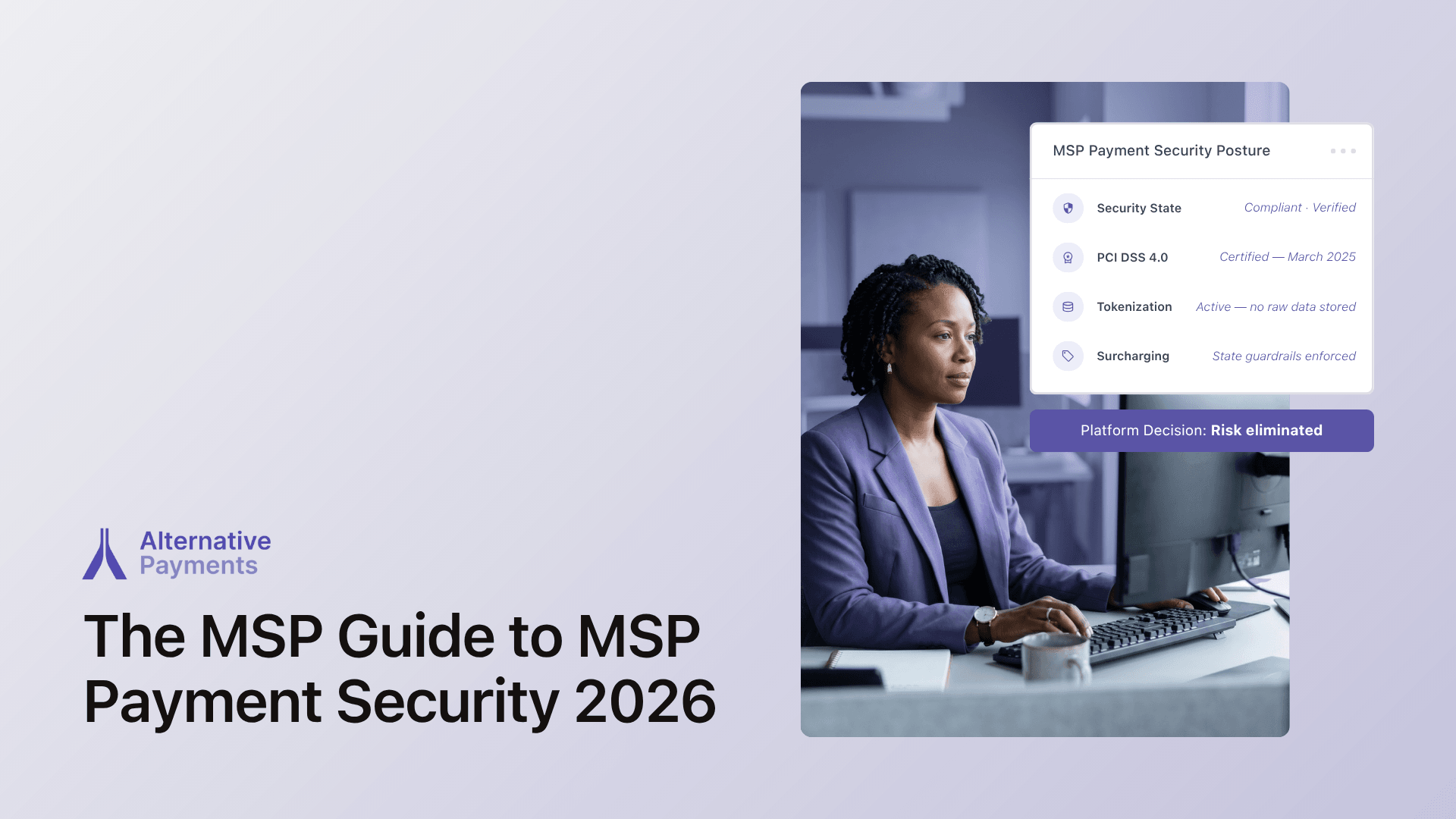
MSP Payment Security: What It Covers and Why It Matters in 2026
MSP payment security is the set of technical, compliance, and operational controls that govern how MSPs collect, store, and transmit payment data from their clients. It covers PCI DSS compliance, ACH fraud prevention, payment tokenization, surcharging compliance, and the security posture of any third party payment platform integrated into the MSP billing stack.
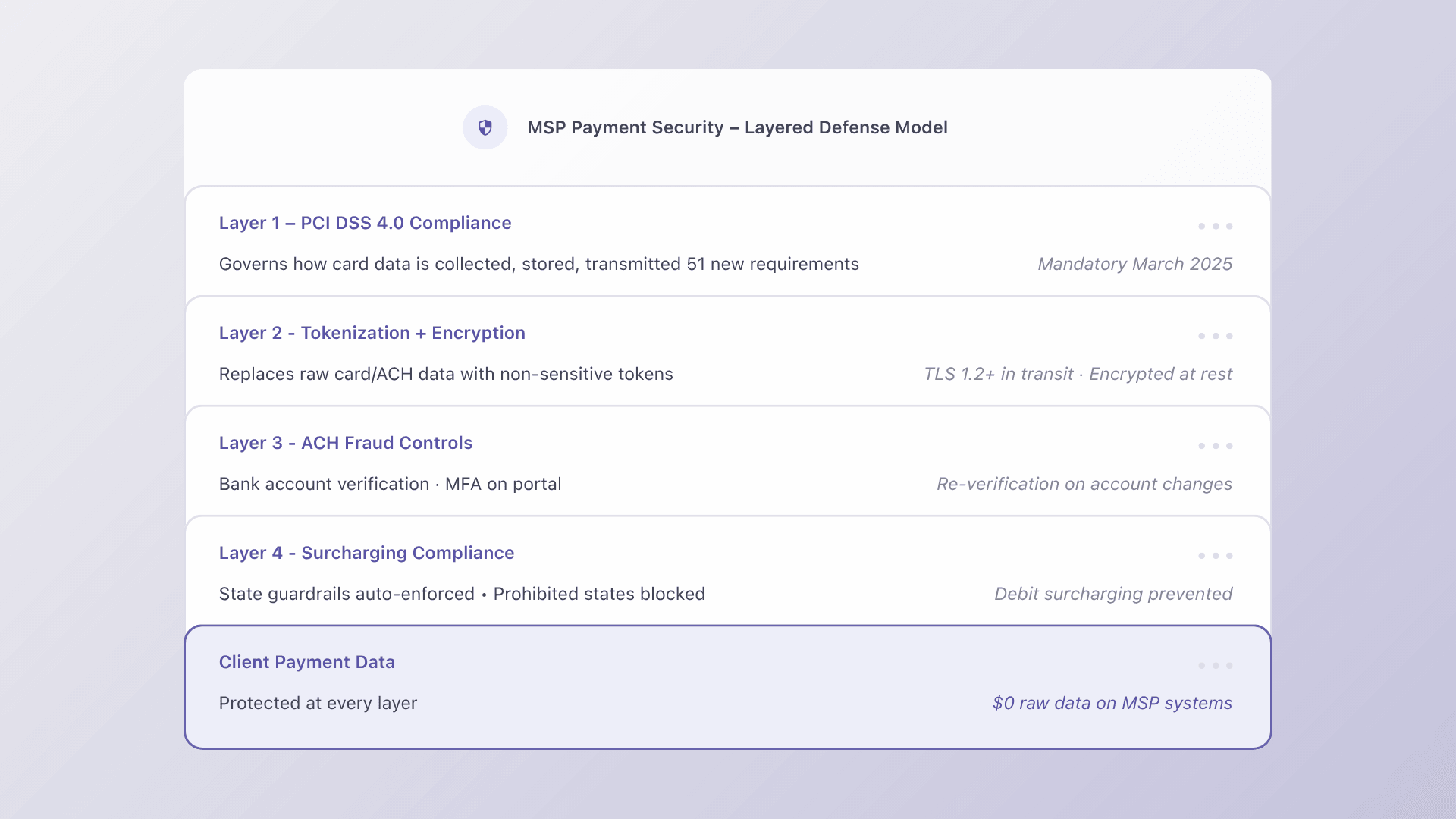
In 2026, MSP payment security is not optional. PCI DSS version 4.0 became fully mandatory in March 2025, introducing 51 new requirements on top of the existing framework. Any MSP collecting card payments, processing ACH transactions, or using a third party payment platform that touches client financial data is in scope and must meet these requirements or face fines, card network penalties, and reputational exposure.
Organizations with an anti-fraud policy experience 50% lower median losses per fraud incident ($100,000) than organizations without one ($200,000), according to the ACFE 2024 Report to the Nations. For MSPs, that statistic has a direct operational implication: the payment platform you choose, and how it is configured, is a security decision as much as a billing one.
PCI DSS 4.0 Compliance: What MSPs Need to Know
PCI DSS 4.0 is the current Payment Card Industry Data Security Standard, mandatory as of March 31, 2025. It replaced version 3.2.1 and introduced stronger authentication requirements, continuous security monitoring, and tighter controls around third party scripts and client side payment pages.
For MSPs that collect card payments directly from clients, PCI DSS compliance is a regulatory requirement. The scope of compliance depends on how card data is handled. MSPs that route clients through a hosted payment page or white label checkout managed by a compliant payment processor significantly reduce their PCI scope, since cardholder data never touches MSP systems directly.
Despite the mandatory nature of PCI DSS, compliance rates remain low. According to Help Net Security (2025), only approximately 32% of organizations met all PCI DSS requirements as of the most recent industry reporting period. For MSPs, this gap represents both a risk and a competitive differentiator: firms that can demonstrate full PCI compliance to enterprise clients are in a stronger position than those that cannot.
The practical path to PCI DSS compliance for most MSPs is choosing a payment platform that is already PCI DSS 4.0 certified and handles cardholder data entirely within its own environment. Alternative Payments operates as a PCI DSS compliant processor, which means MSPs using the platform for client billing do not need to build and maintain their own compliance infrastructure for card data handling.
Tokenization, Encryption, and ACH Fraud Prevention for MSPs
Tokenization
Tokenization replaces sensitive payment data (card numbers, bank account details) with a non-sensitive token that has no value outside the specific payment system that generated it. For MSPs managing recurring billing with stored payment methods, tokenization is the primary security control that protects client payment credentials at rest.
When an MSP uses a payment platform that tokenizes stored payment methods, client card numbers and ACH account details are never stored on MSP systems or servers. The token references the credential in the payment platform’s secure vault. This eliminates the MSP’s exposure if their own systems are compromised, since there is no payment data for an attacker to extract.
ACH Fraud Prevention
ACH fraud is a growing risk for B2B payment operations. Common attack vectors include account takeover, where fraudsters use compromised credentials to redirect ACH payments; business email compromise, where fraudsters impersonate clients to change bank account details; and unauthorized ACH debits initiated against client accounts.
MSP payment security for ACH workflows requires: verified bank account enrollment with micro-deposit validation or instant bank verification, multi-factor authentication on client portal access, monitoring for unusual payment method changes, and a clear process for handling ACH returns and reversals. Platforms that allow clients to change bank account details without re-verification are a common source of ACH fraud exposure.
Encryption in Transit and at Rest
All payment data transmitted between the client, the payment platform, and the MSP’s billing systems should be encrypted in transit using TLS 1.2 or higher. Payment data stored within the platform (tokens, transaction records, audit logs) should be encrypted at rest. When evaluating a payment platform, confirm that both standards are met and documented in the platform’s security documentation.
Surcharging Compliance as an MSP Payment Security Issue
Surcharging, passing credit card processing fees to clients, is a compliance area that most MSPs treat as a billing decision rather than a security or legal one. That framing is incomplete. Surcharging is regulated at both the state level and by card network rules, and non-compliant surcharging exposes MSPs to fines, chargebacks, and card network penalties.
The key compliance requirements for surcharging in 2026 are: surcharging is prohibited in Connecticut, Maine, Massachusetts, and California; fees must not exceed the MSP’s actual cost of card acceptance, capped at 3% for Visa and 4% for Mastercard; the surcharge must be disclosed to the client before the transaction is completed; and debit card surcharging is prohibited in all 50 states under federal law.
MSPs that implement surcharging manually, by adding a line item to invoices without platform support, are the most likely to face compliance exposure. A payment platform with built in surcharging compliance enforces these rules automatically by transaction type and client billing state, removing the compliance burden from the MSP’s internal team. Alternative Payments includes surcharging with state level guardrails built in.
How to Evaluate a Payment Platform for MSP Payment Security
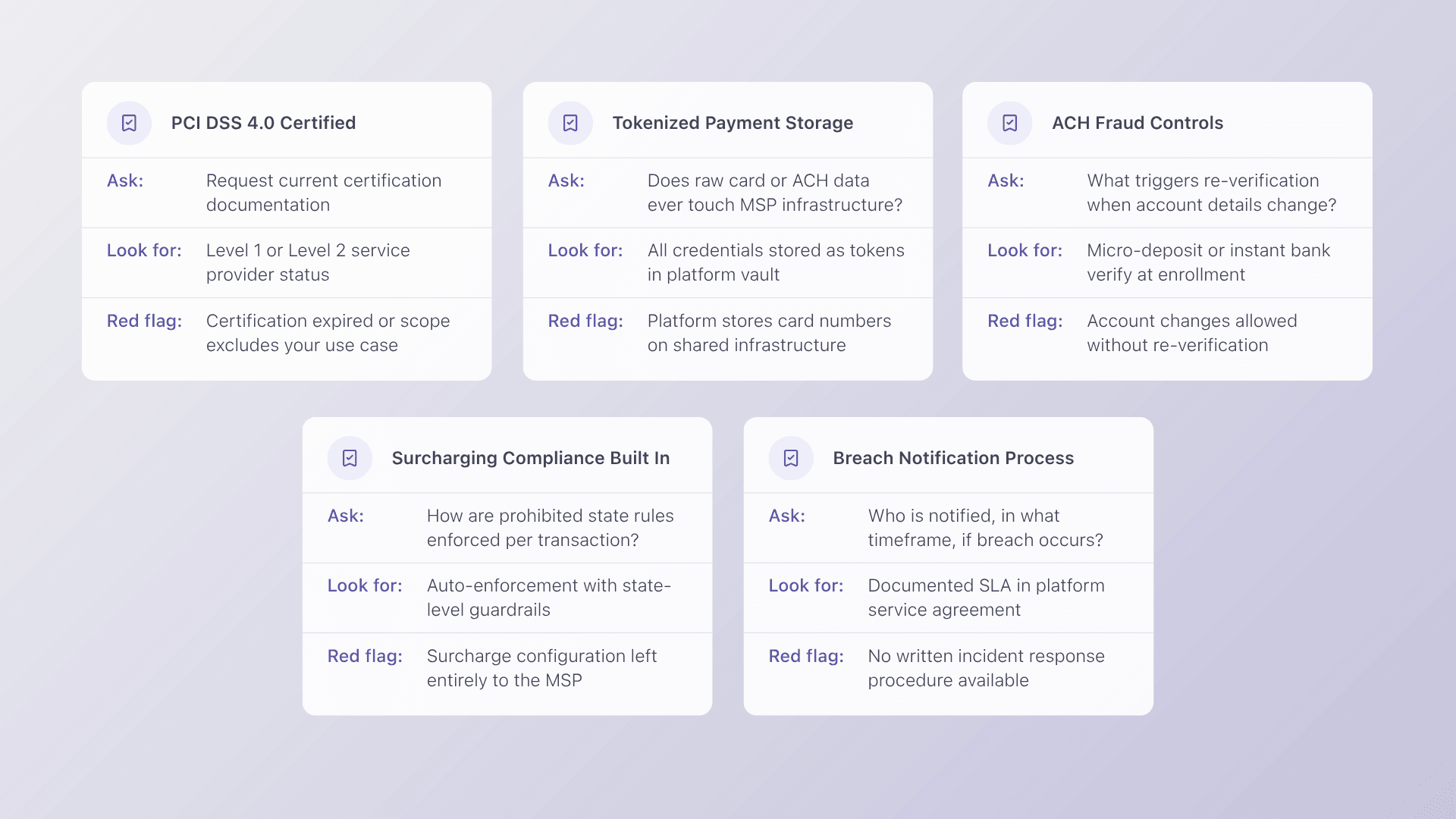
MSP payment security is only as strong as the weakest link in the billing stack. When evaluating payment platforms, these five questions determine whether the platform strengthens or extends your security exposure.
- Is the platform PCI DSS 4.0 certified? Request the platform’s current PCI DSS certification documentation. Confirm the certification level and scope. Platforms that handle cardholder data on your behalf should be certified as a Level 1 or Level 2 service provider.
- Does it tokenize stored payment methods? Confirm that client card numbers and ACH account details are never stored on MSP infrastructure. Tokens should be stored in the platform’s own PCI-compliant vault, with no raw payment data touching your systems.
- What are the ACH fraud controls? Ask specifically about bank account verification methods, what triggers a re-verification requirement when account details change, and how the platform handles ACH returns, unauthorized debit claims, and reversals.
- Is surcharging compliance built in? Confirm that the platform enforces state level surcharging rules automatically. If surcharge configuration is left entirely to the MSP, compliance risk falls on the MSP. Built in guardrails remove that exposure.
- What is the data breach notification process? Understand what happens if the platform experiences a security incident. Who is notified, in what timeframe, and what is the MSP’s obligation to notify affected clients? This should be documented in the platform’s service agreement.
Alternative Payments addresses all five areas: PCI DSS compliant processing, tokenized payment method storage, bank account verification for ACH, built in surcharging compliance with state level enforcement, and documented incident response procedures.
A Practical Approach to MSP Payment Security: Step by Step
Improving MSP payment security does not require a full security audit or a complete billing stack overhaul. These five steps give MSPs a structured path from current exposure to a defensible security posture.
- Audit your current payment data flows. Map where client payment data enters your systems, where it is stored, who has access, and what happens to it after a transaction. Identify every touchpoint where raw card or bank account data could be exposed.
- Confirm your payment platform’s PCI DSS status. Request written confirmation of your current platform’s PCI DSS 4.0 certification. If the platform is not certified or the scope excludes your use case, your MSP carries the compliance gap.
- Implement tokenization for stored payment methods. If your current platform stores raw card or ACH data rather than tokens, migrating to a tokenized platform eliminates your largest area of payment data exposure. Alternative Payments handles this transition with bulk client import and payment method re-enrollment support.
- Review your surcharging configuration for compliance. If you are passing card fees to clients, verify that your surcharging setup meets state law and card network requirements. Confirm that clients in prohibited states are not being surcharged and that disclosure happens before the transaction.
- Roll out with a phased client migration. Migrate 5 to 10 clients first to validate the new payment security configuration before expanding to your full book. Confirm tokenization, ACH verification, and surcharging rules are functioning correctly on the first billing cycle before full rollout.
MSP Payment Security Is a Platform Decision, Not Just a Policy One
MSP payment security is not solved by a compliance checklist sitting in a shared drive. It is solved by choosing a payment platform that handles PCI DSS compliance, tokenization, ACH fraud controls, and surcharging guardrails as built in capabilities rather than configurations your team has to maintain manually.
The cost of getting this wrong is real. The Nilson Report estimates that U.S. businesses will lose $165.1 billion to credit card fraud over the next decade. Non-compliant surcharging exposes MSPs to card network fines and consumer protection penalties. ACH fraud incidents cost time, client trust, and in some cases, direct financial losses that are difficult to recover.
Alternative Payments was built to handle MSP payment security as a core capability, not an afterthought. PCI DSS compliant processing, tokenized payment method storage, built in surcharging compliance with state level enforcement, bank account verification for ACH, and documented incident response procedures. Native integrations with ConnectWise, Autotask, and HaloPSA mean the security controls extend across the full billing workflow.
The FAQ section below covers the most common MSP payment security questions, including PCI DSS scope, tokenization, ACH fraud prevention, and how to evaluate any payment platform against these criteria.
FAQs: MSP Payment Security
Q: What does MSP payment security actually cover?
A: MSP payment security covers PCI DSS compliance for card payment processing, tokenization of stored client payment methods, ACH fraud prevention controls, surcharging compliance under state law and card network rules, encryption of payment data in transit and at rest, and the security posture of any third party payment platform integrated into the MSP billing stack.
Q: Is PCI DSS 4.0 compliance required for MSPs?
A: Yes, if the MSP collects, processes, or transmits client credit card data. PCI DSS 4.0 became fully mandatory in March 2025. MSPs that route clients through a PCI DSS certified hosted payment page reduce their compliance scope significantly, since cardholder data never touches MSP infrastructure directly. Alternative Payments operates as a PCI DSS compliant processor for exactly this purpose.
Q: What is tokenization and why does it matter for MSP billing?
A: Tokenization replaces client card numbers and ACH account details with non-sensitive tokens that have no value outside the payment platform that generated them. For MSPs storing client payment methods for recurring billing, tokenization ensures that if MSP systems are compromised, there is no payment data available to steal. It is the primary security control for stored payment credentials.
Q: How does ACH fraud happen and how do MSPs prevent it?
A: ACH fraud commonly occurs through account takeover using compromised credentials, business email compromise to redirect payments to fraudulent accounts, or unauthorized ACH debits. Prevention requires bank account verification at enrollment, multi-factor authentication on client portal access, re-verification requirements when account details change, and monitoring for unusual payment method updates. Platforms with weak ACH controls are a common source of fraud exposure for MSPs.
Q: What is the best approach to evaluating MSP payment security in a payment platform?
A: Evaluate five areas: PCI DSS 4.0 certification status, tokenization of stored payment methods, ACH fraud controls including bank account verification and re-verification requirements, built in surcharging compliance with state level guardrails, and documented data breach notification procedures. Platforms that leave compliance configuration to the MSP transfer the associated risk to the MSP as well.
If your MSP is ready to close the gap between a billing workflow and a secure one, the fastest next step is seeing what a purpose built platform looks like in practice. Book a 20-minute demo and see how Alternative Payments secures your MSP payment workflow from invoice to reconciliation.