•
IT Services
•
Automate Accounts Receivable
•
Reduce DSO
January 13, 2026
The Data Connection: Measuring The Direct Impact Of Slow IT Payments On Client Loyalty
Are slow IT payments really just an accounting inconvenience, or are they quietly reshaping how clients perceive long-term value?
They do far more than delay cash flow. Payment speed influences trust, confidence, and how stable your business feels to the client over time.
We work closely with MSP leadership teams who invest heavily in service delivery, responsiveness, and outcomes. Billing performance, however, often remains invisible until something fails. The reality is that payment experiences are part of the relationship, even when they operate in the background. When billing feels predictable and transparent, clients remain comfortable. When it feels inconsistent or unclear, uncertainty begins to form.
Business payment behavior shows that visibility and process clarity directly influence how quickly payments are completed and how partners are evaluated. When payment workflows slow down or become opaque, they introduce friction that subtly alters perception, even if service quality remains unchanged. This is where trust erosion begins, quietly and unintentionally.
What Failed Payments Really Mean In MSP Environments
Failed payments are often misunderstood as isolated technical issues. In practice, they take many forms, and their impact extends beyond a single transaction.
In MSP environments, payment failure can mean a declined card, an ACH rejection, a missed retry, or a delay caused by reconciliation gaps between systems. In many cases, the payment is eventually collected, which makes the issue feel minor. But from the client’s perspective, something already went wrong.
When a payment does not process cleanly, it introduces uncertainty. Clients may question whether the invoice was correct, whether authorization was captured properly, or whether future charges will follow the same pattern. Even when no complaint is raised, confidence begins to erode quietly.
This is where many MSPs underestimate risk. A payment that is resolved later still leaves a mark on trust today.
How Payment Friction Reduces Customer Lifetime Value
Customer lifetime value is not only shaped by service quality. It is shaped by how easy it feels to continue the relationship.
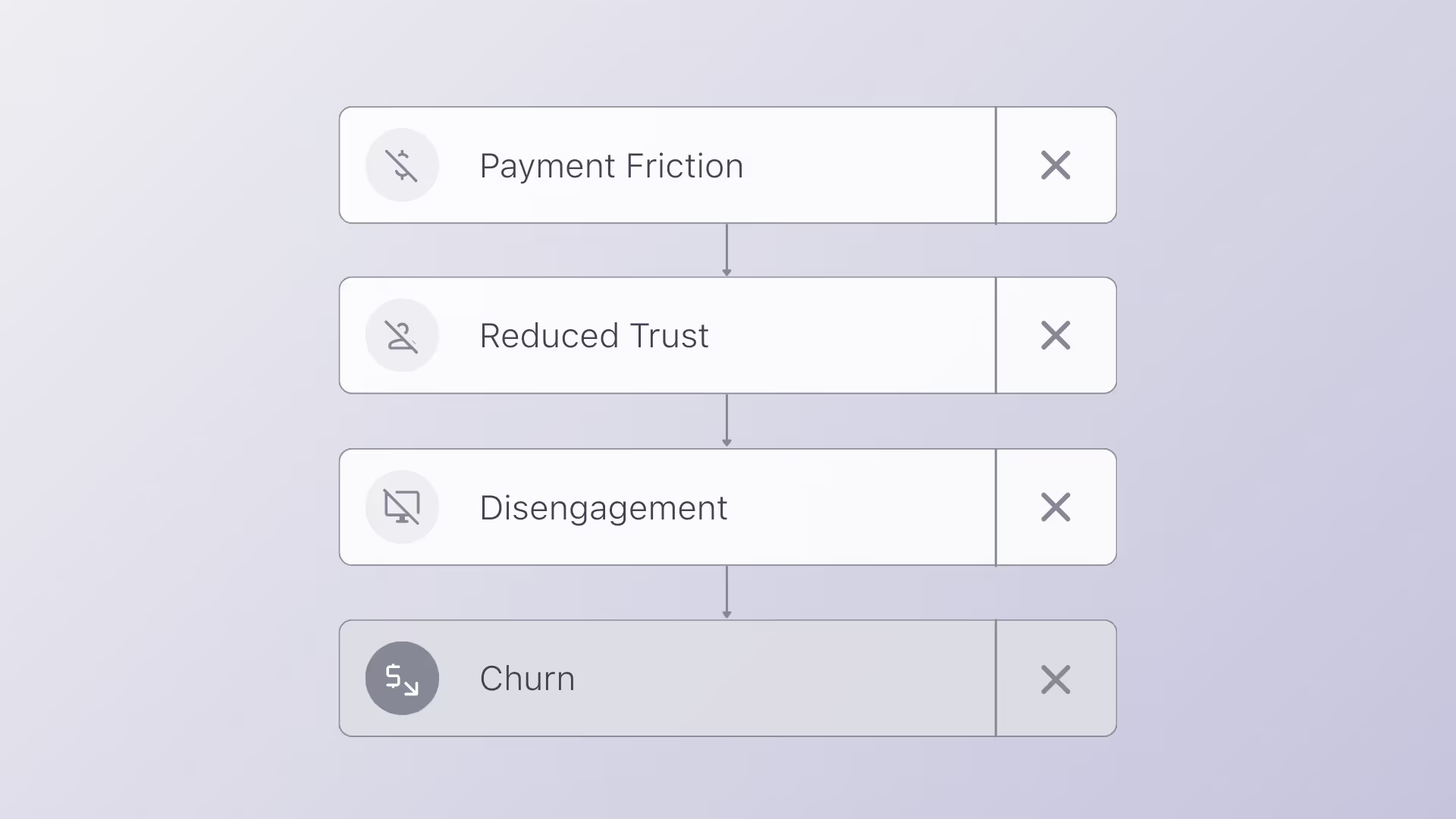
When payment friction becomes part of the experience, renewal conversations change tone. Clients hesitate. Discounts become easier to request. Commitments shorten. Over time, the total value of the relationship shrinks, not because the service failed, but because confidence did.
Research into customer retention consistently shows that trust and continuity play a central role in long-term value. When friction appears in recurring processes like billing, it compounds across months and years.
Retention-focused analysis highlights how small disruptions reduce lifetime value over time, even when core delivery remains unchanged.
For MSPs, this means payment disruptions do not just affect the current invoice. They affect how long the client stays, how much they spend, and how stable that revenue becomes.
The Emotional Cost Clients Rarely Articulate
Clients rarely say they are leaving because billing felt unreliable. Instead, they disengage gradually.
Payment friction introduces a subtle emotional shift rather than an immediate complaint. Clients start paying closer attention. Invoices are forwarded internally more often. Charges that were once assumed to be correct are reviewed more carefully. None of these actions signals dissatisfaction outright, but each reflects a small decrease in confidence.
Customer experience research consistently shows that operational friction erodes trust faster than most businesses expect. When processes feel harder than they should, clients attribute that difficulty to the partner, not the system behind it. Over time, these moments accumulate. The relationship may remain professional and polite, but the sense of ease begins to fade.
This emotional cost rarely appears in reports or dashboards, yet it directly influences how loyal a client feels and how forgiving they are when other issues arise.
When Billing Friction Becomes A Churn Signal
Failed payments often appear before churn, not after they should be treated as early indicators rather than isolated incidents.
We see this pattern repeatedly across MSP billing data, where payment retries increase. Manual follow-ups become more frequent. Response times stretch as clients take longer to resolve billing issues. Individually, each signal seems minor. Together, they form a measurable pattern of friction building within the relationship.
This is where the data connection becomes clear. Rising retry counts, delayed resolutions, and increased manual intervention are not just operational inefficiencies. They are early warning signs that engagement is weakening. Subscription research shows that involuntary churn frequently begins with payment failures, not dissatisfaction with the underlying service. When these failures are handled inconsistently or discovered late, they accelerate disengagement.
The longer recovery depends on ad hoc follow-up or reactive escalation, the more likely a correctable payment issue turns into a trust issue. The solution is not applying more pressure, but responding earlier and more predictably. When retries, reminders, and recovery steps follow a defined cadence, issues surface while context still exists. Clients experience support instead of surprise.
Automation plays a critical role by ensuring payment friction is detected immediately, handled consistently, and resolved quietly before it reshapes perception. For MSPs, slow IT payments should be treated as leading indicators of churn risk, not back-office noise. Addressed early, they protect both revenue and relationships, and they preserve confidence while it still exists.
Why Manual Recovery Quietly Damages Loyalty
When payment issues arise, many teams rely on manual recovery without realizing the downstream impact. The intent is helpful, but the experience often introduces friction at exactly the wrong moment.
Manual follow-up varies by person, timing, and tone. One client receives a friendly nudge. Another receives a delayed reminder. A third hears nothing until the issue has grown larger than it should have been. This inconsistency creates uncertainty, even when the outreach is well-meaning.
Payment research shows that process efficiency and visibility play a major role in how businesses evaluate payment experiences. When follow-up feels improvised, it undermines confidence in the system itself.
Manual recovery does not just slow payments. It signals operational fragility.

How Automation Stabilizes The Client Experience
Automation introduces consistency where human processes struggle to keep pace. It supports retention by ensuring that billing data, service records, and payment confirmations stay aligned over time.
Time-stamped authorizations are captured at the moment of approval. Invoices remain directly linked to the tickets or services they represent. Records are retained in a centralized system rather than scattered across tools or inboxes. When issues surface weeks or months later, the context is already intact.
This stability matters because clients rarely separate billing from service in their perception. When payments feel predictable, and recoveries feel quiet, trust remains intact. Automation does not make billing invisible, but it makes it dependable.
The Compounding Effect Of Consistent Payment Handling
Small improvements in payment handling compound faster than most teams expect, but only when consistency replaces reaction.
This effect is not dramatic at first. It becomes visible over time as repeatable processes remove variability from the billing experience. Instead of each issue being handled differently, the system responds the same way every time, regardless of client size or situation.
The compounding impact shows up when:
- Invoices are generated and delivered on time every cycle
- Recovery workflows follow the same cadence for every client
- Payment status remains visible without manual reconciliation
- Exceptions surface immediately instead of weeks later
Each improvement feels modest on its own. Together, they fundamentally change how the business operates. Less time is spent reacting to surprises. More time is spent planning with confidence. Trust in the numbers starts to return because they no longer require constant explanation.
This is also where the data connection becomes actionable. When retries increase, delays lengthen, or manual follow-ups become more frequent, those signals appear clearly instead of being buried in email threads or spreadsheets. Consistent payment handling turns those signals into early indicators of churn risk, giving teams time to respond before disengagement takes hold.
This compounding effect is what separates reactive billing from strategic billing.
A Quiet MSP Scenario Of Loyalty At Risk
We often see this scenario play out without confrontation.
An MSP notices a client taking longer to pay, then requiring reminders. The services continue without issue, but billing conversations start to feel awkward. Eventually, the client reduces the scope or declines a renewal, citing internal changes rather than dissatisfaction.
The loyalty loss did not happen at cancellation. It happened earlier, when payment friction introduced doubt that was never fully resolved.
Next Steps For Evaluating Payment Friction Risk
This final step is about reflection, not action for action’s sake.
Before making changes, it helps to assess how payment friction shows up today.
To begin that assessment:
- Review how often payment issues require manual follow-up
- Identify where recovery timing varies by client or situation
- Ask whether leadership trusts billing data without verification
- Consider how payment failures are surfaced and resolved
These questions surface risk without assigning blame.
Improving loyalty starts with understanding whether your current IT payments process reinforces trust or quietly weakens it over time.
Strengthening client relationships over time requires addressing friction where it has the greatest impact.
Simplify your customer payments, unlock instant cash flow
Keep reading


Can AI financial analysis explain why your margins changed?

Autotask QuickBooks integration: choosing a billing and payment operating model