•
Accounting
•
Automate Accounts Receivable
•
Professional Services
March 9, 2026
Rethinking Accounts Receivable for Modern Accounting Firms

For many recurring service businesses, one of the most critical financial workflows remains surprisingly manual. Companies have adopted cloud accounting platforms, practice management systems, and sophisticated financial analytics, yet the process of actually collecting revenue often looks the same as it did decades ago. Checks still arrive in the mail, invoices are sent as PDFs, and finance teams spend hours tracking down payments instead of analyzing the business.
Baxter Lanius saw this problem early in his career. Whether working with small service companies or much larger organizations, the pattern was the same: businesses had modernized their operations but not the infrastructure responsible for getting paid.
In his conversation with Amy Vetter on the Breaking Beliefs podcast, Baxter explained how that realization ultimately led to the creation of Alternative Payments. The company was built to address a gap he kept seeing across recurring service businesses, where growing invoice volume and operational complexity exposed the limitations of traditional billing and collection processes.
You can watch a recap of Baxter’s conversation on the future of accounts receivable and financial infrastructure here.
The Problem Hiding in Plain Sight
Before founding Alternative Payments, Baxter Lanius observed the same pattern repeatedly across businesses of all sizes: invoices were sent on time, yet payments were delayed, cash flow remained unpredictable, and tracking processes were largely reactive rather than proactive.
Reflecting on those early experiences, Baxter describes a reality that many firms still recognize:
“People used to drop off checks at my apartment building. We would check the mail every single day, go down a checklist, and once we had enough checks, we would go to the bank. As the number of invoices increases, that challenge and that pain point becomes much more acute.” – Baxter Lanius, CEO of Alternative Payments
Over time, Baxter came to see that the issue extended far beyond slow payments. Many service businesses had modernized nearly every operational system they relied on, yet the infrastructure responsible for collecting revenue often remained rooted in decades old processes.
From his perspective, billing and collections have traditionally been treated as administrative functions rather than as core financial infrastructure. That mindset leaves businesses operating with unnecessary friction at the very point where revenue is converted into cash.
That manual process might feel manageable at a small scale, but it becomes operational drag at a larger scale.
Whether a firm generates two million dollars or one hundred million dollars in revenue, the friction compounds as invoice volume increases. Waiting on checks, chasing wires, reconciling payments manually, and sending reminder emails one by one creates unnecessary administrative strain across finance and operations teams.
The issue is not invoicing, but the workflow that governs how invoices are delivered, tracked, and collected.
Building Financial Infrastructure for Recurring Revenue
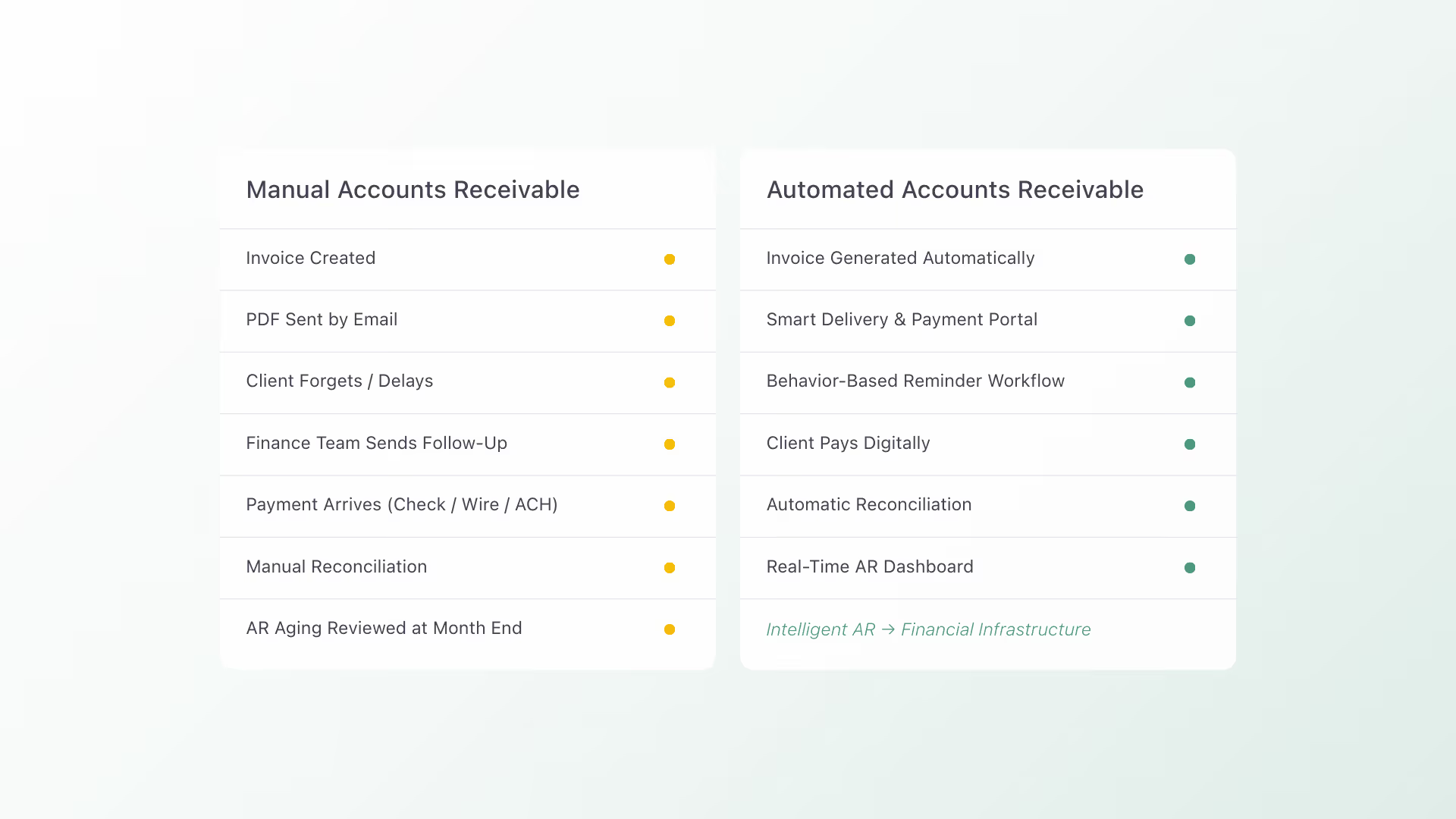
Alternative Payments was designed as financial infrastructure for recurring service businesses, unifying the entire accounts receivable lifecycle into a single automated workflow.
Rather than adding another payments tool to an already fragmented stack, the platform connects directly with accounting and practice management systems to bring invoicing, payment collection, and reconciliation into a single continuous workflow. This approach replaces the disconnected steps that traditionally exist between invoice delivery, payment processing, and financial reporting.
The result is real time visibility into the full revenue cycle, allowing firms to track payments, monitor client behavior, and understand cash flow performance without relying on manual follow ups or disconnected systems.
From Baxter’s perspective, the market did not need another bolt on payment feature. What service firms lacked was financial infrastructure capable of supporting modern, automated revenue operations. Alternative Payments was built specifically to close that gap.
From Reactive Collections to Proactive Intelligence
A defining evolution in the platform has been the integration of intelligence into accounts receivable.
Historically, collections have been reactive. An invoice goes out. The business waits. If payment does not arrive, someone follows up manually.
Alternative Payments is fundamentally shifting that dynamic from reactive follow up to proactive, data driven cash flow management.
Using behavioral data and engagement signals, the platform can optimize invoice delivery timing and automate outreach based on how clients interact with payment emails. If a client consistently opens emails at a specific time of day, the system adapts. If payment timing begins to slip month over month, the system flags potential risk.
That shift transforms accounts receivable from a back office function into a forward looking risk management and cash optimization tool.
Why Many CAS Firms Avoid Accounts Receivable
Baxter often points out that many Client Accounting Services firms avoid accounts receivable work for the same reason many business owners struggle with it.
Managing accounts receivable often means chasing payments, reconciling transactions across disconnected systems, and trying to predict when payments will actually arrive.
Before building Alternative Payments, he saw firsthand how difficult collections could become as businesses scaled. Invoices were sent, but finance teams had little visibility into when or whether payments would arrive. Someone had to monitor inboxes, track responses, reconcile deposits, and follow up with clients individually.
As Baxter described during the conversation:
“You would send the invoice and then you would just wait. You would wait and hope that the client paid you, or that one day you would check the mailbox and the check would be there.”
For accounting and CAS firms trying to build standardized, scalable services, that level of unpredictability creates operational friction. Chasing payments, reconciling transactions across disconnected systems, and managing inconsistent client payment behavior turns AR into a clerical burden rather than a strategic service.
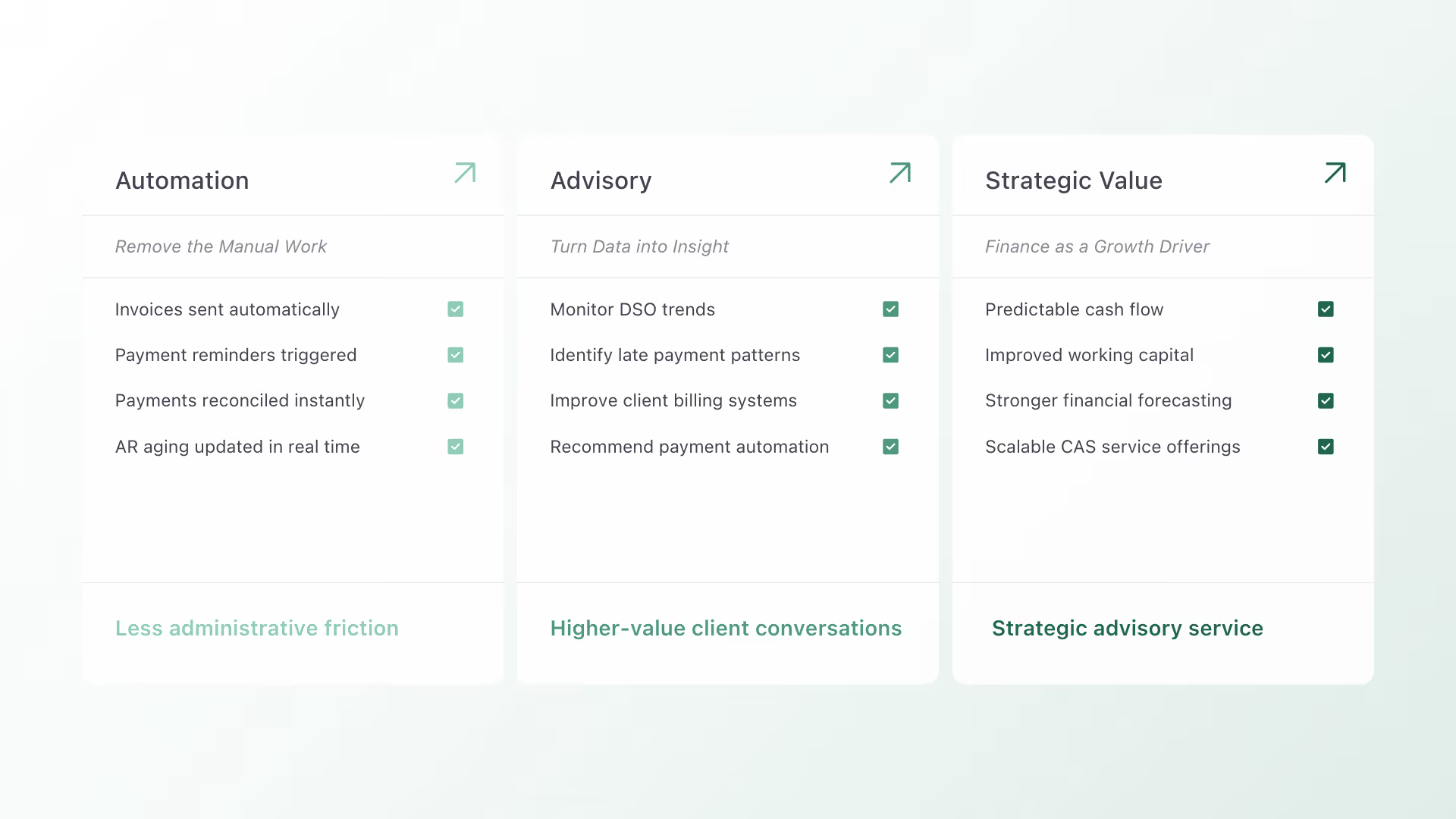
Automation changes that equation by removing the manual friction that has traditionally made accounts receivable difficult to manage and even harder to scale.
When billing, payment collection, and reconciliation are managed through unified infrastructure, the manual friction that once made AR unattractive begins to disappear. Instead of tracking payments manually, firms gain clear visibility into client payment behavior and cash flow performance.
That visibility allows accounts receivable to evolve from an administrative task into an advisory opportunity. Firms can help clients understand payment patterns, identify emerging risks, and improve cash flow predictability.
Just as important, automation allows these services to scale. By removing manual bottlenecks, CAS teams can support more clients and deliver more consistent financial insight without expanding administrative overhead.
AI as an Operational Multiplier
When Baxter talks about automation and artificial intelligence, he often starts with the problem he experienced firsthand.
Before founding Alternative Payments, he worked with businesses of all sizes and saw how much time finance teams spent simply trying to get paid. Invoices were sent, payments were delayed, and someone had to manually track who had opened an email, who had not responded, and which clients were starting to fall behind.
The role of intelligent systems, in Baxter’s view, is not to replace financial professionals but to remove that friction. By continuously analyzing payment behavior, engagement patterns, and timing signals, modern platforms can surface insights that would otherwise require hours of manual oversight.
Instead of chasing payments or piecing together scattered data, accounting and Client Accounting Services teams gain clear visibility into emerging risks and shifting payment behavior. That visibility allows them to intervene earlier, manage cash flow more proactively, and guide clients with greater confidence.
In that sense, automation and AI do more than accelerate collections. They create the operational leverage that allows accounting professionals to spend less time managing transactions and more time delivering the strategic financial insight their clients increasingly expect.
Empowerment as a Growth Strategy
Beyond product innovation, Alternative Payments reflects a broader leadership philosophy shaped by Baxter’s early experiences in sports and entrepreneurship.
Team alignment, empowerment, and internal mobility are central to the company’s culture. Individuals are encouraged to evolve into roles that align with both their strengths and aspirations, and the organization prioritizes growth from within and shared ownership of outcomes.
Winning and losing together is not just a sports metaphor. It is an operating principle that influences how the company builds both its internal teams and its technology.
That same philosophy extends to the businesses Alternative Payments serves. Baxter’s belief is that the right financial infrastructure should empower service firms, not constrain them. When billing and payment workflows are automated, visible, and intelligently managed, firms gain the operational confidence to focus less on administrative friction and more on delivering value to their clients.
In that environment, technology does not simply process transactions. It elevates firms by giving them the clarity, efficiency, and control needed to operate as trusted financial partners to the businesses they support.
The Bigger Shift in Financial Operations
Across the accounting and recurring services landscape, adoption of automation and AI is accelerating. Firms are reevaluating how technology can streamline workflows and unlock new service offerings.
Accounts receivable is often overlooked in that transformation.
Yet it represents one of the most direct levers for improving cash flow, reducing administrative strain, and enhancing client experience.
By replacing mailbox monitoring and manual checklists with intelligent automation, Alternative Payments is helping service businesses modernize one of their most critical financial workflows.
The future of recurring revenue depends not only on selling more services, but on modernizing financial operations so that accounts receivable evolves from a manual collection process into a source of real time visibility, strategic insight, and advisory value.
If you are looking to improve your billing automation, reduce administrative strain, and accelerate cash flow, request a demo to see how Alternative Payments can transform your accounts receivable workflow.
Simplify your customer payments, unlock instant cash flow
Keep reading

AP Automation Software for Mid-Market Service Companies: What to Automate First