The MSP Payment Processing Pricing Problem Nobody Talks About
For most MSPs, the person managing payment processing pricing is the same person generating invoices, chasing overdue accounts, and producing monthly financial reports. When that one person runs out of hours, some clients get followed up with consistently and others do not. Invoices that go out without a reminder behind them tend to stay unpaid longer than they should.
The result is a cash flow gap that is difficult to close through effort alone. Clients paying 30 to 60 days late is not a rare exception for lean MSP operations. It is the pattern that forms when billing workflows were not designed to handle the volume the business has grown into.
The scale of this problem is industry wide. According to PYMNTS Intelligence (2024), more than 64% of B2B invoices are paid late, and businesses report that delayed payments directly stall their ability to pay their own vendors on time. For a lean MSP team, that statistic is not abstract. It shows up in real decisions about vendor payments, payroll timing, and reinvestment capacity every single month.
How Payment Processing Pricing Affects MSP Operations Specifically
Payment processing pricing is one of the most underestimated cost drivers in MSP operations. The rate itself is visible on a statement, but the total cost of how payment is collected, reconciled, and followed up on is harder to see and often far larger.
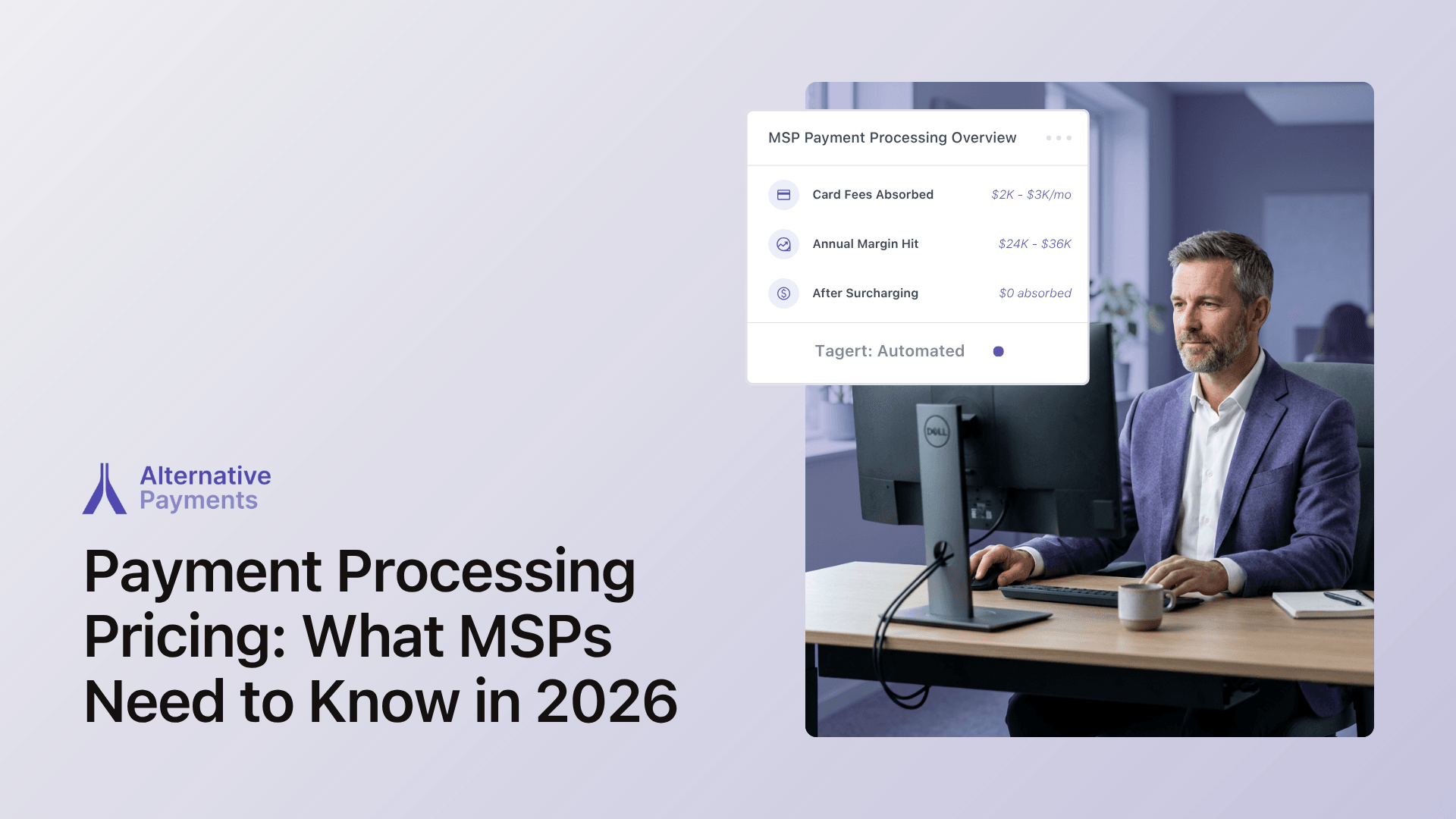
Credit card processing fees are the most common example. When every client pays by card and the MSP absorbs the fee, 2 to 3% disappears from every transaction. Across a book of 50 clients paying monthly retainers, that adds up to thousands of dollars per month in margin erosion that the business never explicitly agreed to absorb.
ConnectWise holds the billing source of truth for most MSPs, but the payment collection and reconciliation steps that follow invoice creation are typically handled manually. Every invoice that leaves ConnectWise and lands in QuickBooks requires a human touchpoint somewhere in the chain before it is fully closed. At scale, those touchpoints consume staff time that is not billable.
The path forward is well documented. According to the Institute of Finance and Management (IOFM, 2024), companies using automated AR workflows reduce day sales outstanding by an average of 15 to 25% and cut manual collection labor by up to 40%. For an MSP running a lean finance team, that reduction translates directly into hours available for higher value work and a materially faster cash conversion cycle.
A Practical Approach to Improving Payment Processing for MSPs: Step by Step
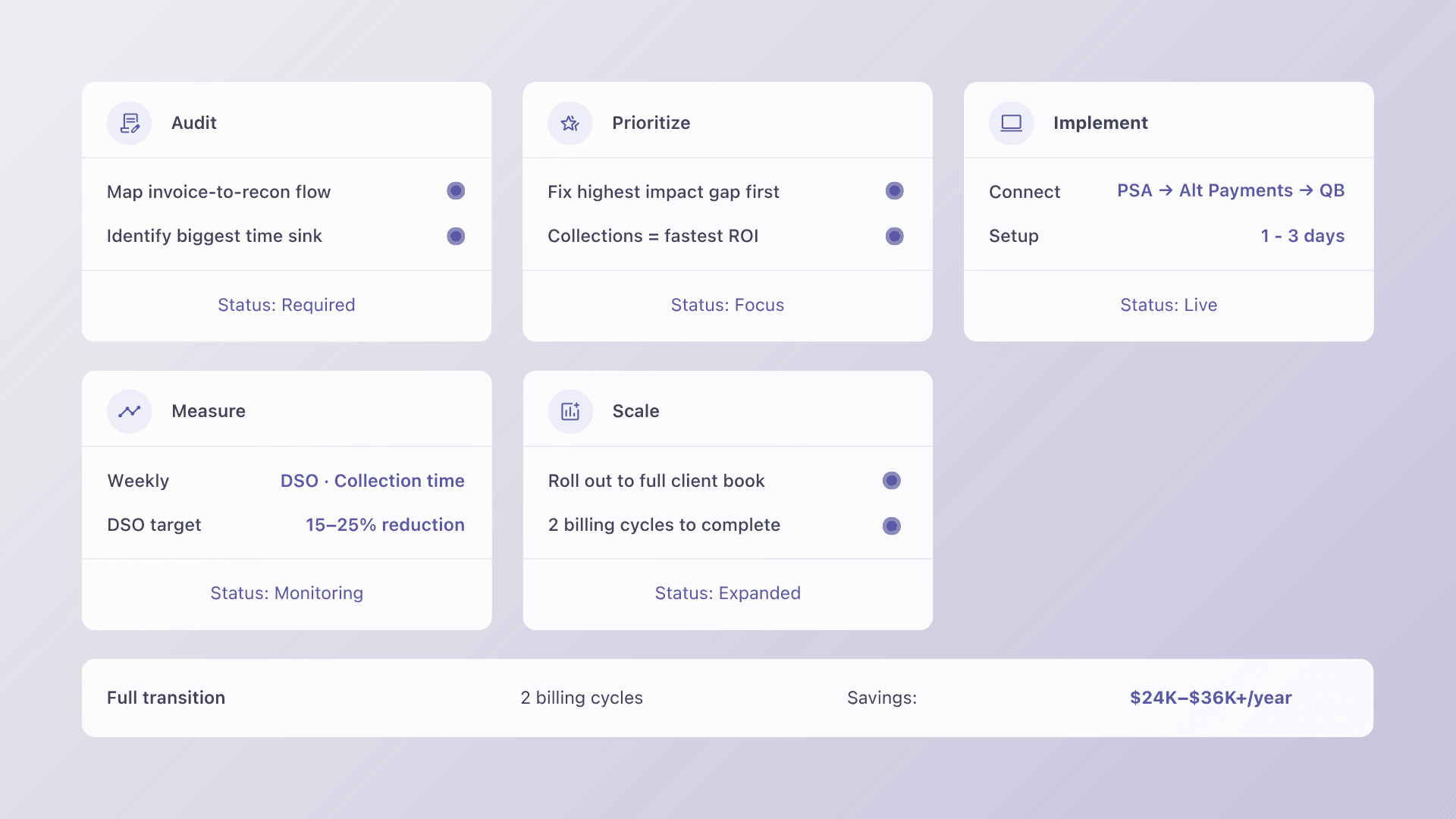
Improving payment processing pricing and reducing collection overhead does not require replacing every tool in your billing stack. These five steps are how MSPs make the transition efficiently without disrupting their current client base.
- Audit. Map your current payment workflow from invoice creation to payment received and reconciled in QuickBooks. Identify the single biggest time sink or error source. For most MSPs it is the manual step between invoice sent and payment collected, where follow up depends entirely on one person’s availability each week.
- Prioritize. Fix the highest impact gap first rather than attempting a full stack overhaul. Payment collection is usually the right starting point because improvements here are measurable within a single billing cycle and directly visible in the AR aging report.
- Implement. Connect your primary tool to Alternative Payments using the native integration. For ConnectWise users, invoice data syncs automatically, payment reminders run without manual input, and reconciliation posts back to QuickBooks without anyone on your team initiating it. Unlike general purpose payment platforms that accept payments but leave reconciliation and AR follow up as manual steps, Alternative Payments handles the full collection cycle natively. Setup takes one to three business days with no middleware required.
- Measure. Track three numbers weekly for the first 90 days: DSO, average collection time per invoice, and manual hours spent on AR. These give you a clear before and after picture of what the change in payment processing has delivered and where further optimization is available.
- Scale. Once the workflow is validated with your pilot group, roll out to your full client book. Most MSPs complete the full transition within two billing cycles, giving you time to catch any configuration issues before they affect your entire revenue stream.
What to Look for in a Payment Processing Pricing Solution for MSPs
Not every payment platform is built to handle the full payment lifecycle for a lean MSP operation. Most cover one or two steps and leave the rest to manual processes. Here is what to look for before committing to a platform.
Predictable Flat Fee Pricing, Not Per Transaction Rates That Scale With Volume
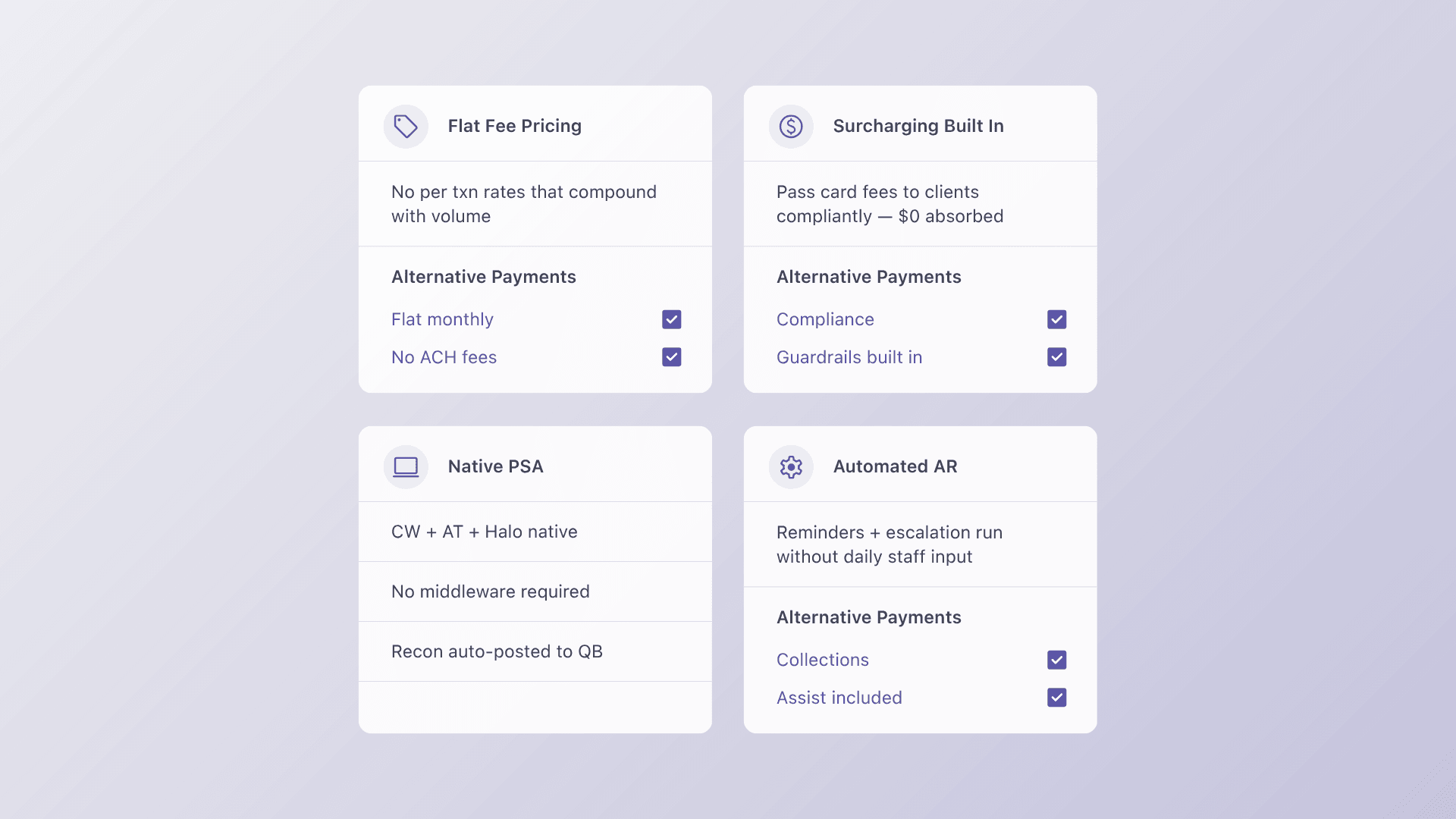
Per transaction payment processing pricing compounds as invoice volume grows. A flat monthly fee model keeps cost predictable regardless of how many invoices your team processes, which matters more as the client book scales. Alternative Payments uses flat monthly pricing with no per transaction fees and no ACH charges, making total cost foreseeable at any volume.
Built In Surcharging to Stop Absorbing Card Fees
A platform with built in surcharging compliance allows MSPs to pass card processing fees to clients who pay by card rather than absorbing 2 to 3% on every transaction. On a book of 50 clients paying a $2,000 monthly retainer by card, that represents $2,000 to $3,000 in processing fees absorbed every month. Alternative Payments includes surcharging with compliance guardrails built in, covering the state level requirements that vary by jurisdiction.
Native PSA Integration That Runs Without Manual Touchpoints
The payment platform needs to connect natively to ConnectWise, Autotask, or HaloPSA and post reconciliation back to QuickBooks automatically. Platforms that require middleware or third party sync tools add maintenance overhead and failure points. Alternative Payments integrates natively with all three major MSP PSA platforms with no middleware required.
Automated AR That Runs Across Every Client Account Without Daily Oversight
When one person manages the entire billing operation, automated reminders, auto pay enrollment, and overdue follow up need to run independently without daily input. According to Datto and Kaseya (2024), over 60% of MSPs cite cash flow management as a top operational challenge, with late client payments identified as the number one contributing factor. Collections Assist in Alternative Payments handles reminders, escalation, and auto pay enrollment automatically, eliminating the manual follow up that drives that statistic.
The Right Payment Processing Pricing Model Changes Everything
Payment processing pricing is not just a line item on a statement. It is a structural decision that affects margin, cash flow, and how much of your team’s time goes toward billing rather than client work. MSPs that get this right are not doing it by negotiating a slightly better per transaction rate. They are eliminating the per transaction model entirely and replacing manual collection steps with automation that runs without anyone initiating it.
The transformation is concrete. Late payments become the exception rather than the norm. Card fees stop eroding margin because surcharging handles the passthrough compliantly. Reconciliation posts automatically. And the one person running your billing operation stops spending their week chasing invoices and starts focusing on work that moves the business forward.
Alternative Payments was built for exactly this. Native integrations with ConnectWise, Autotask, and HaloPSA. Flat monthly pricing with no ACH fees. Built in surcharging. Collections Assist for automated reminders and overdue follow up. And a branded client portal that gives clients self service access from day one.