•
IT Services
•
Automate Accounts Receivable
January 20, 2026
Is Your Legacy MSP Payments Provider Holding You Back?
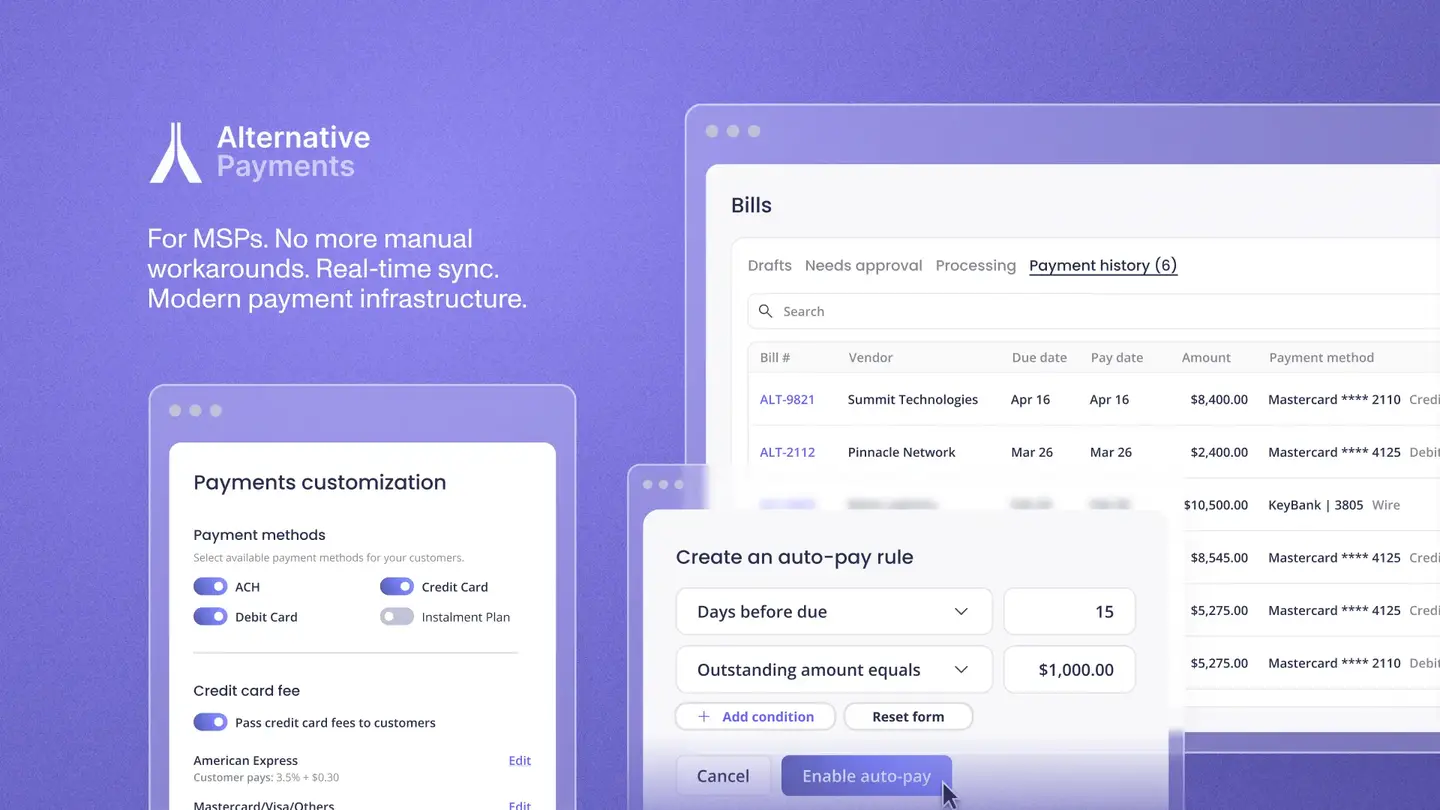
Evaluating the true cost of an aging payment infrastructure reveals several hidden operational risks. This section outlines the specific ways that outdated systems create friction within a growing technology firm.
Modern payment processing relies on seamless automation to maintain high levels of internal efficiency.
- Many MSPs overlook their own back-office stacks while focusing exclusively on client upgrades.
- MSP Payments functions best as a silent engine for growth rather than a source of manual workarounds.
- Systems requiring constant human intervention to bridge the gap between a payment and a ledger act as an anchor.
- The productivity lost to these manual processes often outweighs the perceived cost of switching to a modern platform.
Recognizing these inefficiencies is the first step toward reclaiming your team’s time and professional edge. When the cost of staying the same becomes measurable in lost hours, the shift toward a modern solution becomes a strategic necessity.
The Invisible Drag Of Legacy Systems
Operational friction often disguises itself as a standard business process. In many MSP finance departments, the “way we’ve always done it” involves managing dozens of tiny, manual tasks that exist solely because a payment provider lacks modern automation. This creates a persistent cognitive load on your team, who must remember to check specific portals, verify status updates, and manually move data between disconnected systems.
Over time, this invisible drag lowers the ceiling on how many clients a single administrator can manage, effectively linking your overhead directly to your growth in a way that stifles profitability.
The High Cost Of Latency In Data Syncing
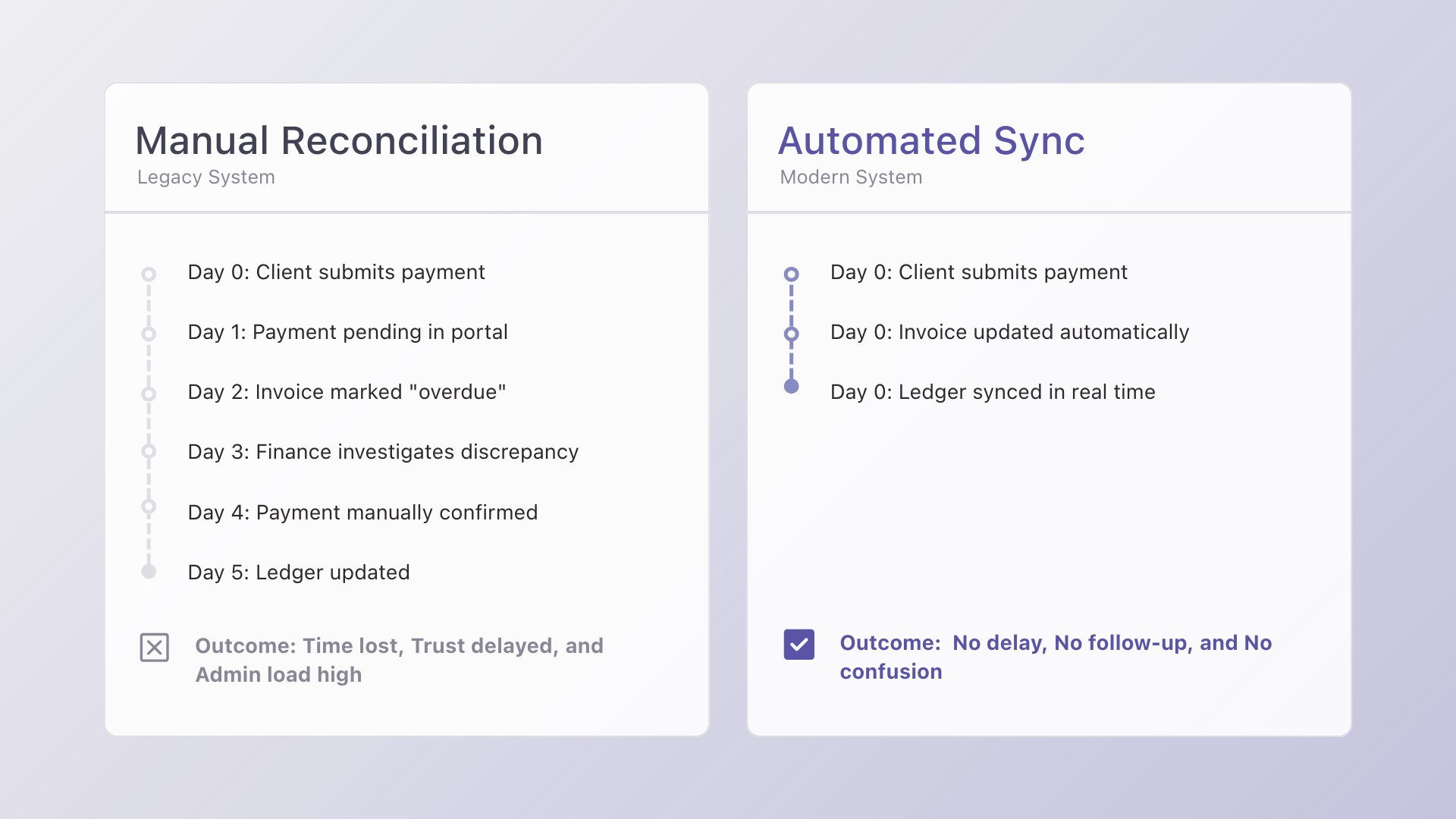
Precision in accounting depends entirely on the speed and accuracy of your data flow. Legacy systems often rely on batch processing or “near-real-time” syncs that can lag by hours or even days, leaving your books in a state of perpetual catch-up.
This latency forces your team into a cycle of double work, where they are investigating “overdue” invoices that have actually already been paid but haven’t been reflected in the system yet. Beyond the wasted hours, this delay compromises the integrity of your financial reporting, making it difficult for leadership to make decisions based on the actual cash position of the company at any given moment.
Client Friction And The Erosion Of Professionalism
Your payment portal is often the most frequent point of digital contact your clients have with your brand. If an MSP promises “cutting-edge” managed services but requires clients to navigate a clunky, 2010-era payment interface, it creates a jarring disconnect in the brand experience. High-friction payment processes, such as forced logins for simple tasks or non-mobile-responsive pages, frustrate clients and can even lead to payment delays as they put off the “chore” of settling their bill.
Providing a seamless, modern checkout experience is not just a convenience; it is a reinforcement of your status as a modern technology partner.
The Impact On Talent Retention And Finance Morale
The current labor market for skilled finance professionals is increasingly competitive, and top talent rarely wants to spend their career performing manual data entry.
When your MSP payments infrastructure relies on outdated workflows, you are essentially asking your highest-value employees to perform the tasks of a script. This leads to burnout and a lack of engagement, as finance teams feel they are constantly fighting the tools rather than using them to provide strategic insights. Replacing a legacy system is often as much about retaining your best people as it is about improving your bottom line.
Security Posture And The Risk Of Stagnant Infrastructure
Cybersecurity is a moving target, and older payment platforms often struggle to keep pace with modern defense requirements. Legacy systems may lack native support for advanced multi-factor authentication, granular role-based access controls, or the automated compliance reporting necessary for SOC2 or PCI audits.
As threats evolve, the liability associated with maintaining “good enough” security grows. Transitioning to a modern provider ensures that your revenue stream is protected by contemporary encryption and fraud-detection logic that legacy providers simply weren’t built to support.
Cash Flow Predictability In An Uncertain Market
Strategic growth requires more than just a high volume of sales; it requires a predictable rhythm of incoming capital.
Legacy payment systems often obscure this rhythm through inconsistent settlement times and a lack of real-time reporting. When funds take five to seven business days to move from a client’s bank account to your operating account, your ability to reinvest in the business is slowed by an artificial bottleneck.
By modernizing the MSP Payments cycle, leadership teams gain a clearer view of their true liquidity, allowing for more aggressive and confident moves in a fluctuating market.
The Hidden Fees Of Legacy Solutions
The sticker price of an older platform is rarely the total cost of ownership. We find that many MSPs are paying a “friction tax” that manifests in lost labor hours and higher error rates.
Research suggests that manual data entry errors can cost businesses significantly more than the transaction fees themselves when accounting for the time required to track down and correct the discrepancy.
Scalability Bottlenecks During Growth
What works for a $2 million MSP often breaks at $10 million.
Legacy systems are frequently built on rigid architectures that cannot easily accommodate the complexities of growth, such as multi-entity billing or complex contract structures. As an MSP expands, whether through organic growth or acquisition, the limitations of an outdated payment provider become amplified. If your team has to double in size just to manage a 50% increase in client volume, the system is failing to provide the economies of scale necessary for a healthy, growing business.
Data Integrity For Leadership Confidence
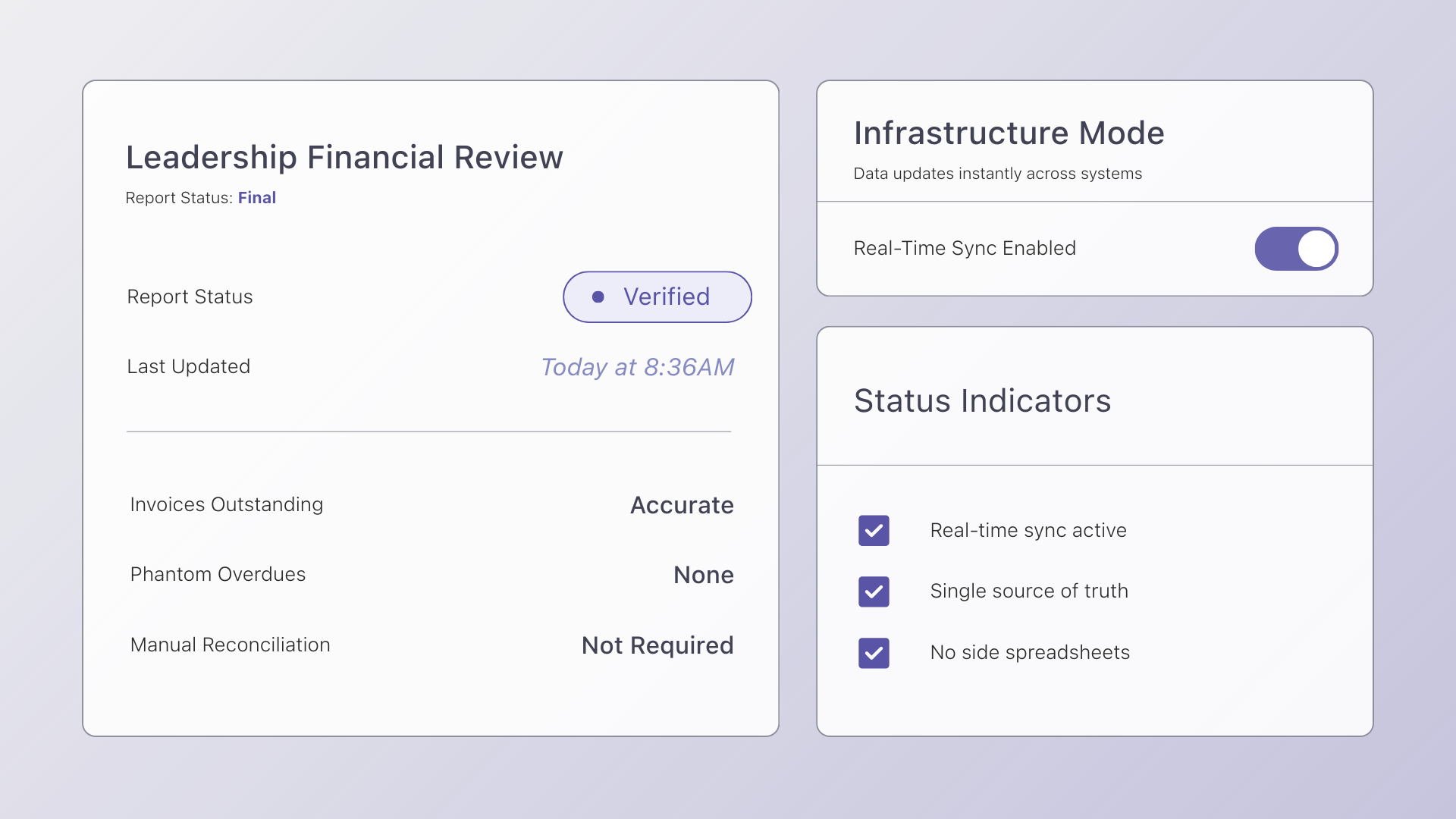
A CEO is only as effective as the data they receive. When payment information is siloed in an aging portal or requires manual manipulation to reach the executive dashboard, the risk of “dirty data” increases. This creates a psychological barrier for leadership; if you cannot trust that the numbers on your screen reflect reality, you will naturally hesitate during critical decision-making moments.
Modernizing your payment stack ensures that data integrity is baked into the process, providing a single source of truth that allows leadership to act with absolute certainty.
Building Optionality For The Future MSP
The landscape of managed services is shifting toward more diverse billing models, from pure per-seat pricing to consumption-based or project-heavy structures.
Legacy providers often lack the flexibility to support these evolving models without significant manual intervention. Investing in a modern infrastructure today is about more than just solving today’s friction; it is about building the optionality to pivot your business model tomorrow.
When your payment system is agile, your entire business becomes more resilient and ready to capitalize on new market opportunities.
Next Steps For Evaluating Your Infrastructure
We believe that a payment system should be an asset that empowers your finance team, not a hurdle they have to clear every day. Assessing your current provider requires a clear-eyed look at the time spent on administrative “workarounds.”
- Determine the actual efficiency of your current billing and reconciliation cycle.
- Identify the specific manual steps your team performs to sync data between your payment portal and your accounting software.
- Calculate the total hours spent per month by your finance team on manual reconciliation and chasing “phantom” overdue invoices.
- Survey your internal team to identify the top three friction points they encounter when managing client payments.
- Review your current client feedback or support tickets for any complaints related to the ease of use of your payment portal.
This assessment provides the clarity needed to decide if your current path supports your long-term scalability goals or if it is time to move toward a more automated future.
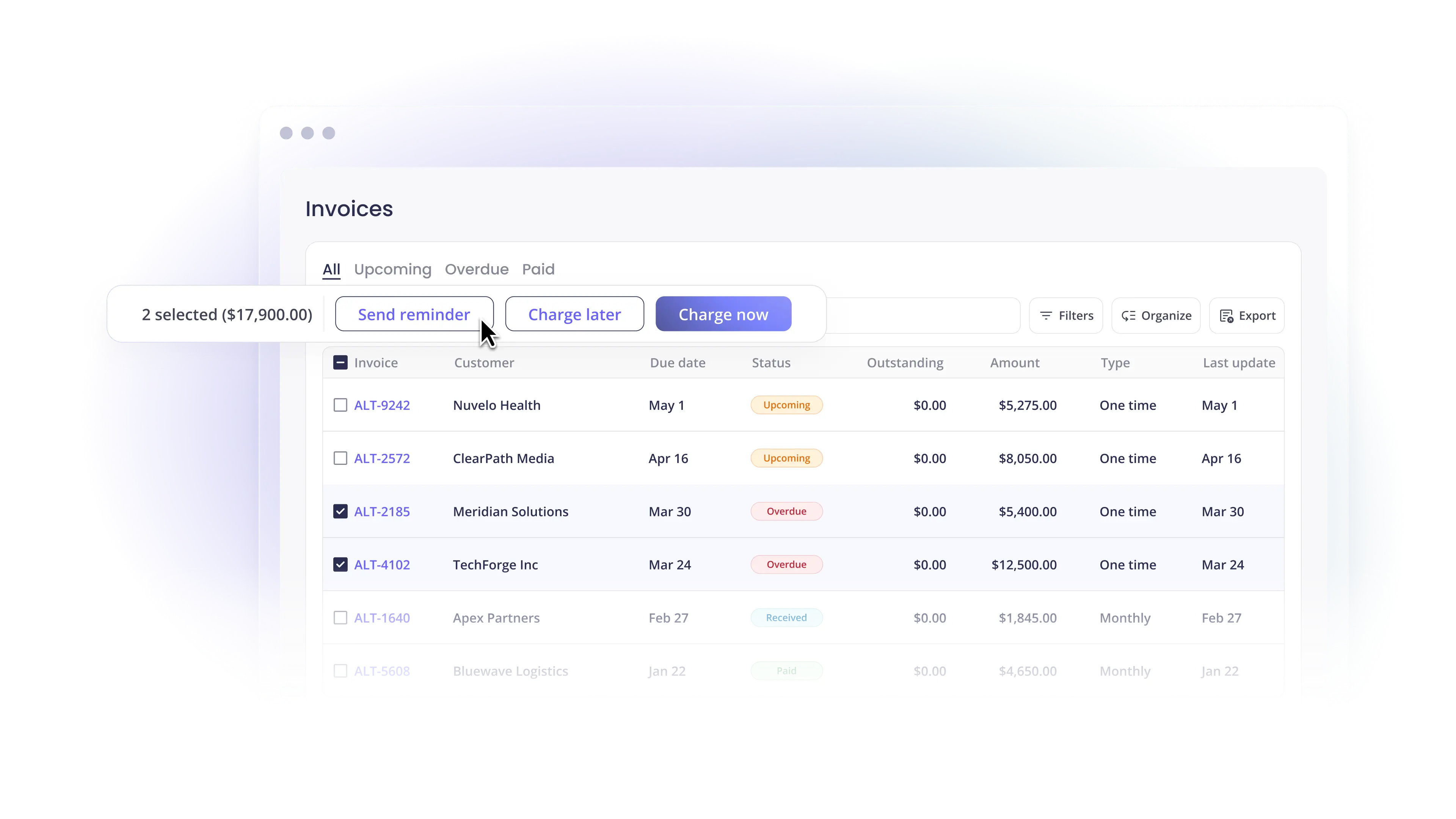
Simplify your customer payments, unlock instant cash flow
Keep reading


AI cash-flow forecasting: how business owners can test assumptions

Can AI financial analysis explain why your margins changed?