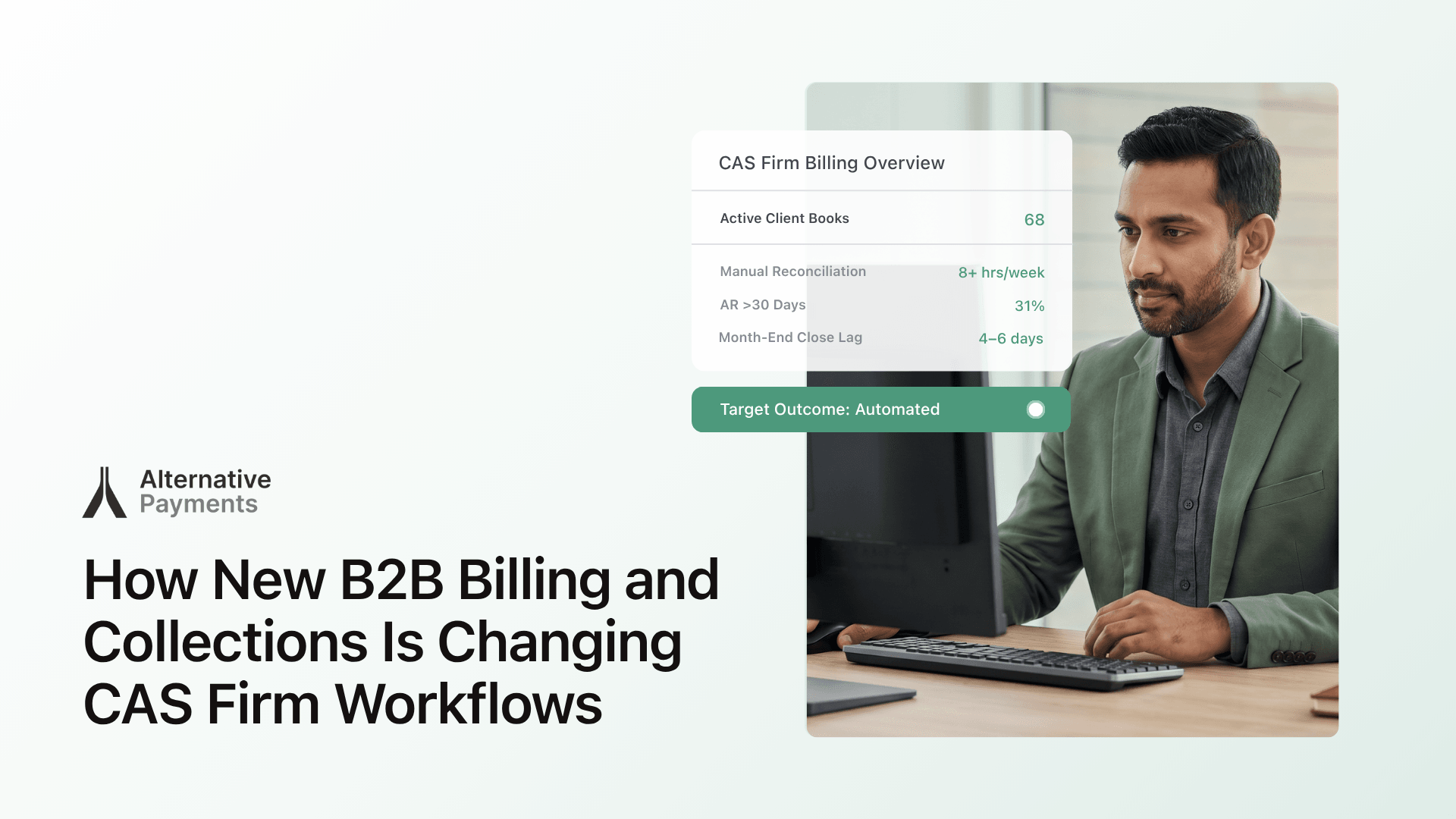
The Billing Problem Accounting Firms Will Not Talk About
What is driving CAS firms to adopt B2B billing and collections new infrastructure is straightforward: the old approach stopped scaling. For firms managing dozens of client books, the combination of QuickBooks reminders, manual reconciliation, and disconnected payment processors creates an overhead that compounds with every new client onboarded.
QuickBooks reminder caps are a specific example. A controller actively managing AR across a growing client book hits a ceiling on how many accounts can be tracked and followed up with simultaneously. Accounts beyond that threshold get less consistent attention, and late payment habits form in the gaps.
When payment data flows through multiple platforms that were not built to stay synchronized, reconciliation work accumulates across every client book at once. For firms running high client volumes, this is not an inconvenience. It is a structural inefficiency that erodes staff capacity every billing cycle.
The scale of the problem is industry wide. According to PYMNTS Intelligence (2024), more than 64% of B2B invoices are paid late, and businesses report that delayed payments directly stall their ability to pay their own vendors on time. For CAS firms, that statistic is not abstract. It shows up in cash flow gaps, slower month end close, and clients who have learned that late payment carries no consistent consequence.
Why Traditional Billing Tools Fall Short for CPA Firms
The tools most CAS firms rely on were built for specific parts of the billing workflow and serve those parts well. Where they fall short is in delivering the full automated loop that new B2B billing and collections infrastructure is designed to provide.
Ignition
Ignition handles the front end of the engagement lifecycle well. Proposal generation, engagement letter signing, and upfront payment collection are its core strengths. For firms that want to collect a deposit or set up a retainer at the point of engagement, it does that cleanly. The workflow narrows after the engagement goes live, particularly for firms that need ongoing automated collections, deep QuickBooks reconciliation, or ACH without transaction fees.
CPACharge
CPACharge is purpose built for accounting and legal professionals and handles trust accounting compliance in a way that most general purpose payment platforms do not. Its primary strength is payment acceptance. Firms that need automated AR reminders, a self service client portal, or a collections workflow that runs without manual input typically look for a platform that extends beyond the transaction layer.
QuickBooks Online Payments
QuickBooks Online Payments is a natural starting point for firms already operating inside the QuickBooks Online ecosystem. It covers basic invoice delivery and payment acceptance without additional integration work. As the client book grows, the need for surcharging, a persistent client portal, and automated AR follow up typically develops beyond what the built in payment layer was designed to provide.
The common thread across all three is a gap between payment acceptance and payment automation. According to the Institute of Finance and Management (IOFM, 2024), companies using automated AR workflows reduce days sales outstanding by an average of 15 to 25% and cut manual collection labor by up to 40%. Reaching that outcome requires a platform that handles the full billing cycle from invoice to reconciliation, not just the transaction in the middle.
A Modern Approach to New B2B Billing and Collections for CAS Firms
The most effective new B2B billing and collections setup for CAS firms is not a single replacement tool. It is a connected workflow where each step in the billing cycle hands off to the next one automatically, with no manual touchpoints in between.
The Workflow: Engagement to Reconciliation
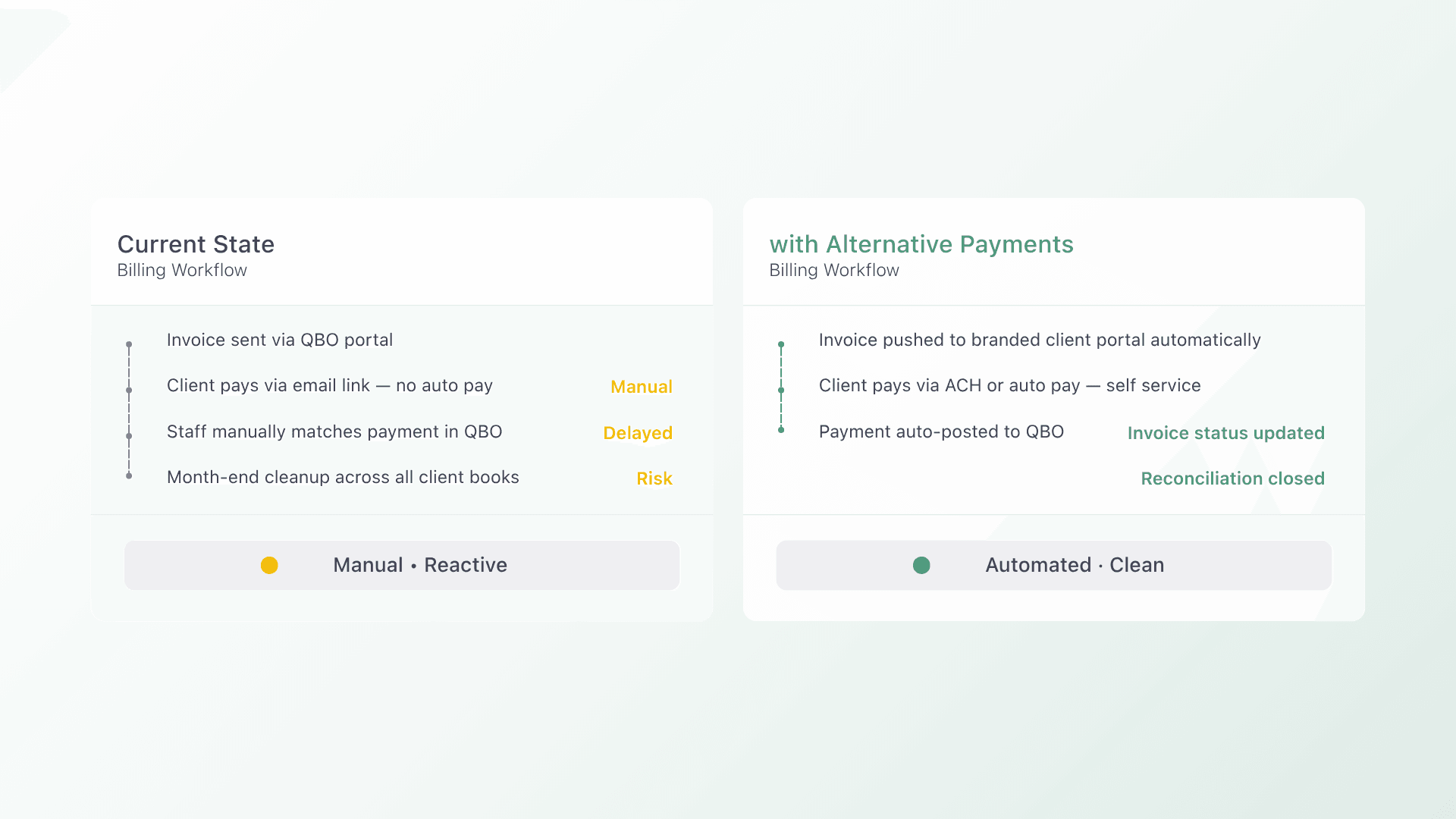
Engagement scoping and client work management sit in Karbon or Canopy, where your team tracks deliverables and manages billable time. Once billing is ready, invoices generate in QuickBooks Online, which stays the accounting source of truth. Alternative Payments then handles the collection side: presenting the invoice through a branded client portal, collecting payment via ACH or card, and posting the result back to QuickBooks automatically.
What this workflow eliminates is the three step disconnected process most firms run today: generate an invoice in QuickBooks Online, manually send a payment link or reminder, then return to QuickBooks Online to match the payment and reconcile. With Alternative Payments in the loop, those steps collapse into a single automated sequence that runs without staff input at any stage.
Unlike general purpose payment tools that accept payments but leave reconciliation, reminders, and AR follow up as manual steps, Alternative Payments was purpose built to close the full loop. The invoice syncs automatically from QuickBooks, the client pays through a branded self service portal, and the payment posts back without anyone on your team initiating any step in between.
ACH First with Surcharging as an Option
For CAS firms, ACH should be the default collection method. It carries lower processing costs than card, suits the recurring billing cycles that advisory retainers run on, and settles predictably. Alternative Payments supports ACH with no per transaction fee, making it meaningfully more cost effective at volume than platforms that charge a percentage per ACH payment.
For clients who prefer cards, built-in surcharging allows the firm to pass the processing fee through compliantly rather than absorbing 2 to 3% on every transaction. This is included natively in Alternative Payments, with compliance guardrails that enforce state level surcharging requirements automatically.
Client Self Service Portal
A branded self service portal gives clients persistent access to their invoice history, payment method management, and auto pay enrollment without requiring them to contact your office. For firms managing 50 or more accounts, this reduction in inbound billing requests is immediate. Clients who can manage their own payment details consistently pay faster and with fewer follow up touchpoints from your team.
What to Look for in a New B2B Billing and Collections Platform for Accounting Firms
Choosing the right new B2B billing and collections platform for a CAS firm comes down to four criteria that most general purpose payment tools do not fully address.
QuickBooks Online Integration Depth: Auto Reconciliation, Not Just Invoice Sync
Many platforms claim QuickBooks integration but deliver only invoice sync, leaving reconciliation as a manual step. The standard to look for is full auto reconciliation: payments post back to QuickBooks automatically, invoice status updates in real time, and no manual matching is required at month end. This is the integration depth that removes the recurring cleanup work that builds up across a multi-client book.
Trust Accounting Compliance
For firms handling client funds, trust accounting compliance is a non-negotiable capability. The platform needs to support the separation of client funds from operating funds in a way that meets professional standards requirements. Verify this explicitly before committing, as it is not universally supported and is frequently overlooked in general purpose payment platform evaluations.
Surcharging Support That Is Built In
Absorbing 2 to 3% on every card transaction across a growing client book is a significant and avoidable cost. A platform with built in surcharging compliance handles fee passthrough cleanly without requiring separate configuration or third party tools. Alternative Payments includes this natively, with guardrails that enforce compliance across state level surcharging requirements that vary by jurisdiction.
Client Portal with Auto Pay and AR Automation
A client portal with auto pay enrollment and automated AR follow up directly addresses the QuickBooks reminder cap problem. When reminders go out automatically and clients can self-enroll in auto pay, the number of accounts a controller can effectively manage is no longer limited by how many they can manually track. The cap on active AR management disappears when the follow up runs automatically.
Implementation: Getting Your CAS Firm Started
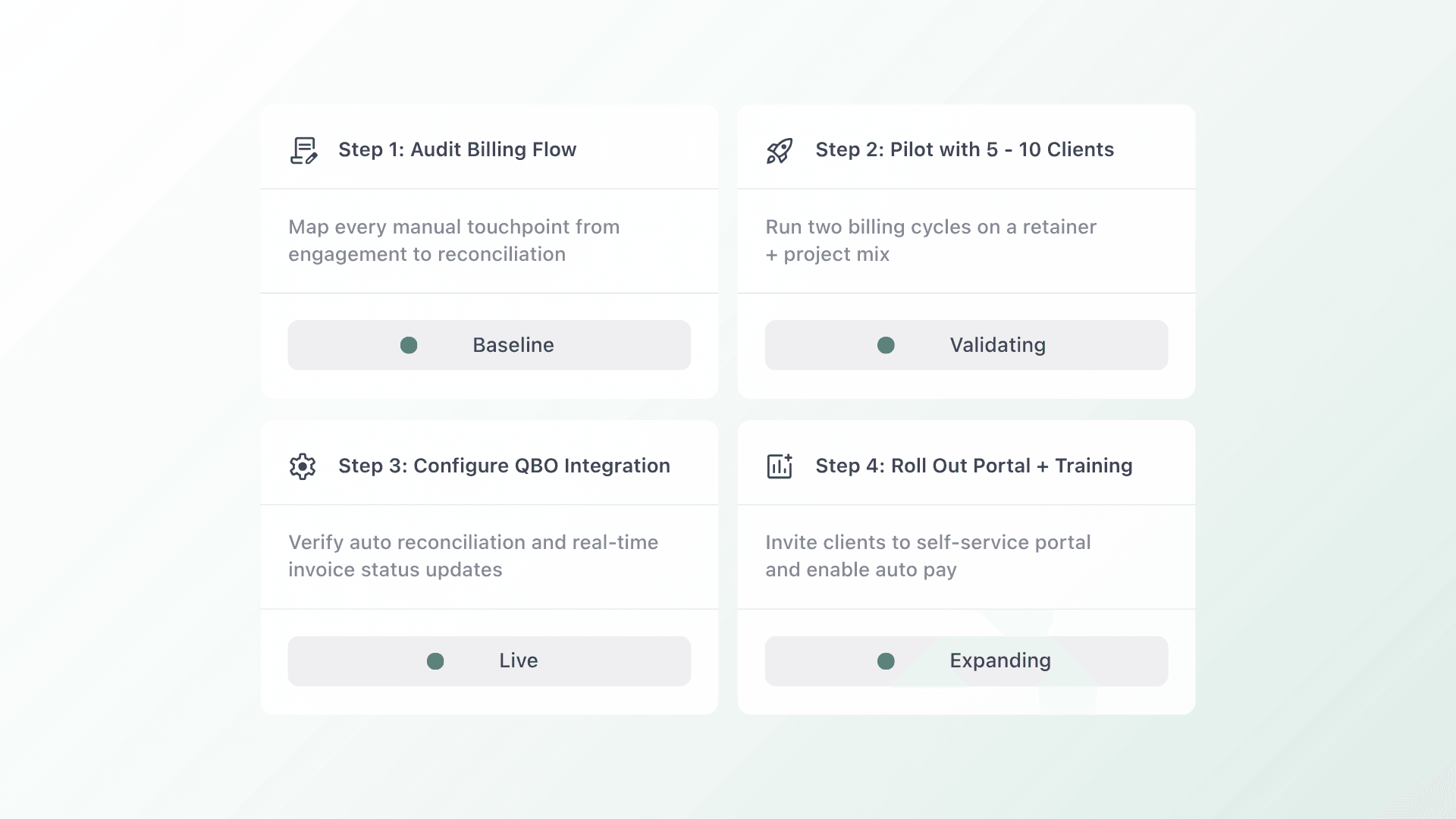
Moving to a modern B2B billing and collections workflow does not require rebuilding your firm’s billing infrastructure from the ground up. These four steps are how CAS firms make the transition without disrupting active client billing cycles.
- Audit your current billing flow. Map every manual touchpoint from engagement scoping to payment collected and reconciled. Where does a team member need to initiate an action, send a reminder, or manually match a transaction? Each touchpoint you identify is a step the new workflow will automate.
- Start with 5 to 10 clients on auto pay. Choose a representative mix of retainer and project based clients and run two full billing cycles before expanding. This validates the QuickBooks Online integration accuracy and surfaces any configuration adjustments before they affect your full book.
- Configure QuickBooks Online integration and verify reconciliation. Confirm that payments are posting back to QuickBooks Online automatically and that invoice status is updating in real time. Run a manual reconciliation check on the first billing cycle to verify accuracy before relying on the automation fully.
- Roll out client portal access and train staff. Send portal invitations to clients with clear instructions for setting up payment methods and enrolling in auto pay. Brief your team on what the new workflow handles automatically and what, if anything, still requires their attention.
Most CAS firms complete full rollout within two billing cycles. The phased approach is not about moving slowly. It is about protecting existing client relationships while the new workflow proves itself.
From Manual AR Chaos to B2B Billing and Collections New Standards
Adopting B2B billing and collections new practices is not a technology upgrade for its own sake. It is a revenue decision. When your billing workflow runs automatically from invoice to reconciliation, your team stops losing hours to manual follow up and starts focusing on the advisory work that actually grows the practice.
Clients get a payment experience that is simple, consistent, and on their own terms. Your firm gets faster collections, a lower DSO, and a billing operation that scales with the client book rather than against it.
Alternative Payments was built to deliver exactly that for accounting firms. Native QuickBooks Online and Xero integration with full auto reconciliation. ACH with no transaction fees. Built in surcharging. Collections Assist for automated AR follow up. A branded client portal that works from day one.
Book a 20-minute demo and see how Alternative Payments helps accounting firms automate client billing and get paid faster.