The MSP Challenge: One Person Handling Everything
At most MSPs, the entire finance and billing operation runs through one person. That means one team member is responsible for generating invoices, sending reminders, following up on overdue accounts, reconciling payments in QuickBooks, and producing monthly financial reports. All of it. Every billing cycle.
That structure works until the client book grows large enough that the manual workload exceeds what one person can reliably manage. At that point, some clients get followed up promptly and others do not. Invoices that go out without a reminder behind them tend to be paid on the client’s schedule rather than yours, and 30 to 60 day late payments become a recurring pattern rather than an exception.
The pattern is common across the industry. According to PYMNTS Intelligence (2024), more than 60% of B2B invoices are paid late, and businesses report that delayed payments directly stall their ability to pay their own vendors on time. For a lean MSP operation, that cash flow pressure is not abstract. It shows up in real decisions about vendor payments, payroll timing, and reinvestment capacity.
Better MSP recurring payment management does not solve this by adding headcount. It solves it by removing the manual steps that make the current workload unsustainable in the first place.
How Recurring Payment Challenges Affect MSPs Specifically
Late payments are the most visible symptom of a broken recurring payment workflow, but the operational costs run deeper than the AR aging report suggests.
Credit card processing fees are one of the most underestimated costs in MSP billing. When every client invoice is paid by card and the MSP absorbs the processing fee, 2 to 3% erodes off every transaction. Across a book of 50 or 100 clients paying monthly retainers, that is a meaningful and recurring margin hit that compounds silently over the course of a year.
ConnectWise holds the billing source of truth for most MSPs, but it was not designed to manage the collection side of the invoice lifecycle. Once an invoice leaves ConnectWise, the follow up, payment collection, and reconciliation back into QuickBooks typically requires manual steps that the ops person handles individually across every account.
The impact of fixing this is well documented. According to the Institute of Finance and Management (IOFM, 2024), companies using automated AR workflows reduce days sales outstanding by an average of 15 to 25% and cut manual collection labor by up to 40%. For an MSP with one person managing the entire billing operation, that reduction translates directly into time available for other work and a materially faster cash conversion cycle.
Cash flow management is not just an operational inconvenience for MSPs. According to Datto and Kaseya (2024), over 60% of MSPs cite cash flow management as a top operational challenge, with late client payments identified as the number one contributing factor. The tools most MSPs are using for recurring payment management were not built to address that challenge at its root.
A Practical Approach to MSP Recurring Payment Management: Step by Step
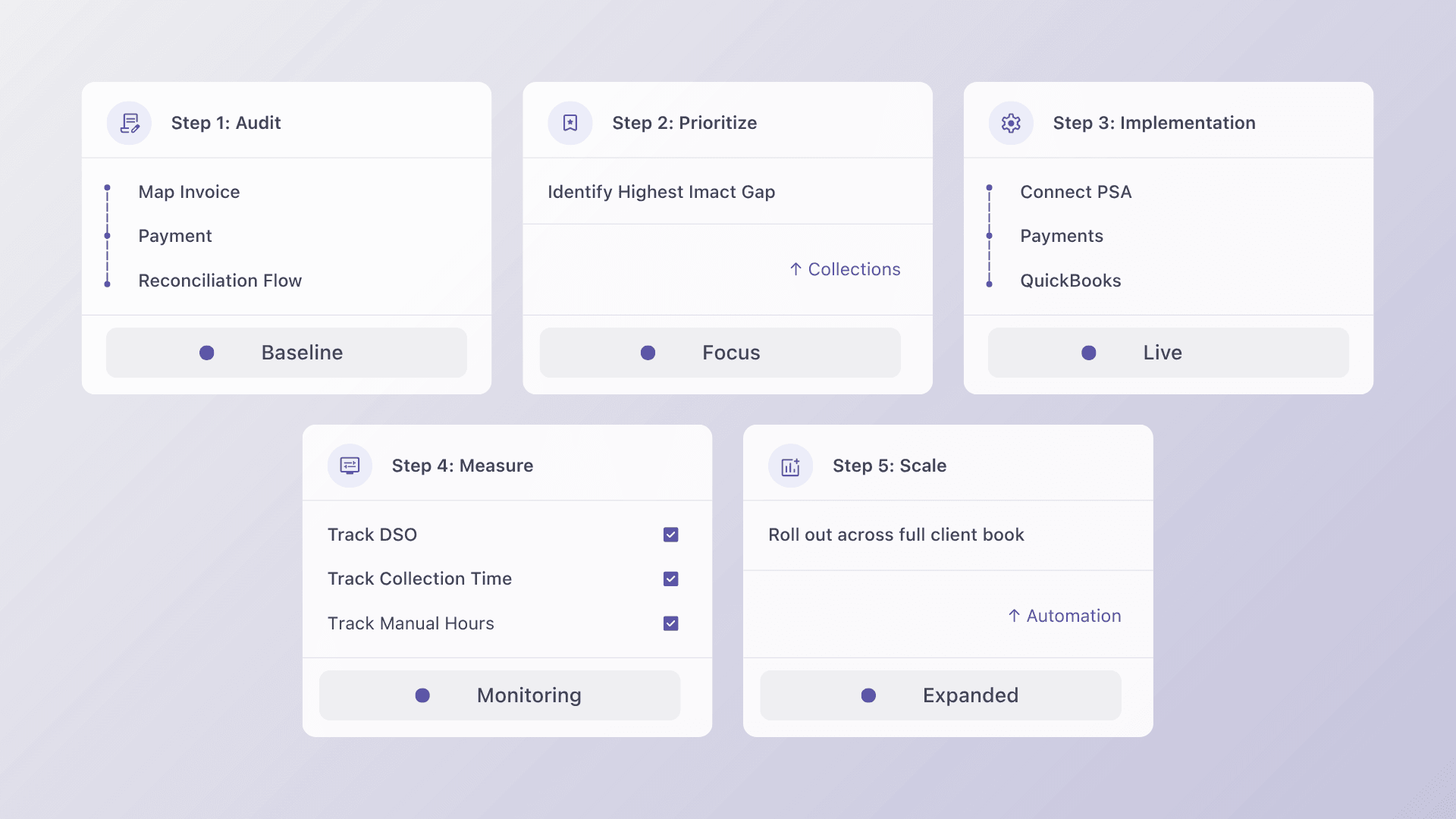
Improving MSP recurring payment management does not require replacing every tool in your billing stack. It requires identifying where the process is breaking down and building out from the highest impact point first. These five steps are how MSPs make that transition without disrupting their current client relationships.
- Audit. Map your current recurring payment workflow from invoice generation to payment received and reconciled. Identify the single biggest time sink or error source. For most MSPs it is the gap between invoice sent and payment collected, where manual follow up is the only thing keeping the process moving.
- Prioritize. Fix the highest impact gap first rather than attempting a full stack overhaul simultaneously. Payment collection is usually the right starting point because it directly affects cash flow, and improvements here are measurable within a single billing cycle.
- Implement. Connect your primary tool to Alternative Payments using the native integration. For ConnectWise users this means invoice data syncs automatically, payment collection and reminders run without manual input, and reconciliation posts back to QuickBooks without anyone on your team initiating it. Setup takes one to three business days with no middleware required.
Unlike general purpose payment platforms that require separate tools for reminders, reconciliation, and AR follow up, Alternative Payments handles the entire MSP recurring payment management workflow natively. Your ops person configures it once and the platform runs the full collection cycle from invoice to payment posted without manual input at any step.
- Measure. Track three numbers weekly for the first 90 days: DSO, average collection time per invoice, and manual hours spent on AR. These give you a clear picture of what the automation has delivered and where further optimization is available as you expand to the rest of your book.
- Scale. Once the workflow is validated with your pilot group, roll out to your full client base. Most MSPs complete the full transition within two billing cycles. The phased approach ensures that no configuration issue affects your entire revenue stream before it has been identified and resolved.
What to Look for in an MSP Recurring Payment Management Solution That Actually Works
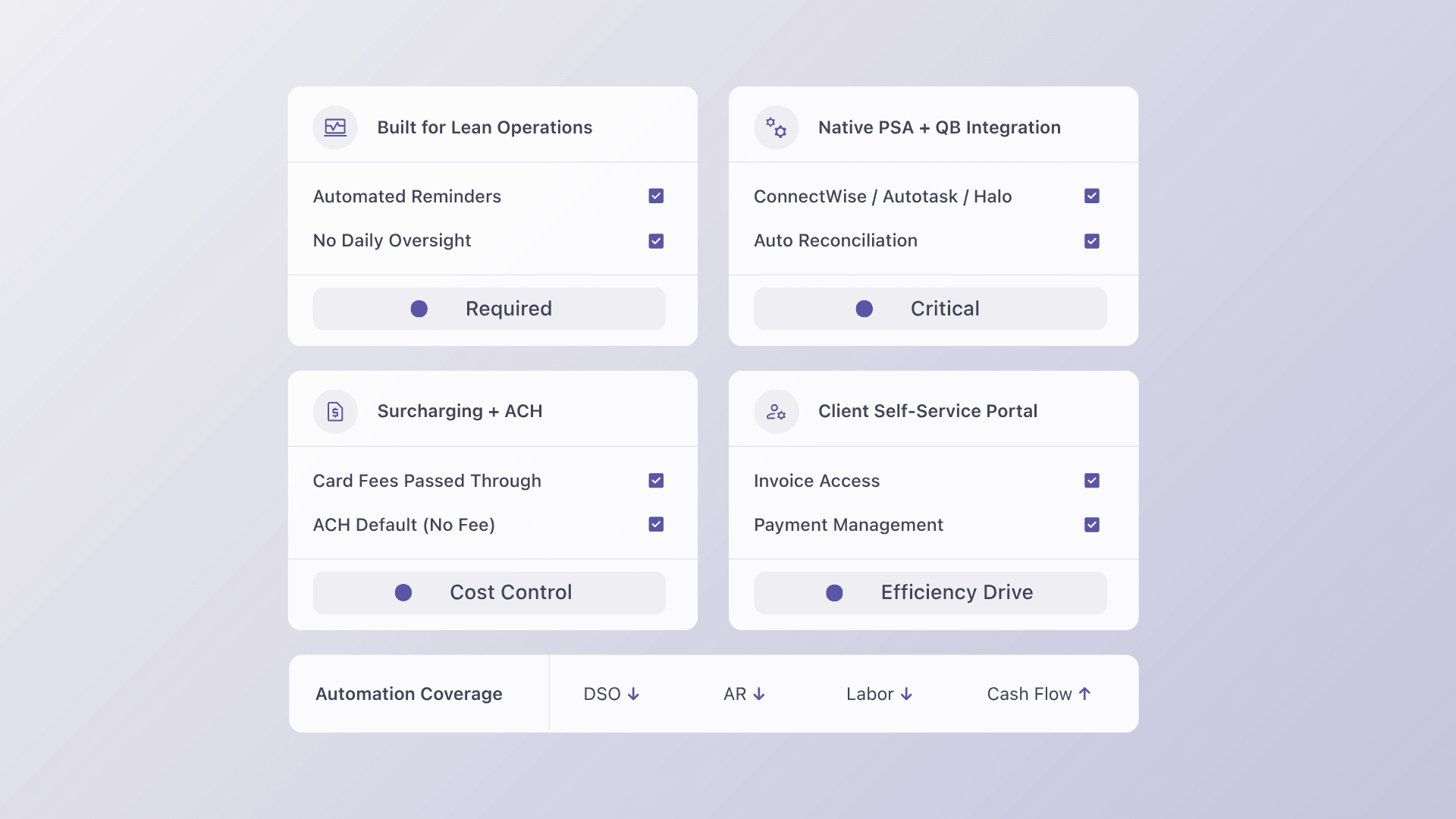
Not every payment platform is built to handle the full recurring payment lifecycle for an MSP. Most address one or two steps and leave the rest to manual processes. Unlike general purpose tools that solve for payment acceptance alone, Alternative Payments is purpose built for MSP recurring payment management from invoice sync through collections, reconciliation, and client self service. Here is what to evaluate before committing to a platform.
Built for Lean Operations: Automation That Runs Without Daily Oversight
When one person is managing the entire billing operation, the platform needs to run the collection workflow independently without requiring daily input. That means automated payment reminders on a configurable schedule, auto pay enrollment with retry logic for failed payments, and AR follow up that escalates automatically for overdue accounts. Alternative Payments includes Collections Assist, which handles all of this without manual initiation across every client account simultaneously.
Native PSA and QuickBooks Integration
The platform should connect natively to ConnectWise, Autotask, or HaloPSA and post reconciliation back to QuickBooks automatically. Platforms that require middleware or third party sync tools add maintenance overhead that compounds over time. Alternative Payments integrates natively with all three major MSP PSA platforms, with no middleware required and a typical setup time of one to three business days.
Surcharging to Stop Absorbing Card Fees
A platform with built in surcharging compliance allows MSPs to pass card processing fees to clients who pay by card rather than absorbing 2 to 3% on every transaction. This is not a minor feature at scale. On a book of 50 clients paying a $2,000 monthly retainer by card, that is $2,000 to $3,000 in processing fees absorbed every month. Alternative Payments includes surcharging with compliance guardrails built in, so there is no need for a separate solution to manage fee passthrough.
A Client Portal That Reduces Inbound Billing Requests
When clients can log in, view their invoice history, update payment methods, and enroll in auto pay on their own, your ops person stops fielding billing questions and the collection cycle shortens. Look for a branded self service portal that handles client payment management without requiring your team to act as the intermediary between the client and the payment system.
From One Person Chasing Invoices to a Billing Operation That Runs Itself
The MSPs that have solved their recurring payment management challenge are not the ones that hired more billing staff. They are the ones that replaced every manual step in their collection workflow with automation that runs consistently across every client account, every cycle, without exception.
The transformation is concrete. Your ops person stops spending 5 to 8 hours a week on invoice follow up and starts focusing on work that moves the business forward. Clients pay on time because automated reminders reach them consistently. Card fees stop eroding margin because surcharging handles the passthrough compliantly. And cash flow becomes predictable because auto pay means payment arrives on schedule rather than whenever the client gets around to it.
Alternative Payments was built for exactly this. Native integrations with ConnectWise, Autotask, and HaloPSA. Auto pay and ACH with no transaction fees. Collections Assist for automated reminders and overdue follow up. Built in surcharging. And a branded client portal that gives clients a self service experience from day one.