•
Professional Services
•
Automate Accounts Receivable
•
IT Services
•
Reduce DSO
•
Collections
March 10, 2026
How Collection Friction Devalues Your Practice
Many firms still treat accounts receivable as a bookkeeping issue. It appears on financial reports, gets reviewed during month-end close, and occasionally prompts a follow-up email when invoices extend too far beyond payment terms. But this perspective misses the real economic impact of receivables on the firm.
But the real impact of accounts receivable is rarely framed correctly.
Late payments are not simply delayed revenue. They represent capital that the firm has already earned but cannot yet use. That distinction matters because the ability to reinvest capital is one of the most important drivers of long term firm profitability.
When invoices sit unpaid for weeks or months, growth opportunities quietly disappear. Hiring is delayed. Technology upgrades get postponed. Marketing investment slows. What appears to be a collections issue is actually a capital allocation problem.
Understanding the opportunity cost of accounts receivable changes how leaders think about collections and payment infrastructure.
The Misconception Around Accounts Receivable
In many professional service firms, accounts receivable is treated as an administrative responsibility rather than a strategic financial lever.
Finance teams manage invoicing, track aging reports, and occasionally escalate overdue balances. Leadership attention tends to remain focused on revenue growth, client acquisition, and service expansion. Collections rarely receive the same strategic attention.
This mindset hides the true economic impact of slow payments.
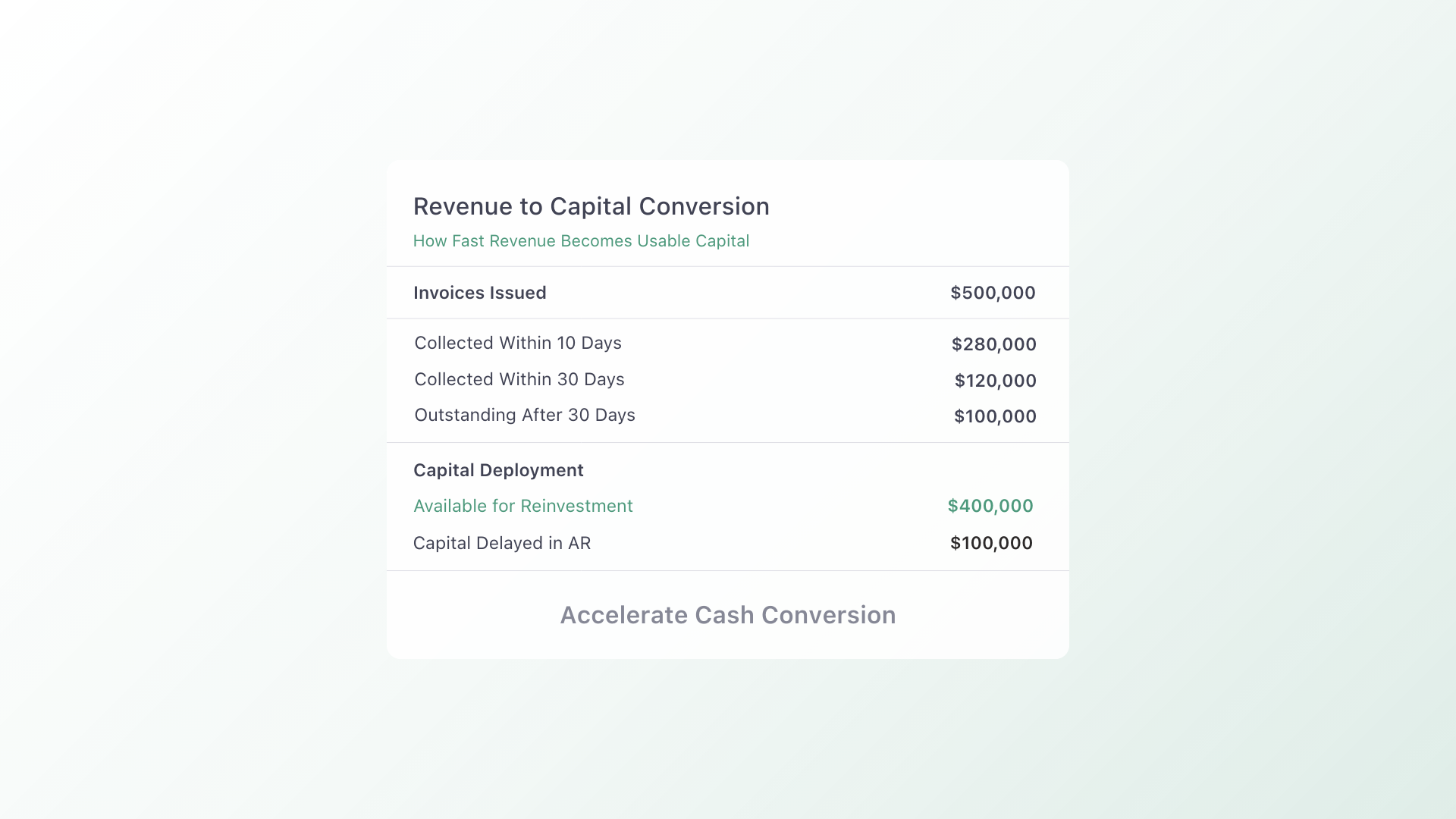
Revenue only contributes to firm profitability when it converts into usable cash. Until that conversion happens, the firm cannot deploy that capital toward productive investments. As a result, firms that appear healthy on the income statement can still experience financial constraints because revenue is trapped inside receivables.
Across industries, slow collections remain a widespread challenge. Industry surveys consistently show that around 70 percent of businesses experience collection cycles extending well beyond standard payment terms.
When those delays accumulate, the effect on growth becomes measurable.
Late Payments Are Frozen Capital
A more useful way to think about accounts receivable is through the lens of opportunity cost.
Every unpaid invoice represents capital that cannot currently be reinvested in the business. That capital might otherwise support several growth initiatives.
Firms frequently delay hiring decisions because leadership wants stronger cash reserves before expanding the team. Technology upgrades are postponed while partners prioritize liquidity. Marketing investment is scaled back because leaders prefer to preserve working capital.
In many cases, the funding for these initiatives already exists. It is simply sitting inside unpaid invoices.
Research consistently shows how widespread this problem has become. Small businesses with overdue invoices are owed an average of more than seventeen thousand dollars at any given time, and those delays frequently lead to cash flow constraints that slow hiring and operational investment.
This is the core opportunity cost of accounts receivable. When capital is frozen inside unpaid invoices, firms lose the ability to deploy resources quickly in response to growth opportunities.
The Compounding Effect of Slow Collections
The financial impact of slow collections compounds over time.
When revenue conversion slows, firms begin to experience a chain reaction of financial constraints. Working capital becomes tighter. Budget planning becomes more conservative. Leadership teams begin prioritizing liquidity preservation over strategic investment.
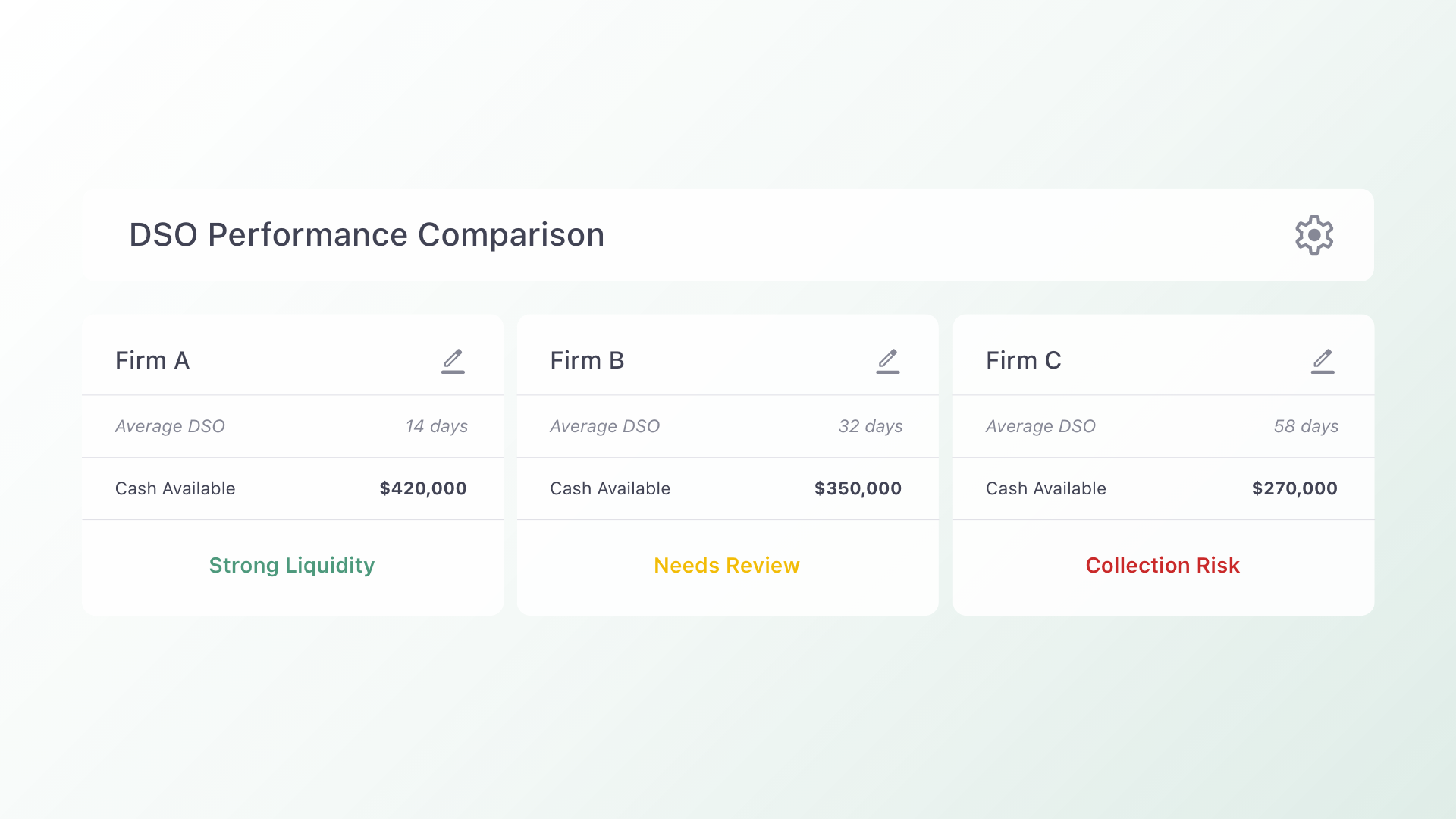
Delayed payments also lengthen the cash conversion cycle, which directly affects the speed at which revenue becomes deployable capital. Finance teams track this through metrics like DSO, which measures the average number of days required to collect payment after a sale.
When DSO rises, several operational pressures typically follow.
Firms may rely more heavily on credit lines to bridge temporary liquidity gaps. Finance teams spend additional time managing aging receivables. Forecasting becomes less predictable because incoming cash flows become harder to anticipate.
Over time, these inefficiencies place measurable pressure on firm profitability.
Why Firms Hesitate to Address Collections
If the financial impact is so clear, why do many firms tolerate slow collections?
The answer is rarely financial analysis. It is usually cultural hesitation.
Many partners view collections as an uncomfortable conversation with clients.
They worry that stronger payment policies might damage relationships or create friction in the client experience. As a result, billing processes remain flexible, payment terms stretch beyond their intended limits, and overdue balances accumulate quietly.
In reality, most payment delays are not caused by client resistance. They are caused by inconsistent billing processes and outdated payment infrastructure.
When payment systems are difficult or inconvenient, clients delay action simply because completing the transaction requires extra effort.
Collections problems often begin as process problems.
Operational Friction Inside the AR Process
Traditional billing systems unintentionally create barriers that slow down payment cycles.
Invoices may be generated manually at the end of the month, which delays delivery. Payment options may be limited to bank transfers or mailed checks. Finance teams must manually reconcile incoming payments into accounting systems, which adds administrative work and slows financial visibility.
Even small inefficiencies compound over time.
Late payments are already placing increasing pressure on businesses across industries. Research indicates that delayed payments significantly strain operations and force firms to tighten credit controls or seek new technology solutions to improve collections.
When firms rely on manual workflows to manage receivables, finance teams spend time tracking payments instead of analyzing financial performance.
Operational friction inside accounts receivable quietly erodes firm profitability.
How Modern Payment Infrastructure Changes the Equation
Improving collections does not require uncomfortable conversations with clients. In most cases, it requires better financial infrastructure.
Modern payment systems remove many of the operational barriers that slow down payment cycles. Automated invoicing, embedded digital payment options, and real time reconciliation all help reduce the time between invoice issuance and payment receipt.
These systems create a smoother experience for both the firm and the client.
Invoices arrive promptly and contain clear payment options. Clients can complete transactions immediately rather than navigating manual processes. Finance teams gain faster visibility into incoming revenue and can close financial periods with greater accuracy.
When payment friction disappears, collection timelines shorten naturally.
The result is faster capital velocity, stronger cash flow predictability, and improved Firm Profitability.
Turning Accounts Receivable Into Usable Capital
This is where infrastructure becomes critical.
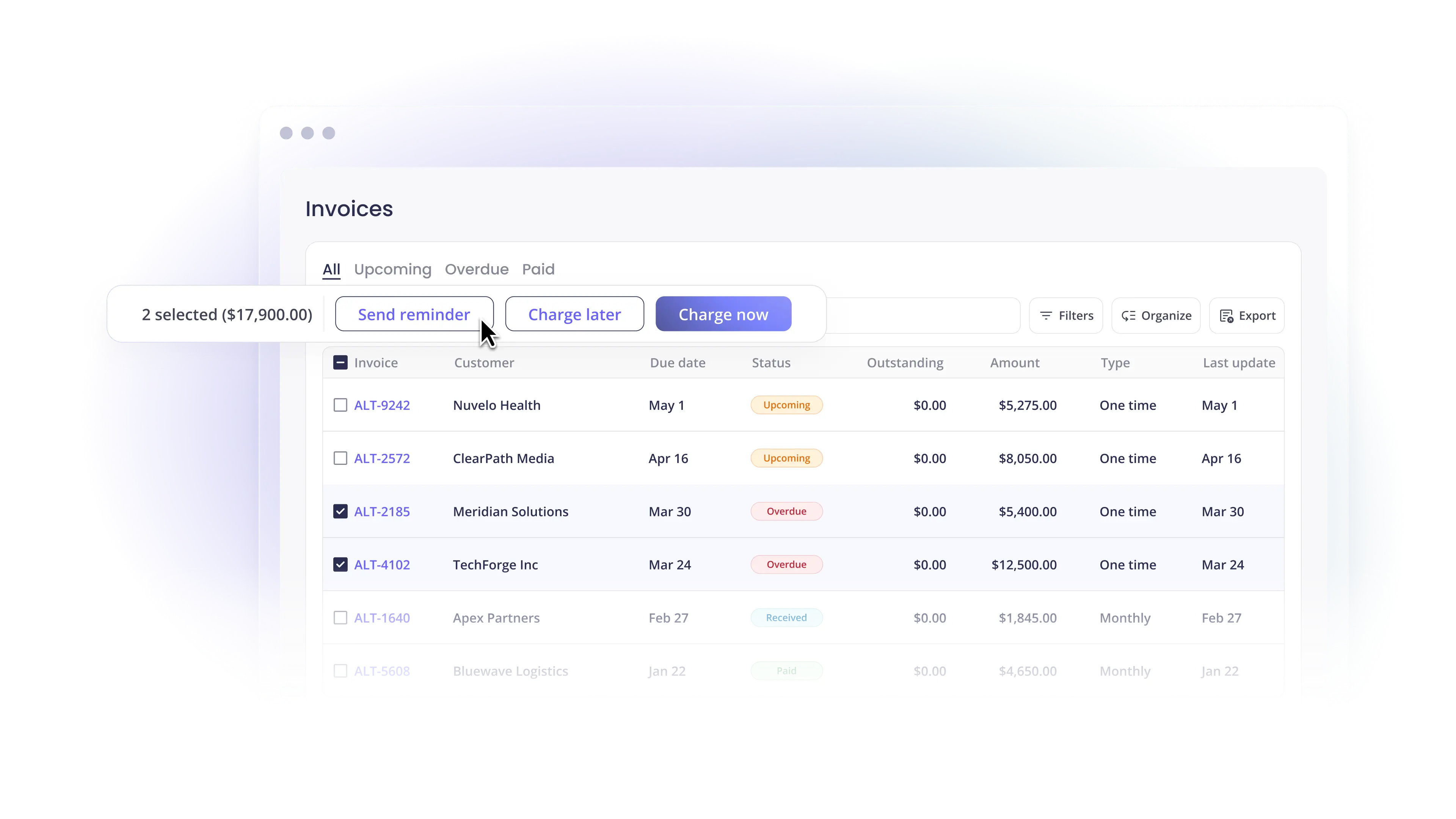
Alternative Payments provides financial infrastructure designed to unify invoicing, payment collection, and reconciliation into a single automated workflow. Instead of relying on fragmented systems and manual processes, firms can standardize how invoices are delivered, how payments are collected, and how transactions are recorded.
Invoices generated through the platform include embedded payment options that allow clients to complete transactions immediately. Automated workflows send reminders and follow up communications without requiring manual intervention from finance teams.
Once payment is received, transactions reconcile automatically into accounting systems, reducing the administrative workload associated with accounts receivable.
These improvements do more than streamline operations. They accelerate the conversion of revenue into usable capital. When firms reduce payment delays and improve collection consistency, they gain faster access to cash that has already been earned.
That capital can then be reinvested into hiring, technology upgrades, marketing initiatives, and operational expansion.
Over time, faster capital cycles translate directly into stronger firm profitability.
Turning Accounts Receivable Into a Strategic Advantage
Accounts receivable should not be viewed as an administrative function. It is a financial system that determines how quickly revenue becomes deployable capital.
Firms that treat AR strategically tend to focus on capital velocity rather than simply revenue generation. They recognize that growth depends not only on how much revenue the firm produces, but also on how efficiently that revenue converts into cash.
When payment infrastructure improves, leadership gains more financial flexibility. Investment decisions can be made faster. Expansion initiatives face fewer liquidity constraints. Financial forecasting becomes more reliable.
In short, optimizing accounts receivable strengthens the economic engine of the firm.
Plugging the Hidden Leak
Uncollected fees rarely appear as a dramatic crisis. They accumulate quietly inside aging reports, creating what can be described as a hidden financial leak.
Every delayed payment represents capital that cannot currently be reinvested in the firm. Over time, those delays limit hiring, technology investment, and operational expansion.
Firms that address accounts receivable strategically unlock growth capital that already exists within their business. The opportunity is not to generate new revenue, but to accelerate access to the revenue that has already been earned.
By improving payment infrastructure and accelerating collections, leadership teams can convert earned revenue into usable capital faster. That shift strengthens financial flexibility, improves operational efficiency, and ultimately drives stronger firm profitability.
For firms looking to modernize their billing and payment infrastructure, learning how platforms like Alternative Payments streamline accounts receivable may be the first step toward closing one of the most overlooked leaks in business growth.
Learn more about how Alternative Payments can streamline accounting workflows and accelerate accounts receivable so your firm can convert earned revenue into usable capital faster.
Simplify your customer payments, unlock instant cash flow
Keep reading
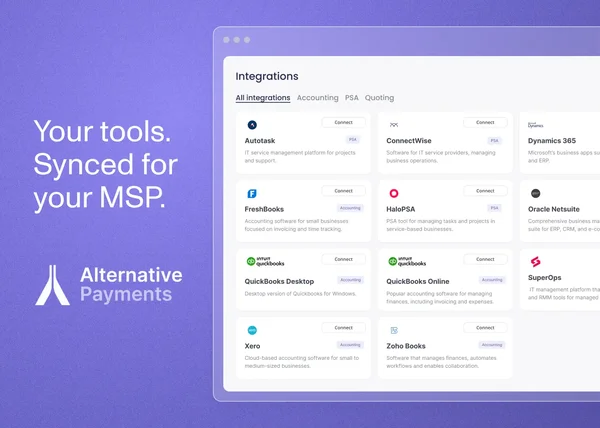

How Seamless PSA Integration for MSP Payments Is Changing MSP Operations

ConnectBooster vs. Alternative Payments: Which MSP Payment Platform Fits Your Billing Workflow?