•
Professional Services
•
Automate Accounts Receivable
•
IT Services
•
Mid-market
February 10, 2026
How Administrative Efficiency Increases Firm Valuation & Cash Flow
In most professional services firms, growth discussions follow a familiar script. Leaders debate utilization rates, billable hours, pricing power, and pipeline. These are the levers everyone knows to pull, and they matter.
But there is another lever, rarely discussed in boardrooms and often dismissed as “back office,” that quietly determines how much profit actually reaches partners at the end of the quarter: administrative efficiency, particularly in billing and payments.
This isn’t efficiency as a feel-good operational goal, it’s efficiency as a direct driver of valuation, liquidity, and partner distributions.
The Hidden Cost of Administrative Drag in Billing and Payments
Administrative drag doesn’t announce itself loudly. It accumulates slowly, embedded in routine tasks that feel unavoidable: manually generating invoices, reconciling payments across systems, following up on late accounts, reissuing corrected bills, and explaining payment options to clients who just want to pay and move on.
Each task seems small. Collectively, they form a system-wide tax.
Multiple industry studies estimate that professional services firms spend 15–30% of non-billable administrative time on billing and collections alone, time that produces no client value and no incremental revenue.
That time doesn’t just disappear, it converts directly into lower margins.
Operational Efficiency as Non-Dilutive Growth
The mistake many firms make is treating administrative efficiency as a cost-control initiative. In reality, it functions much more like margin expansion.
When billing and payments are manual, every dollar collected carries friction:
- Delayed invoicing extends revenue recognition
- Payment failures increase labor costs
- Reconciliation errors distort cash forecasts
- Leadership hesitates to deploy capital due to uncertainty
When those processes are automated, the opposite happens. Revenue moves faster through the firm without additional sales effort.
This is why private equity firms increasingly describe operational efficiency as “non-dilutive growth.”
No new clients. No new hires. Just cleaner flow.
How Administrative Drag Becomes a Partner Distribution Problem
Partner frustration rarely starts with billing. It starts with distributions.
The firm looks profitable on paper. Revenue is strong. Utilization is high. Yet quarterly distributions feel constrained. Cash is tight. Reserves seem thinner than expected.
The culprit is often timing.
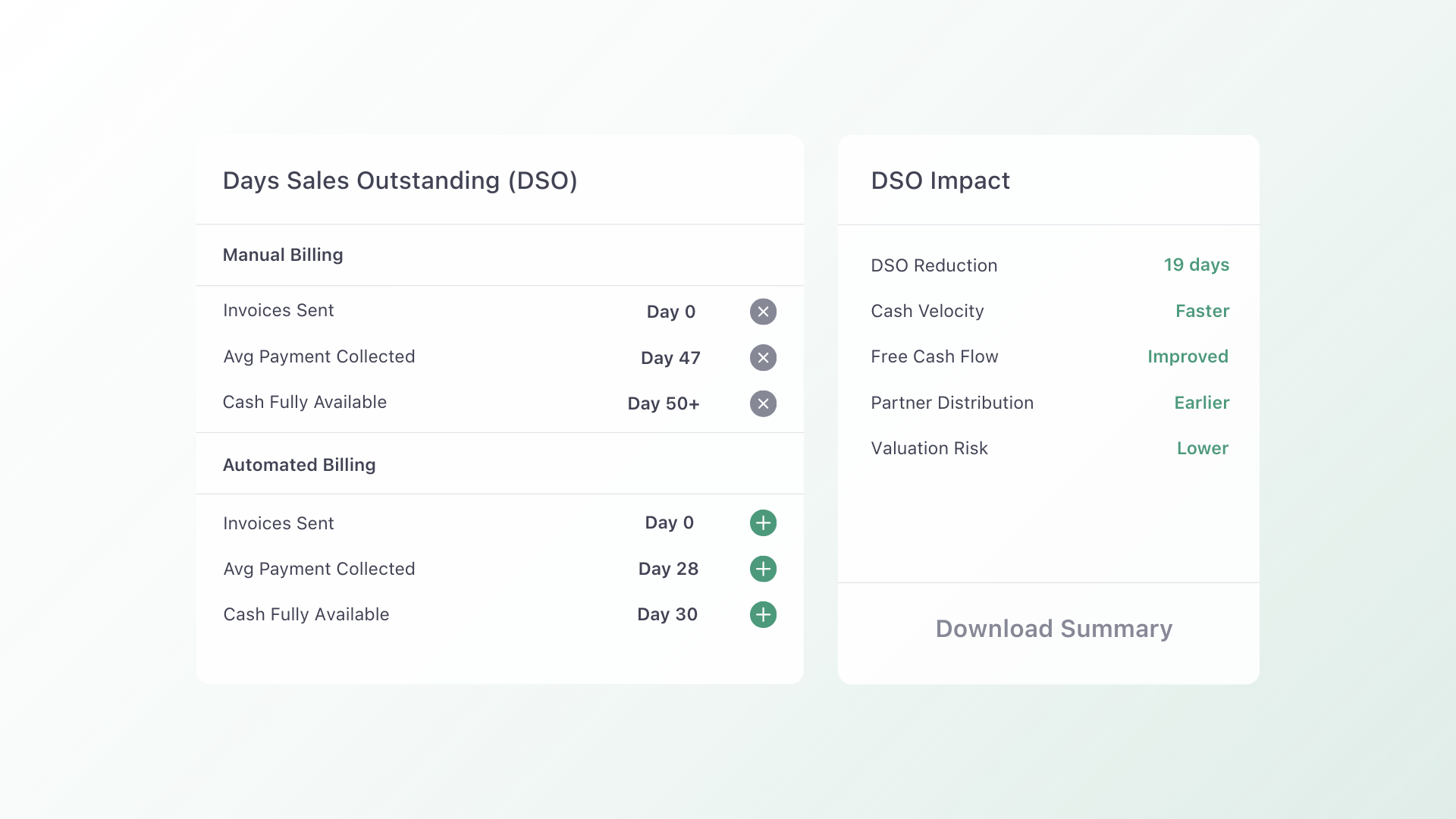
Manual billing processes extend Days Sales Outstanding (DSO), forcing firms to float payroll, rent, and vendor costs longer than necessary. The result is a structural delay between earned revenue and distributable cash.
Research from Invevo, shows that firms reducing DSO by even 10–15 days materially increase free cash flow available for distributions. by even 10–15 days materially increase free cash flow available for distributions.
Partners may never see a line item labeled “administrative drag,” but they feel it every quarter.
Why EBITDA Multiples Depend on Cash Flow Predictability
Valuation is ultimately a confidence exercise.
Buyers don’t just evaluate revenue, they evaluate predictability. They want to know whether earnings are repeatable, scalable, and insulated from operational risk.
Manual billing and fragmented payment systems introduce uncertainty:
- Revenue timing becomes unreliable
- Collections require heroics instead of systems
- Financial reporting lags reality
- Growth appears labor-dependent
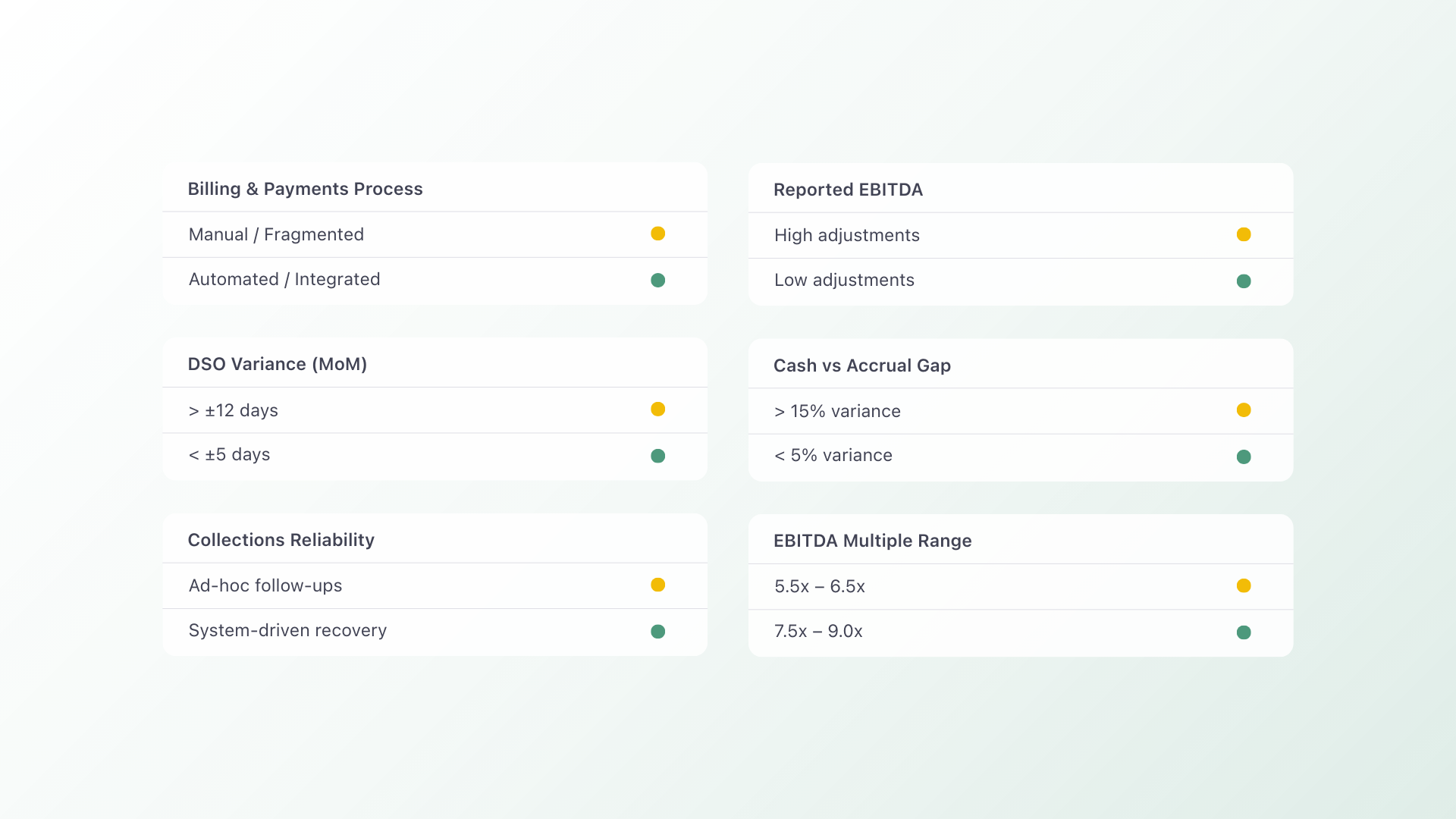
M&A advisors and valuation frameworks consistently emphasize that EBITDA multiples are driven by performance, not industry labels. Firms that demonstrate durable margins and stable, predictable cash flows are valued more highly than peers. In professional services, automated billing and payment systems strengthen that operational performance by making cash flows more defensible, repeatable, and easier for buyers to underwrite.
Clean financial systems don’t just make firms easier to run. They make them easier to underwrite.
Cash Velocity Is a Strategic Asset
Cash velocity, the speed at which revenue turns into usable cash, is one of the most under appreciated competitive advantages in professional services.
Firms with predictable, automated payment workflows:
- Rely less on lines of credit
- Fund growth internally
- Absorb market volatility more easily
- Make investments earlier than competitors
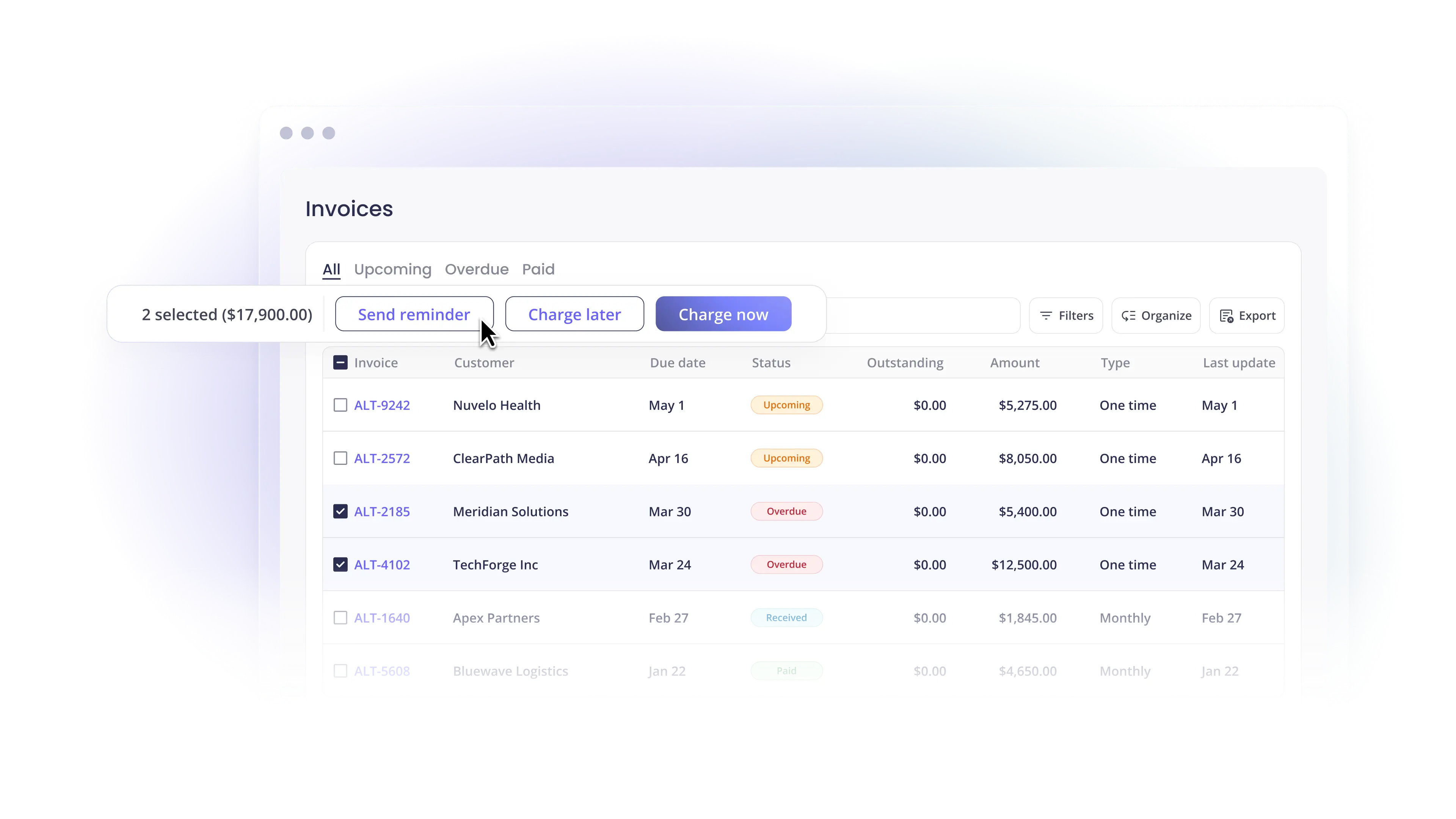
This is where modern payment platforms like Alternative Payments quietly reshape the business. By standardizing invoicing, automating collections, and offering flexible B2B payment options, firms accelerate the movement of cash without increasing operational strain.
It’s not about getting paid eventually. It’s about getting paid consistently.
Why Buyers and Private Equity Firms Value Operational Calm
Sophisticated buyers don’t like surprises. Neither do partners.
Automated billing and payment systems create what investors often describe as “operational calm”—a state where financial data is current, accurate, and trusted.
While private equity firms don’t publish formal diligence checklists, commonly used diligence frameworks and operating reviews routinely assess back-office automation and financial infrastructure alongside traditional risk factors such as revenue concentration, client retention, and margin durability. These elements signal how scalable, and how defensible, the business truly is.
When financial integrity is high, buyers perceive less risk. Less risk translates directly into higher valuation multiples.
How Administrative Drag Slows Leadership Decision-Making
Administrative drag doesn’t just live in the finance department. It quietly shapes how leaders behave and how firms grow.
When billing and payment data is delayed, fragmented, or unreliable, leadership operates with hesitation instead of confidence. Hiring decisions get postponed because cash flow timing feels uncertain. Potential acquisitions or strategic investments slow down as partners wait for cleaner numbers. Growth initiatives stall while leadership asks for “one more month of clarity” before committing.
Over time, this pattern compounds. Momentum fades, opportunities pass, and the firm begins to underperform not because demand is weak, but because decision-making is constrained by incomplete information.
Real-time visibility into receivables, cash flow, and payment performance removes this invisible brake. When leaders trust the numbers in front of them, they move decisively, because the business is finally moving at the same speed as the data.
Billing and Payments as a Client Experience Driver
Clients may never comment on excellent billing, but they always notice bad billing.
Confusing invoices, limited payment options, and repeated administrative errors introduce friction unrelated to service quality. Over time, that friction erodes trust.
Client experience research consistently shows that operational friction increases churn risk, even when core service delivery remains strong.
A frictionless billing experience doesn’t just reduce complaints. It reinforces professionalism.
Turning Administrative Efficiency Into Long-Term Ownership Leverage
When billing and payments are automated, something else happens: people get smarter work.
Instead of managing exceptions and corrections, administrative staff shift toward:
- Forecasting
- Analysis
- Client financial insights
- Strategic support
This transformation increases organizational leverage without increasing headcount. It’s one of the rare changes that improves morale, accuracy, and profitability at the same time.
Building Firms That Distribute More and Last Longer
Administrative efficiency isn’t about chasing perfection in the back office. It’s about building a firm that can withstand pressure, scale with confidence, and reward its owners consistently.
When billing and payment friction is removed, firms don’t just operate more smoothly—they unlock tangible financial outcomes. Free cash flow strengthens. Partner distributions become more predictable. Valuations rise because earnings are cleaner, faster, and easier to trust. And when market conditions shift, these firms adapt quickly instead of reacting defensively.
This is where platforms like Alternative Payments move from operational tool to strategic infrastructure. By standardizing and automating the entire billing and payment lifecycle, Alternative Payments eliminates the invisible drag that quietly constrains cash flow, decision-making, and long-term value creation.
What’s left is clarity—clarity that fuels reinvestment, accelerates growth, and compounds equity over time.
In a market that rewards speed, confidence, and financial discipline, efficiency isn’t overhead.
It’s ownership leverage.
Simplify your customer payments, unlock instant cash flow
Keep reading


ConnectWise QuickBooks integration: what a complete payment workflow should cover

NetSuite payment gateways: an enterprise MSP buyer's framework