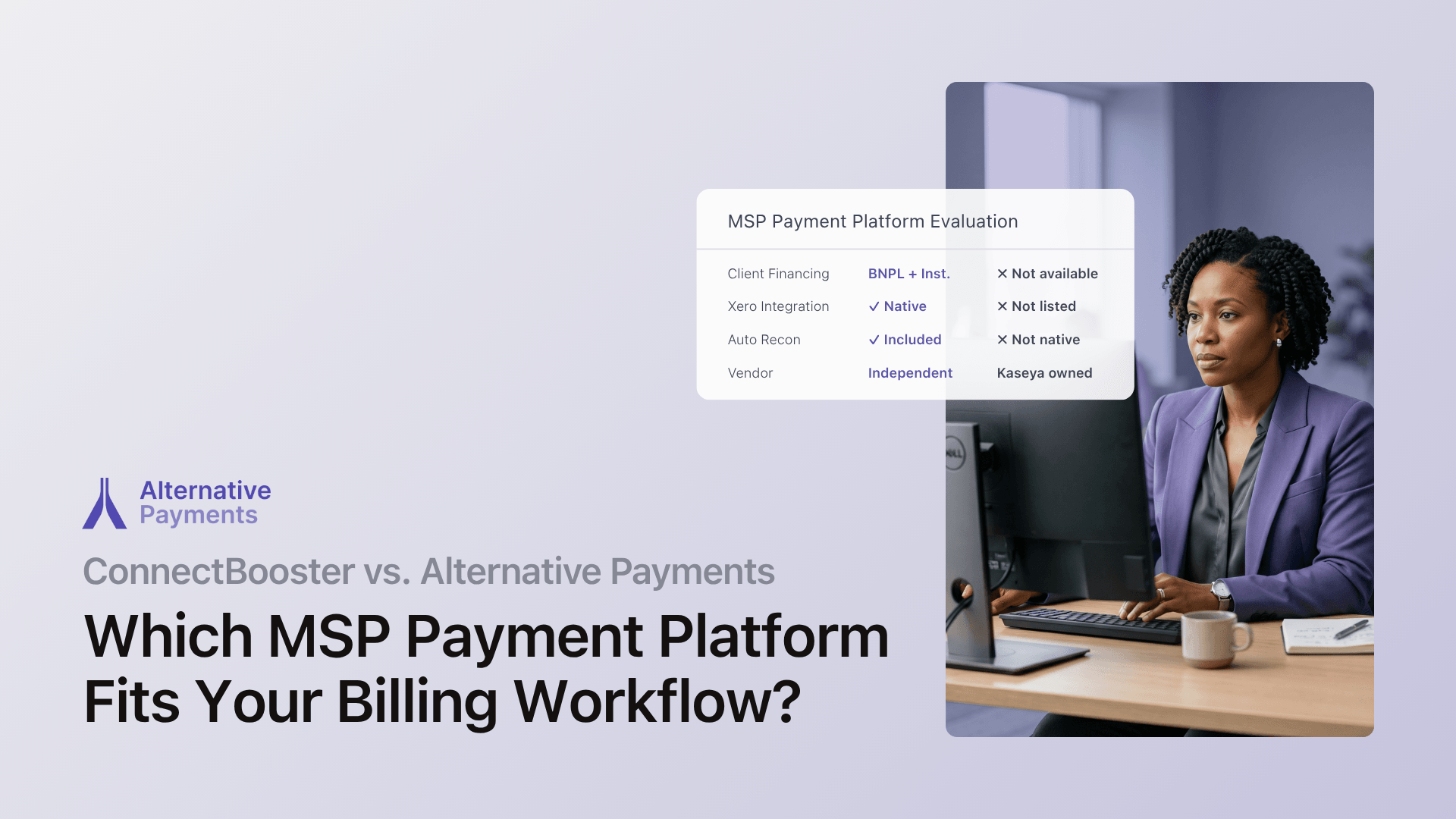
Alternative Payments offers broader PSA coverage, flat monthly pricing, dedicated AR automation, and vendor independence. ConnectBooster fits MSPs already committed to the Kaseya ecosystem who need a payment layer within that stack. The right choice depends on your PSA environment, billing volume, and how much manual collections work you want to eliminate.
The managed services market is on pace to exceed $1.1 trillion by 2034, and the payment platform you choose now shapes how efficiently your finance operations scale with that growth. Below, we compare both platforms across the six dimensions that matter most for MSP billing: PSA integrations, pricing, AR automation, client payment experience, accounting connections, and vendor independence.
What Each Platform Does
Both ConnectBooster and Alternative Payments sit between your PSA and your accounting system. They pull invoices, present them to clients, collect payments via ACH and credit card, and push transaction data back into your financial stack. That shared foundation makes the comparison worthwhile. The differences emerge in how deep each platform goes and where its boundaries are.
ConnectBooster is a Kaseya-owned payment platform focused on accounts receivable automation for MSPs using ConnectWise and Autotask. It provides a client portal, automated payment reminders, autopay rules, and two-way PSA sync. Since Kaseya acquired ConnectBooster, the platform has been bundled into Kaseya 365 subscriptions and optimized for the Kaseya product ecosystem.
Alternative Payments is an independent B2B payments and checkout infrastructure provider purpose-built for service businesses. It offers native PSA integrations with ConnectWise, Autotask, and HaloPSA, automated reconciliation to QuickBooks and Xero, ACH with no per-transaction fee, a dedicated Collections Assist tool for AR automation, and client-facing financing options including installments and B2B buy now pay later. The company raised $22 million in total funding from MissionOG and Third Prime to accelerate product development and expansion.
PSA Integration Depth
This is where the comparison starts to diverge. Your PSA generates invoices, but it does not collect payments, reconcile deposits, or follow up on overdue accounts. The payment platform fills that gap, and the quality of the PSA connection determines how much manual work remains.
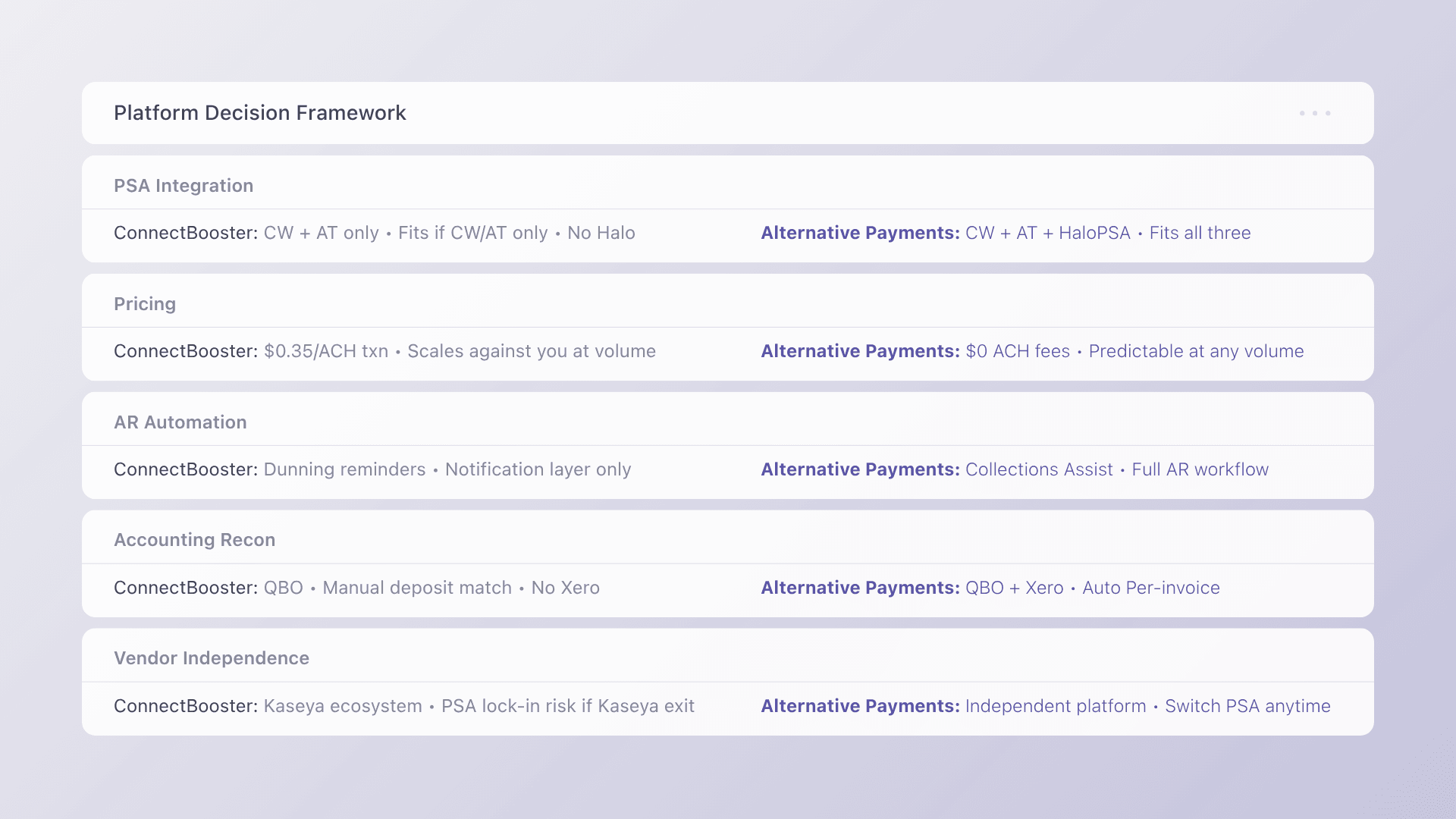
ConnectBooster integrates natively with ConnectWise and Autotask, the two PSA platforms in the Kaseya ecosystem. If you run either of those tools, ConnectBooster syncs invoices bidirectionally and pushes payment status back to the PSA. It does not currently offer native HaloPSA integration.
Alternative Payments connects natively with ConnectWise, Autotask, and HaloPSA, all three major MSP PSA platforms. This matters for MSPs running HaloPSA or managing a mixed PSA environment across multiple client accounts. The sync is bidirectional and real time, with no middleware or CSV exports required. For a deeper look at how PSA integration affects billing workflows, read How PSA Integration Is Changing MSP Operations.
Bottom line: If you run HaloPSA or anticipate switching PSA platforms, Alternative Payments is the only option with native support across all three. If you are fully committed to ConnectWise or Autotask with no plans to change, both platforms cover your PSA.
Pricing Structure
Pricing determines whether your payment platform costs scale predictably or balloon with billing volume.
ConnectBooster uses per-transaction pricing with a custom quote structure. Third-party reviews report a starting price around $349/month with a 36-month commitment, plus $0.35 per ACH transaction and additional merchant services fees for credit card processing. PCI compliance and email tracking come at extra cost. The total expense depends on transaction volume, payment method mix, and contract negotiation.
Alternative Payments operates on a flat monthly fee with no per-transaction charges and no ACH fees. Credit card processing runs at 2.9% + $0.30 for Visa/Mastercard and 3.5% for American Express, with surcharge options to pass card fees to clients. A single monthly bill covers all platform fees, which makes cost predictable regardless of how many invoices you process.
Bottom line: MSPs processing high volumes of ACH payments see the biggest cost difference. Per-transaction ACH fees compound quickly. At 200 ACH transactions per month, that $0.35 fee adds $70/month on top of the base platform cost. Flat-fee pricing removes that variable entirely. For a detailed breakdown of how ACH economics affect MSP billing, see our ACH guide.
AR Automation and Collections
Late payments are the most common cash flow problem for MSPs. The question is whether your payment platform actively reduces overdue invoices or merely sends notifications.
ConnectBooster includes automated dunning, including payment reminders and follow-up emails on a configurable schedule. This covers the basics of collections communication, but it operates as a notification layer rather than a dedicated AR workflow engine.
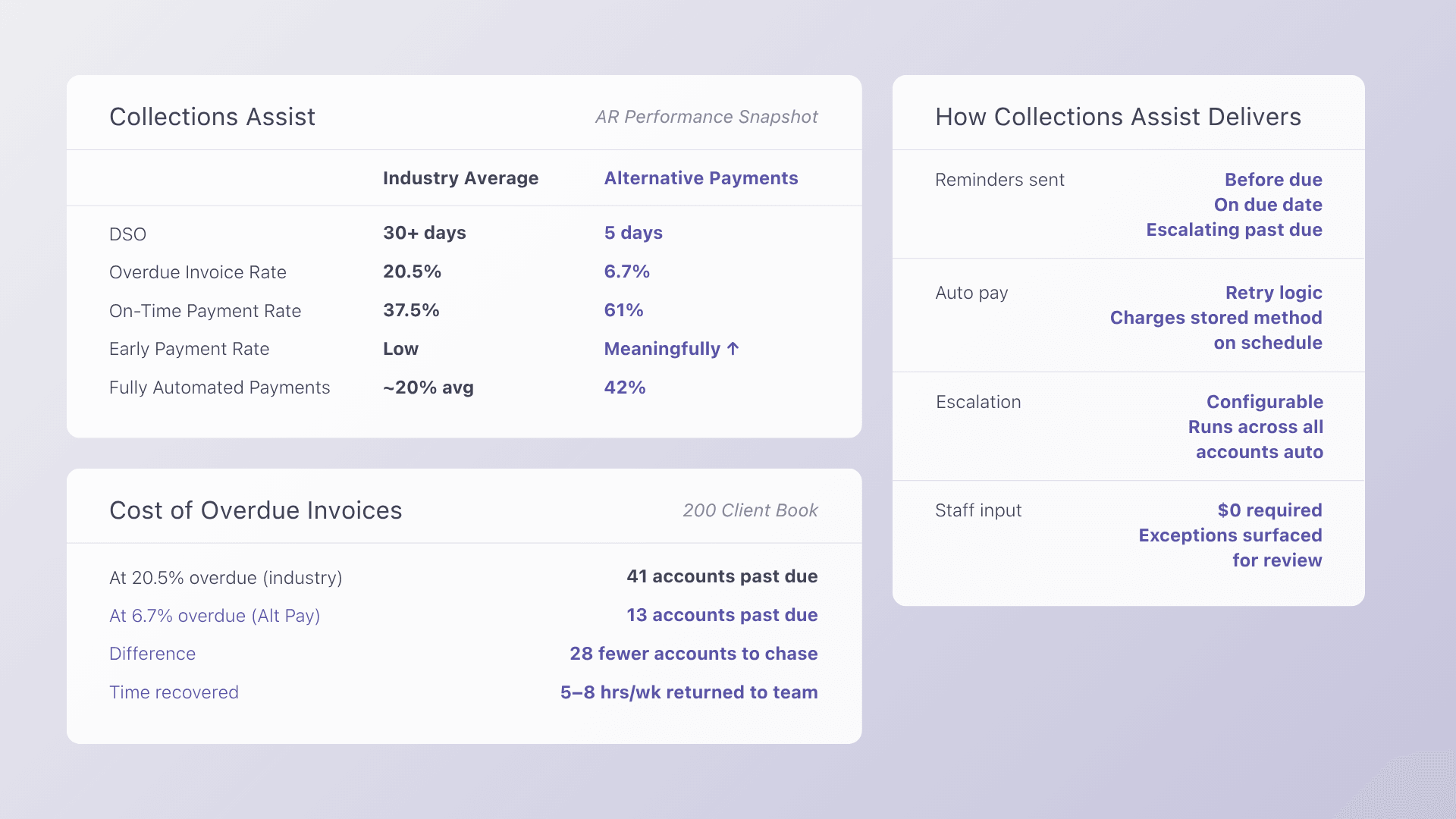
Alternative Payments includes Collections Assist, a purpose-built AR automation tool that handles payment reminders, overdue follow-up, and escalation across every client account on a configurable schedule. It runs without manual input and is designed as a dedicated collections layer, not just a reminder feature. The difference shows up in the data: MSPs on the platform see overdue invoices drop from 20.5% to 6.7%, and the average DSO for Alternative Payments customers is 5 days.
Bottom line: Both platforms automate payment reminders. Alternative Payments extends this into a full AR automation workflow with measurable impact on DSO and overdue rates. If collections is a persistent pain point, that dedicated layer matters.
Client Payment Experience
How clients interact with your payment platform affects adoption rates, time-to-pay, and the number of billing support tickets your team handles.
ConnectBooster provides a client portal where customers can view invoices and make payments. The portal supports saved payment methods and autopay enrollment. Some user reports note that the portal interface can feel dated compared to modern B2B checkout experiences.
Alternative Payments delivers a white-label checkout experience branded to your MSP. Clients pay through a portal that looks like your business, not a third-party processor. Beyond ACH and credit cards, the platform offers client-facing financing options including installment billing and B2B buy now pay later. These options reduce friction on larger project invoices. Clients get flexibility, and you get paid in full. For MSPs dealing with collection challenges on larger invoices, financing options close the gap between client budgets and project costs.
Bottom line: Alternative Payments offers a more polished client experience with financing options ConnectBooster does not include. If client-facing payment flexibility is a priority, the choice is clear.
Accounting Integration and Reconciliation
The payment lifecycle does not end at collection. Every payment needs to map to an invoice and post correctly to your accounting system, without manual matching.
ConnectBooster syncs with QuickBooks and offers some accounting connectivity, but users report challenges with tax calculations and limited integration depth. Automated deposit reconciliation is not a native capability, which means the finance team may still need to match payments to deposits manually.
Alternative Payments reconciles automatically to both QuickBooks and Xero. Every payment maps to the right invoice and posts to accounting without manual intervention. This automatic reconciliation eliminates the month-end scramble of matching bank deposits to invoice payments, a process that typically consumes 5–10 hours per month for MSPs using manual methods. For MSPs on Xero, this is a critical distinction: ConnectBooster does not currently list Xero as a supported integration.
Bottom line: If your accounting stack includes Xero, or if manual reconciliation is eating your team’s time, Alternative Payments covers both gaps. The auto-reconciliation capability alone can return hours to your finance team every month.
Vendor Independence
This factor is easy to overlook during evaluation, but it affects your flexibility long term.
ConnectBooster is owned by Kaseya. For MSPs already consolidated within the Kaseya product ecosystem (Autotask, IT Glue, ConnectBooster, Kaseya 365), this can mean simplified vendor management and bundled pricing. The trade-off is platform lock-in: your payment infrastructure is tied to the same vendor as your PSA, documentation, and monitoring tools. If you ever move away from Kaseya, your payment platform moves with it, or needs to be replaced.
Alternative Payments operates independently, with no ownership ties to any PSA vendor. This means the platform works equally well whether you run ConnectWise, Autotask, or HaloPSA. You can switch PSA platforms without switching payment platforms. The company maintains the largest dedicated payments team in the MSP space, focused exclusively on B2B payment infrastructure rather than splitting attention across a broader IT management product suite.
Bottom line: MSPs that value vendor independence and the flexibility to change PSA platforms should weigh this seriously. If you are already all-in on Kaseya and plan to stay, the ecosystem advantage may matter more.
Side-by-Side Comparison
| Dimension | ConnectBooster | Alternative Payments |
| PSA Integrations | ConnectWise, Autotask | ConnectWise, Autotask, HaloPSA |
| Pricing Model | Per transaction (custom quote) | Flat monthly fee |
| ACH Fees | $0.35 per transaction | No ACH fees |
| Accounting Integrations | QuickBooks | QuickBooks, Xero |
| Auto-Reconciliation | Not included natively | Automated |
| Collections Automation | Dunning reminders | Collections Assist (dedicated AR workflow) |
| Client Financing | Not available | Installments, B2B BNPL |
| White-Label Portal | ConnectBooster-branded | Your brand |
| Vendor Ownership | Kaseya | Independent |
| Surcharging | Limited | Built-in compliance |
When ConnectBooster Is the Right Fit
ConnectBooster works for MSPs that:
- Run exclusively on ConnectWise or Autotask with no plans to change PSA platforms
- Are already consolidated within the Kaseya ecosystem (Autotask, IT Glue, Kaseya 365) and value bundled vendor management
- Need basic payment collection and dunning without requiring dedicated AR automation or client financing
- Use QuickBooks exclusively (not Xero) for accounting
If your operations are fully inside the Kaseya stack and your billing workflow is relatively straightforward, ConnectBooster covers the fundamentals.
When Alternative Payments Is the Better Choice
Alternative Payments fits MSPs that:
- Use HaloPSA, or manage a mixed PSA environment across client accounts
- Want flat, predictable pricing that does not scale with transaction volume
- Need dedicated AR automation to reduce DSO and overdue invoices, not just reminders
- Require automatic reconciliation to QuickBooks or Xero
- Want to offer clients financing options (installments, B2B BNPL) on larger invoices
- Prefer an independent platform not tied to any single PSA vendor
For a broader look at how purpose-built MSP payment platforms compare to generic processors, our guide covers the key differences.
Frequently Asked Questions
Is ConnectBooster owned by Kaseya?
Yes. Kaseya acquired ConnectBooster, and the platform is now bundled into Kaseya product offerings including Kaseya 365. MSPs already within the Kaseya ecosystem may find this convenient for vendor consolidation. MSPs that prefer an independent payment platform evaluate alternatives like Alternative Payments.
Does Alternative Payments work with ConnectWise?
Yes. Alternative Payments integrates natively with ConnectWise, Autotask, and HaloPSA. The ConnectWise integration is bidirectional and real-time. Invoices sync automatically, and payment status pushes back to the PSA without manual intervention. Learn more in our PSA integration guide.
Which platform has lower ACH fees?
Alternative Payments charges no ACH fees. ConnectBooster charges $0.35 per ACH transaction. For MSPs processing hundreds of ACH payments monthly, this difference can add hundreds of dollars in annual savings.
Can I pass credit card processing fees to my clients?
Alternative Payments includes built-in surcharging compliance, allowing you to pass credit card fees to clients where regulations permit. ConnectBooster offers limited surcharging capabilities.
What is Collections Assist?
Collections Assist is Alternative Payments’ dedicated AR automation tool. It handles payment reminders, overdue follow-up, and escalation on a configurable schedule across every client account simultaneously, without manual input from your team. It is designed as a full collections workflow, not just a notification system.
Does ConnectBooster integrate with Xero?
ConnectBooster does not currently list Xero as a supported accounting integration. Alternative Payments reconciles natively to both QuickBooks and Xero.
Make the Right Choice for Your MSP
The decision between ConnectBooster and Alternative Payments comes down to how much your billing workflow demands beyond basic payment collection. If you need broader PSA coverage, flat pricing, dedicated AR automation, client financing, and automatic reconciliation, Alternative Payments is built for that use case.
Want to see how it works with your PSA and accounting stack? Book a demo and walk through the full invoice-to-reconciliation workflow with our team.