•
IT Services
•
Mid-market
•
Reduce DSO
February 27, 2026
Benchmarking Your Billing Speed Against Top Tier MSPs
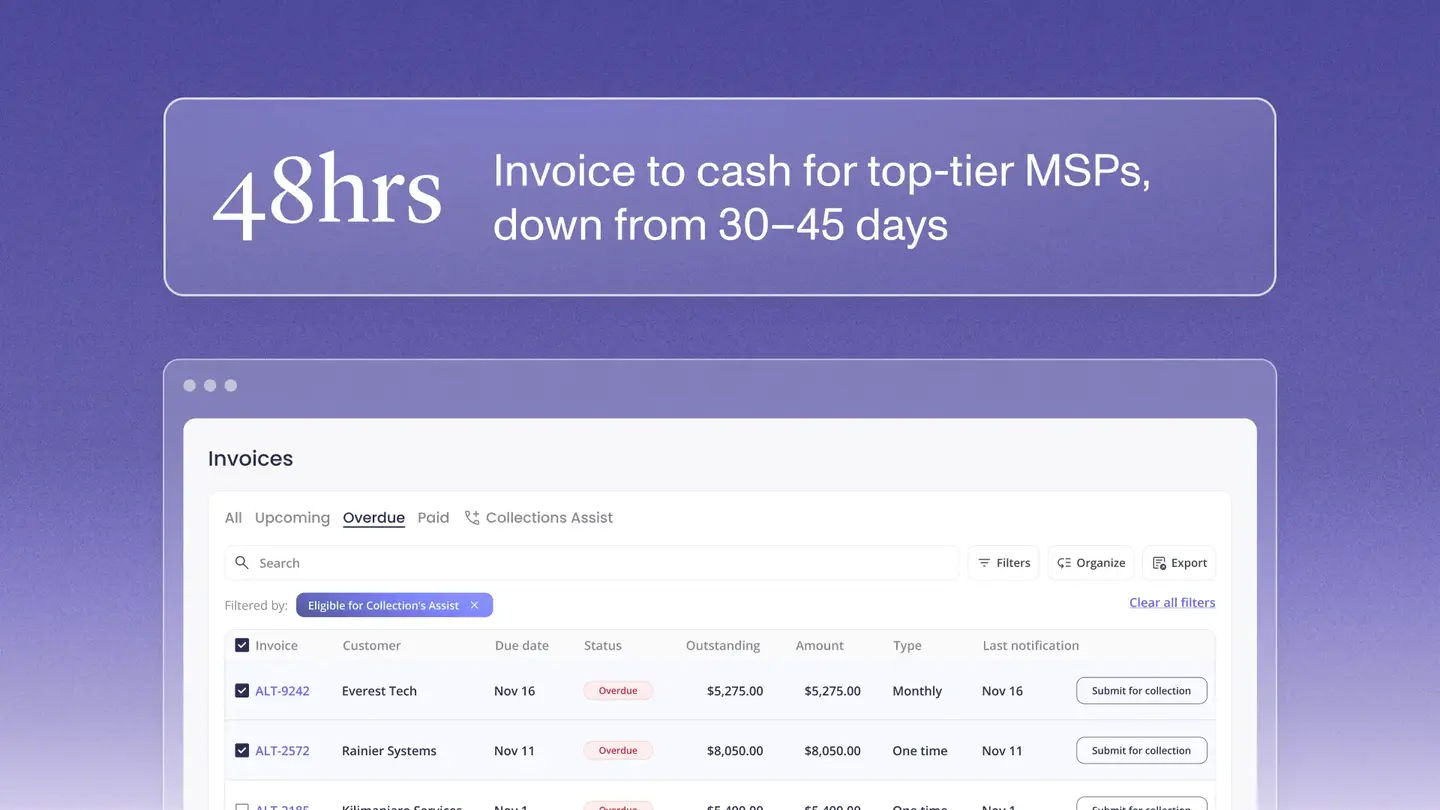
In MSP Finance, most firms track revenue, margin, and churn with precision. Few track billing speed with the same discipline.
That is a mistake.
Billing speed is not a back office metric. It is a competitive indicator. It reflects operational maturity, cash discipline, and system design. The difference between getting paid in 45 days and getting paid in under 48 hours is not administrative. It is strategic.
The real question is simple. How fast do top tier MSPs actually get paid and how does your firm compare?
The Industry Baseline: What Average Looks Like
In broader B2B services, Net 30 remains the standard. In reality, many businesses collect even slower than their stated terms.
Atradius shows that late payments are common across B2B sectors, extending actual collection cycles beyond agreed terms.
Days Sales Outstanding in professional services often stretches beyond 30 days depending on sector and client mix.
In practical MSP Finance terms, average billing performance typically means invoices are issued several days after month end, often delayed by internal review cycles before they are sent to clients.
Payment terms are commonly set at Net 30, and even then, clients frequently pay on or after those terms. When questions arise around usage counts, overages, or line items, disputes can push payment out even further.
As a result, a total cycle of thirty to forty five days from service delivery to cash receipt is not unusual. More importantly, it is often treated as normal rather than as a performance gap.
But average is not the ceiling.
What World Class Looks Like in MSP Finance
Top tier MSPs design billing for speed.
World class performance in MSP Finance is defined by immediacy and automation.
Invoices are issued as soon as the service period closes, with recurring agreements tied directly to automated billing logic rather than manual preparation.
Client payment authorization is securely stored in advance, and digital payment options are embedded directly within the invoice experience to eliminate friction.
When these elements work together, recurring revenue can move from invoice to cash in under 48 hours, transforming billing from a waiting period into a streamlined financial process.
Under 48 hours may sound aggressive. It is not.
For recurring service agreements with payment authorization on file and automated invoice delivery, this speed is achievable and increasingly common among top-tier MSPs. When invoices are accurate, automated, and connected to saved payment methods, payment friction collapses.
The difference is not client behavior. It is infrastructure.
Why Billing Speed Impacts Cash Flow, Growth, and Valuation
Billing speed directly affects capital velocity.
When revenue converts to cash quickly, MSP Finance becomes more flexible and less reactive. Instead of waiting weeks for receivables to clear, leadership operates with liquidity already in hand. That liquidity can fund technician hires, cybersecurity tooling, or acquisition opportunities without relying on short-term credit.
Faster collections also strengthen working capital metrics and create room for reinvestment in talent, tools, or growth initiatives. Expansion becomes a strategic choice, not a timing constraint.
There is also a signaling effect. During due diligence, buyers review receivables aging and cash conversion efficiency closely. Predictable, fast collections reflect operational discipline. Slow and inconsistent billing suggests friction.
Billing speed is not just an accounting detail. It is a structural indicator of financial maturity in MSP Finance.
Research on working capital consistently highlights that companies who shorten cash conversion cycles unlock liquidity without increasing revenue.
In other words, growth capital may already be sitting inside your receivables.
Billing speed is not about pushing clients harder. It is about designing systems that remove delay.
The Silent Drag on Your MSP Finance Performance
Most delays are not dramatic. They are small inefficiencies repeated monthly.
Common friction inside MSP billing often stems from inconsistencies and manual processes that seem minor in isolation but compound over time.
Per user count discrepancies, license true up confusion, and RMM or cloud overage disputes frequently trigger clarification cycles before invoices can be approved.
Mismatches between service agreements and invoice line items add another layer of back and forth, while internal approval workflows further delay issuance.
On the payment side, limited digital options and slow ACH verification processes introduce additional lag after the invoice has already been sent.
Individually, each issue may only add a few days. Together, they meaningfully extend Days Sales Outstanding and slow the overall cash conversion cycle.
Organizations with higher levels of billing and payment automation experience materially faster processing times and lower dispute rates compared to manual environments.
Friction is rarely visible on a single invoice. It becomes visible in your aging report.
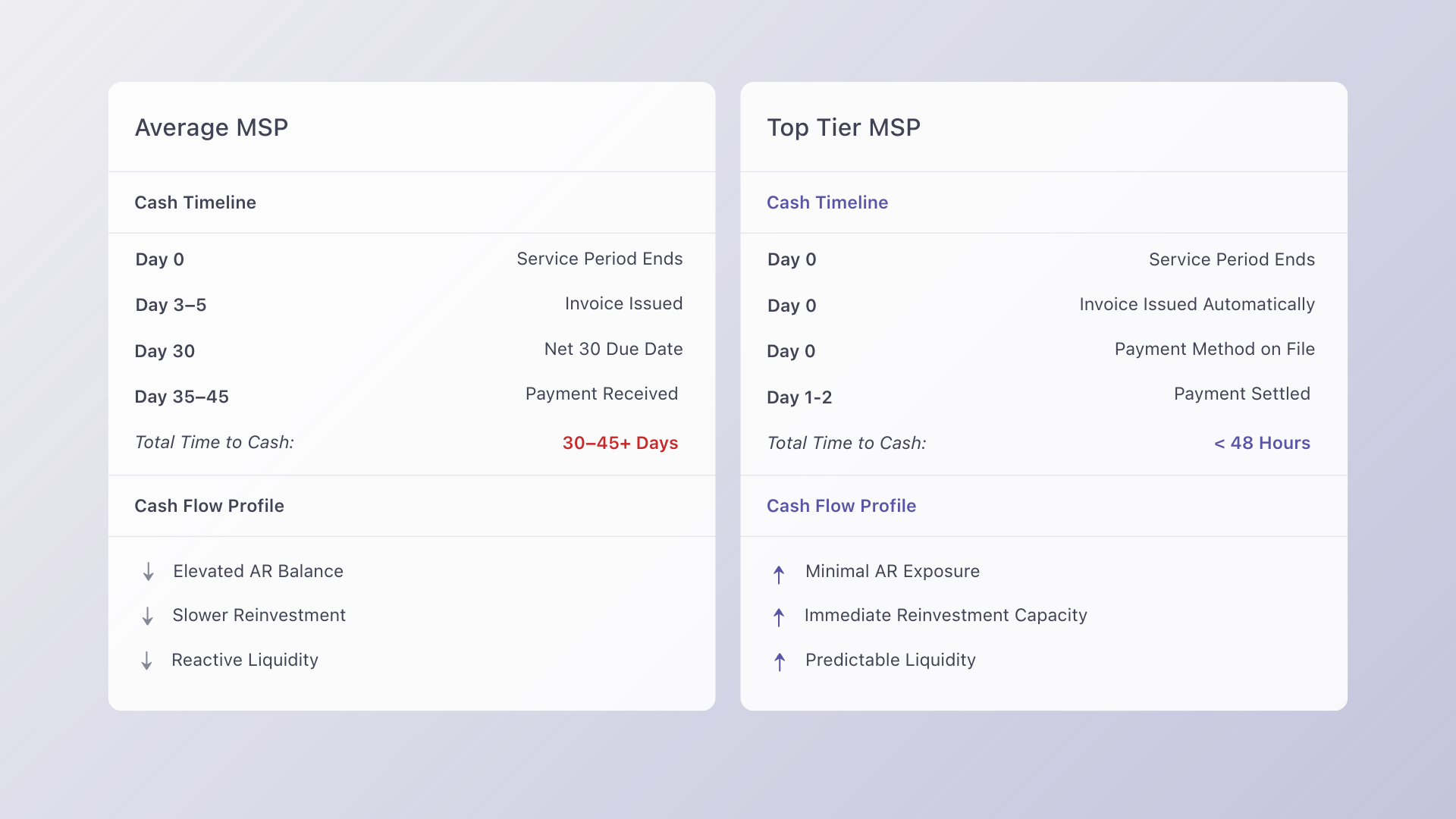
The Benchmarking Framework
If billing speed is a competitive metric, it should be benchmarked like one.
Measure the following and review them monthly at the executive level:
Metric
Average MSP
Top Tier MSP
The gap between those two states is not incremental. It is structural.
How MSPs Can Move from Average to Top Tier
Improving billing speed requires intentional system redesign.
Moving from average to top tier billing performance does not require a complete overhaul overnight. It begins with a few structural shifts.
Start by standardizing billing cycles across all clients. When every agreement follows a consistent schedule, invoice timing becomes predictable and easier to automate. Pair that with automated invoice generation directly from your PSA system so invoices are issued immediately at period close rather than days later after manual review.
Next, embed digital payment options directly into invoice delivery and require payment authorization on file for recurring services. When payment capture is integrated into the billing experience, the delay between invoice and cash shrinks dramatically.
Finally, align service agreements with billing logic to reduce disputes before they happen. Fewer clarification cycles mean fewer stalled payments and a smoother path from service delivery to cash receipt.
These targeted changes alone can significantly compress the invoice to payment timeline and elevate overall MSP Finance performance.
When billing is automated end to end, speed becomes the default outcome.
World class MSP Finance performance is engineered. It is not chased.
The Infrastructure Behind World Class Billing Speed
Execution matters.
The practical steps outlined above such as standardized billing cycles, automated invoice generation, embedded payment options, and real time reconciliation require the right infrastructure to work together.
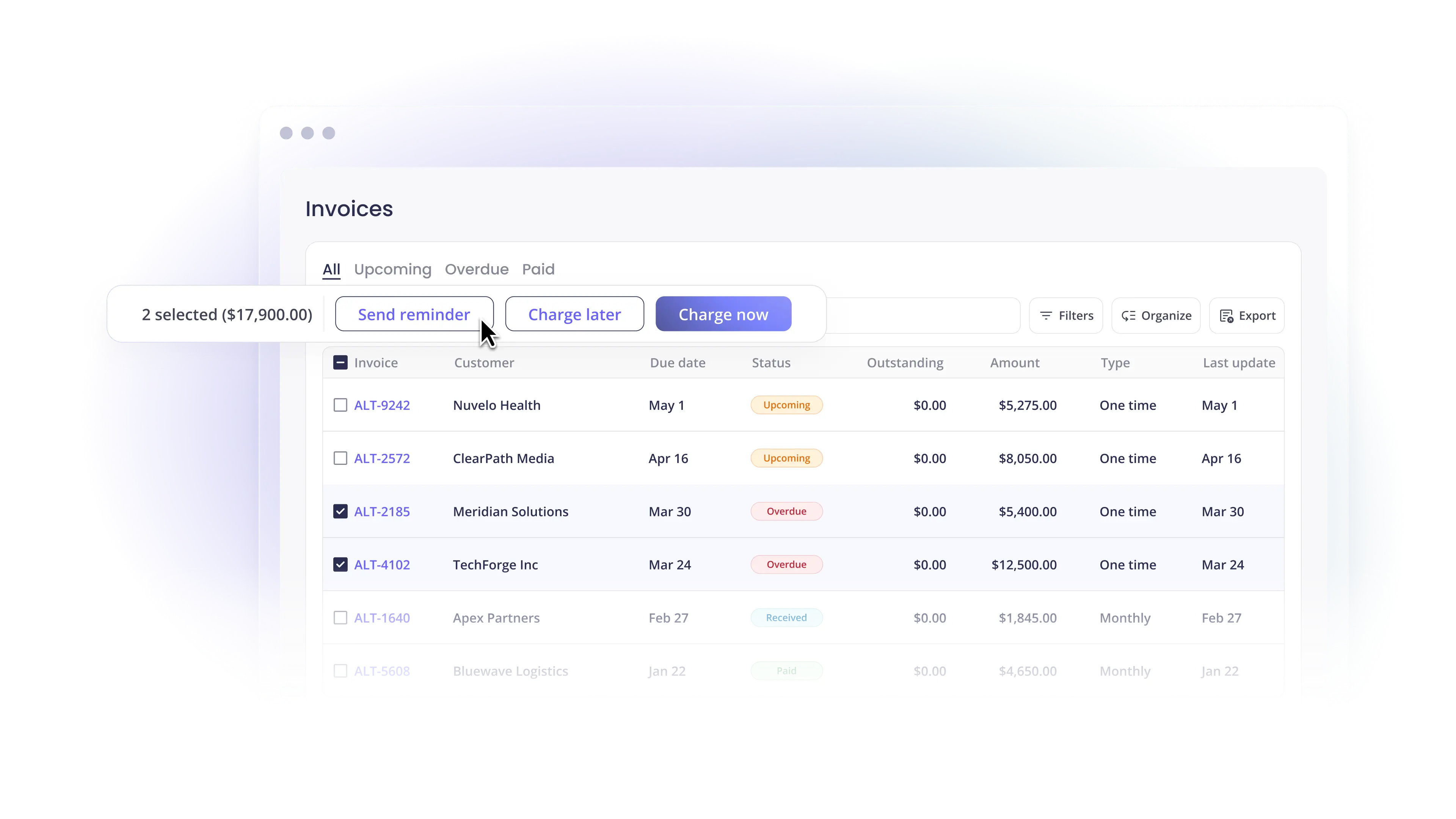
World-class billing speed requires billing and payment infrastructure that works as a single system. Alternative Payments connects recurring billing directly to service agreements, embeds digital checkout into invoices, enables saved payment methods and autopay, automates reminders, and syncs payments in real time with accounting systems. When invoice creation and payment capture are aligned, the time from invoice to cash compresses dramatically.
By aligning invoice creation with payment capture, MSPs can dramatically compress the time from invoice to cash.
If world class performance means under 48 hours for recurring services, the real question is whether your current billing stack is designed to deliver it.
Speed Signals Maturity in MSP Finance
Billing speed is not about collection pressure.
It is about operational discipline.
Top tier MSPs treat time to payment as a core financial metric alongside revenue growth and margin performance. They understand that cash velocity drives flexibility, resilience, and valuation.
If your firm is benchmarking growth, retention, and profitability, billing speed belongs on that same executive dashboard.
Because in MSP Finance, the firms that get paid fastest are often the ones positioned to grow fastest.
If you want to learn how to accelerate billing speed and modernize your MSP Finance infrastructure, explore how Alternative Payments is helping firms move from average collection cycles to world class performance.
Simplify your customer payments, unlock instant cash flow
Keep reading


Can AI financial analysis explain why your margins changed?

Autotask QuickBooks integration: choosing a billing and payment operating model